The cost of moving goods across the U.S.-Mexico border is rising — and it’s starting to ripple through the entire economy.
What looks like a fuel story is something bigger. Diesel prices are part of it, but freight companies say they are being hit at the same time by higher wages, rising tolls, more expensive permits, and growing cross-border costs.

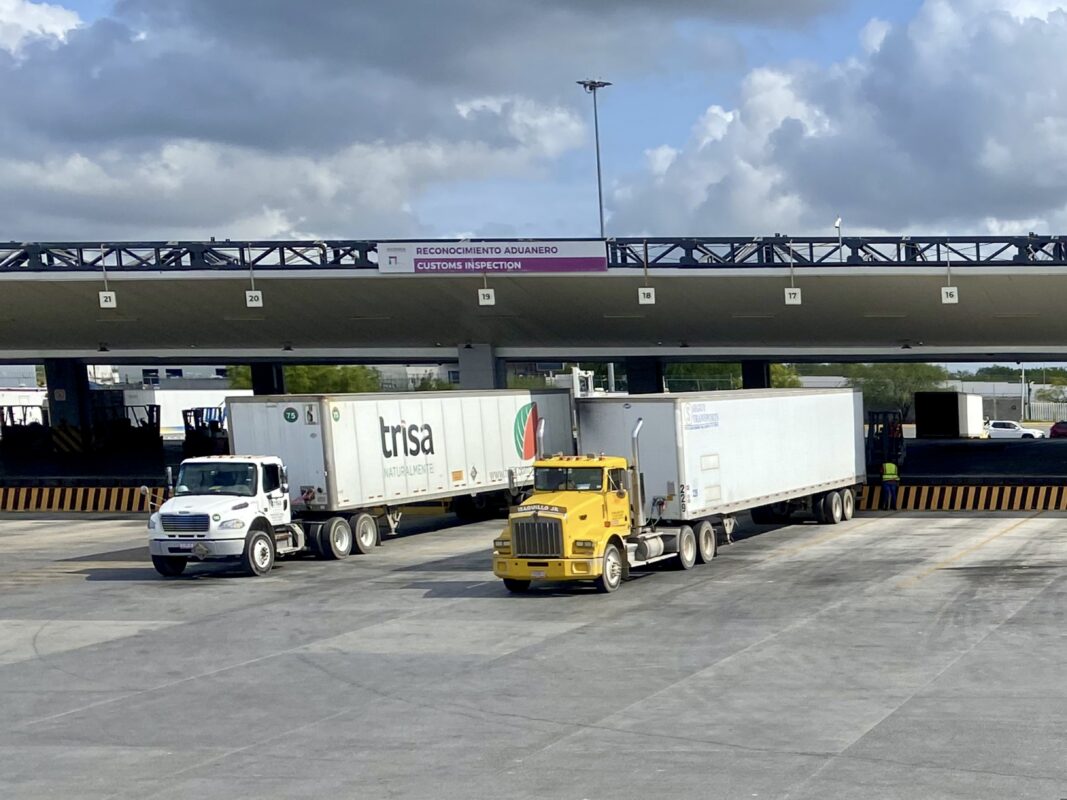
Photo Credit | Anayancy Ulloa
Mexico’s effort to cap diesel at 27 pesos per liter is meant to ease pressure. But along the northern border, where trade activity is concentrated, the market is moving in a different direction.
In cities like Reynosa, diesel is still selling closer to 28 pesos per liter, or about $1.59, highlighting a gap between the government’s target and actual prices.
That gap reflects a broader trend.
According to transport industry representatives, diesel had already climbed from 26 pesos to 28.50 pesos per liter — an increase of nearly 10% — before the government’s intervention. That makes the 27-peso target more of a containment measure than a true reflection of market pricing.
Costs rising across the system
Fuel is only one piece of a larger shift in how the freight sector operates.
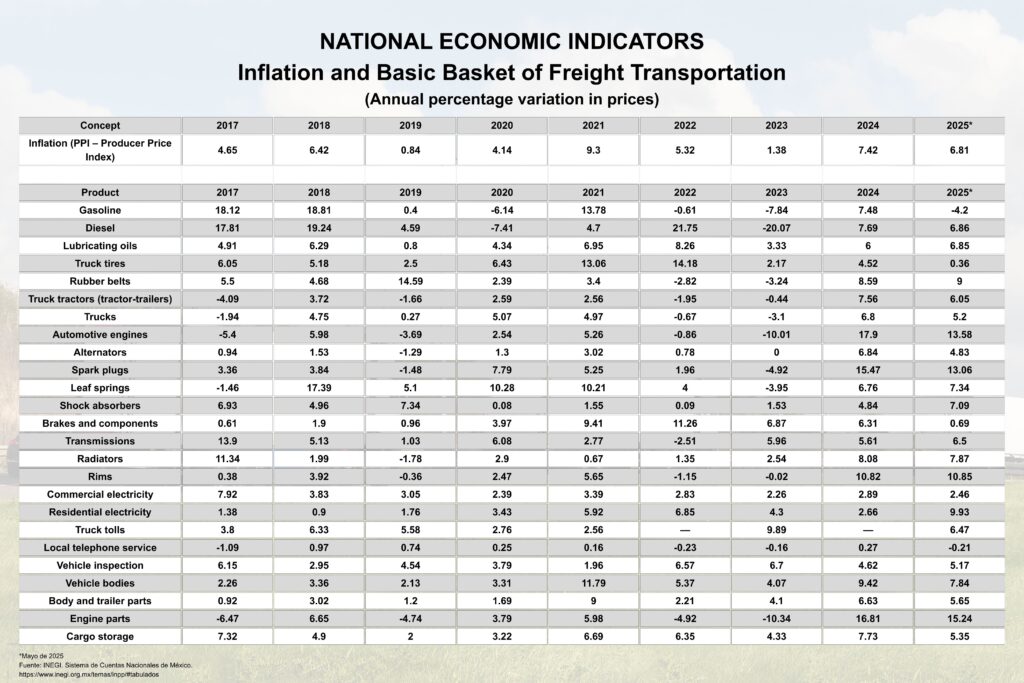
According to the Agenda Económica del Autotransporte de Carga 2025 from the Cámara Nacional del Autotransporte de Carga, or CANACAR, the industry is undergoing a structural change driven by sustained increases in fuel, labor, infrastructure, and cross-border operating costs.
Diesel prices alone have increased more than 45% over the past six years, now ranging between $1.48 and $1.62 per liter in 2026. Fuel represents nearly 40% of total freight costs.
Labor costs have also climbed sharply.
Truck driver wages have increased from $6.43 per day in 2017 to $18.65 in 2025.
The national minimum wage has risen from $4.55 to $15.84, while daily wages along the northern border have doubled from $12.10 in 2021 to $25 in 2026.
Other costs are rising as well.
Toll rates for a five-axle truck have increased about 10%. Border crossing costs are up roughly 17%. DECAL permits — required for cross-border operations — have more than doubled, rising from $418 to $942. Insurance costs in the United States can reach $2,500 per unit.
Taken together, these increases are reshaping the cost of moving goods.
Immediate impact in Reynosa
In Reynosa, freight companies say those pressures are already showing up in pricing.
Carriers expect freight rates to increase between 12% and 20%, according to Uriel Ordóñez, president of the Asociación de Transportistas de Reynosa.

“Fuel represents nearly 40% of freight costs, so the impact is significant,” he said.
He said the binational nature of operations adds to the pressure, including higher tolls, border crossing fees, and insurance requirements in the United States.
“With these increases in the transportation system, we have no choice but to adjust our costs,” he said.
Ordóñez said the impact goes beyond the trucking industry.
“Everything we see had to be transported at some point,” he said, pointing to the broader effect on prices across the economy.
The association, which represents more than 40 companies, is working to avoid layoffs and maintain service levels while raising awareness about the need for rate adjustments.
Limited relief from fuel prices
The government’s diesel target offers some relief — but not enough, carriers say.
Carlos Alanís, director of Transportes CART, said lower fuel prices help, but only marginally.
“If it drops one or two pesos, it helps. On a full tank, it does make a difference — but it’s not enough to offset everything that has increased,” he said.
A single tractor-trailer can consume up to 1,000 liters per trip. A reduction from 28 to 27 pesos per liter represents about $57 in savings per unit, while a drop from 29 to 27 pesos could save up to $114.
Those savings fall short of the overall increase in operating costs, which Alanís estimates have risen between 20% and 25%.
“Even when clients accept rate adjustments, they don’t fully cover the increase — we’re still absorbing part of the impact,” he said.
Companies are responding by optimizing routes, cutting costs, and adjusting operations.
A system under pressure
Industry leaders say the current situation reflects deeper structural challenges.
Arminda Alemán, director of the Centro de Capacitación de Operadores en Reynosa, said the cost of operating goes far beyond fuel.

“Transportation is a good business, but highly demanding. Costs are numerous and constantly rising — it’s not just one factor, it’s everything involved in operating,” she said.
That includes permits, insurance, certifications, maintenance, and inspections — all of which require ongoing investment.
She also pointed to uneven conditions in the market.
“Some companies comply with all requirements, others don’t. Then someone offers a lower price, and the client chooses that option,” Alemán said.
That dynamic puts compliant carriers at a disadvantage.
Contracts under strain
The structure of the market is adding to the pressure.
“Clients often dictate both pricing and payment timing,” Alemán said.
That leaves companies choosing between absorbing costs, operating on thin margins, or risking the loss of contracts.

Aileen Echartea of Logimex México said companies are negotiating with clients to update rates.
“We are talking with clients, doing our part and asking them to do theirs in order to update rates,” she said.
But not all clients are willing to adjust, delaying necessary changes.
Companies are also absorbing new costs, including ongoing driver training to meet U.S. requirements such as English proficiency.
Supply chain impacts spreading
From a logistics perspective, rising costs are beginning to affect the entire supply chain.
“It is significantly impacting our operating costs. It affects the entire supply chain — not only suppliers, but also clients,” said Pablo Romero Ángeles, operations manager for the IMMEX program at ZAT Logistics.

He described a constant cycle of renegotiation.
“It’s a daily struggle between clients and providers to reconcile prices set six months ago,” he said.
Many contracts are locked in for one to two years, limiting flexibility.
“We’ve seen our profit margins shrink,” Romero said.
At the same time, uncertainty in international trade — including tariff changes and U.S. regulatory shifts — is slowing import activity.
“There is a lot of uncertainty in the market — there aren’t many imports, and that slows us down,” he said.
Pressure building across the border economy
Mexico’s attempt to stabilize diesel prices has not fully translated to the market — especially along the border.
For freight companies, the issue is no longer just fuel.
It is a system under pressure, where rising costs across labor, infrastructure, and cross-border operations are converging at the same time.
As those costs build, they are moving through the supply chain — affecting manufacturers, exporters, and ultimately consumers.

Anayancy Ulloa
Reporter
Anayancy Ulloa Luna is a contributor to the Rio Grande Valley Business Journal who hails from Reynosa in the Mexican state of Tamaulipas. Ulloa has a long history as a U.S.-Mexico region business expert in marketing, formerly the editorial director of Mexico Industry.
Most Read
- Is SpaceX quietly building a data center at Starbase? Job postings offer clues
- 25 Mexican businesses eye McAllen expansion after city pitches U.S. market entry program
- McAllen metro keeps selling more homes as Brownsville-Harlingen market sees 17% drop through August
- Rio Grande LNG moves closer to getting even bigger at Port of Brownsville
- Starbase EDC may issue $3 billion in tax-exempt bonds to support SpaceX, records show
Get the latest business news delivered to your inbox every morning for free.
Try 30 Days Free!
Get full access to award-winning journalism covering business, real estate, health care, economic trends, and the people shaping the Rio Grande Valley.
30 Days Free!
$9.95/month
Limited time offer
Subscription renews after your 30 day free trial at $9.95/mo.
Included Benefits
- Unlimited access to all articles
- Daily business news and analysis
- Subscriber-only content and features
Stories That Matter
- Texas A&M seeks contractors for new health education and research building in McAllen
- Beach Water Park files plans for $750K go-kart track project on South Padre Island
- Hundreds are vying for jobs in Brownsville. Here’s what jobseekers are seeing in the market
- Mission’s first Small Business Expo puts $25K on the line for local entrepreneurs
- McCoy’s gives $10K, tools to launch Mid-Valley construction academy
- UT Health RGV performs new digestive procedure for first time in the Valley
- TSTC bets on advanced manufacturing to meet RGV’s industrial boom
- Pharr’s cross-border business push earns international recognition
- Brownsville eases drought restrictions after nearly three years as Rio Grande reservoir levels improve
- Texas A&M’s $53.5M McAllen research center will tackle water, food security and Valley health