Tomato supply across the United States and Mexico is tightening as fewer tomatoes move through Texas border crossings and prices continue rising on both sides of the border.
New data from the U.S. Department of Agriculture (USDA) and Mexico’s National Institute of Statistics and Geography, known as INEGI, show lower export volumes, tighter supply and higher costs across the tomato market.
For the Rio Grande Valley, the issue goes beyond grocery store prices.
Texas border crossings — especially the Pharr-Reynosa International Bridge — are some of the country’s biggest entry points for Mexican produce.
The slowdown is now affecting trucking companies, distributors, restaurants and food suppliers across the region.

In Texas, tomato supply is “very limited” for this time of year, Dante Galeazzi, president and CEO of the Texas International Produce Association, told the Rio Grande Valley Business Journal.
Galeazzi said weather events in Florida and Mexico reduced production, while higher fuel and transportation costs continue pushing prices upward.
Tomato prices are up nearly 20% compared to the same period last year, Galeazzi said.
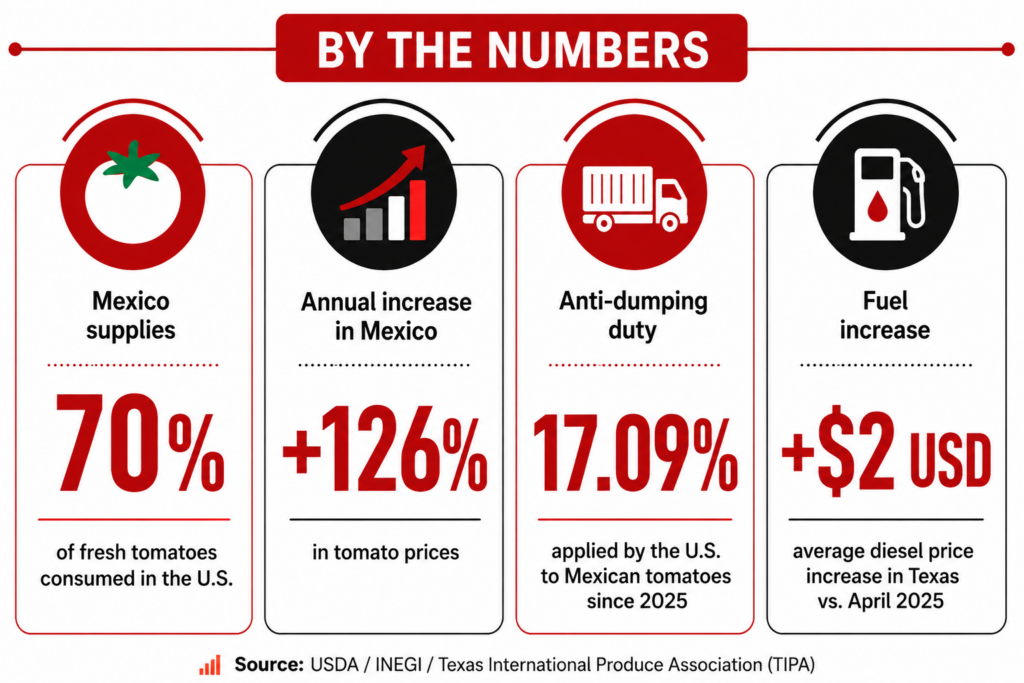
Meanwhile, Mexico supplies nearly 70% of the fresh tomatoes consumed in the U.S., he said.
Tomato crossings through Pharr drop sharply
New USDA data show tomato shipments moving through Pharr have dropped nearly 45% compared to last year.
For Roma tomatoes, crossings through Pharr totaled 6,868 units of 40,000 pounds so far this season, compared to 12,460 units during the previous season.
The USDA also reported “light supply” and “very good demand” across several tomato categories.
Prices at Texas crossings have also climbed sharply.
Roma tomatoes ranged from about $49 to $55 per 25-pound box, while vine-ripe tomatoes reached as much as nearly $71 per box, according to USDA market reports.
Wholesale markets in cities including Los Angeles, New York, Boston and Chicago also reported very limited supply and elevated prices.
Galeazzi said the market is now entering a transition period as supply shifts away from Sinaloa, Mexico’s largest tomato-producing region during the winter growing season.
Canadian greenhouse production and other U.S. growing regions are expected to help stabilize supply later this spring.
Still, Galeazzi said the biggest problems remain tied to production.
Tariffs and inflation are adding pressure
In Mexico, INEGI reported tomatoes saw a 24.37% price increase during the first half of April alone.

Photo Credit | Anayancy Ulloa
The agency also identified tomatoes as one of the agricultural products contributing most heavily to inflation.
According to the report, Mexican consumers paid 126% more for tomatoes in April 2026 compared to the same period last year.
Meanwhile, Mexican tomato exports during January and February were the lowest recorded for those months in the past six years.
The report partly blamed the decline on adjustments to export pricing rules and the 17.09% anti-dumping duty the United States imposed on Mexican tomatoes in 2025.
Galeazzi said the tariff “has further aggravated” current market conditions.
Trucking and food service companies are feeling the impact
The tightening market is also creating problems for transportation and food service companies along the border.
From Reynosa, Carlos Alanís, director of Transportes CART, said tomato prices in the United States have risen sharply while supply continues tightening.

“The good tomatoes normally come from Sinaloa. I used to bring them from Sinaloa, from Culiacán,” Alanís said.
He said agricultural producers are now dealing with financial pressure, water shortages and rising production costs.
“Tomatoes, onions, potatoes, pineapples, melons — everything coming out right now is struggling. Producers no longer have the financial resources to produce the way they used to,” he said.
Alanís said tomato prices in Reynosa recently climbed to between 70 and 75 pesos per kilogram compared to previous prices between 20 and 24 pesos per kilogram.
“A box used to cost them $15 or $16. Now it’s costing them up to $60,” he said, referring to reports from New York markets.
Roberto Zertuche, director of Oasis Food Service in Reynosa, said rising prices for tomatoes, avocados and fruit are also increasing costs for industrial food service companies.
Zertuche said higher diesel and transportation costs continue raising expenses, though companies are trying to avoid passing all those increases directly to consumers.
“We are doing everything possible to avoid raising product prices and to continue giving consumers access to affordable products,” he said.
Tight supply could continue through May
Galeazzi said the market is dealing with both limited supply and high prices at the same time.
“Both statements are true,” he said when asked whether the market faces both shortages and rising prices.
He said prices and supply pressure will likely continue through May while additional growing regions work to increase production by mid-June.

Anayancy Ulloa
Reporter
Most Read
- How much water does SpaceX need to operate near Brownsville? Nearly 20x its current use
- Could apartment-to-condo conversion help make $100K homeownership in the McAllen metro more affordable? One investor says yes.
- SpaceX’s futuristic city of Starbase finalizes massive 7,100-acre annexation. Here’s what we know.
- Cameron County is negotiating a $20M Fluidstack data center donation after Harlingen waffles on the same offer
- Fluidstack breaks ground on $4 billion Cameron County AI data center
Get the latest business news delivered to your inbox every morning for free.
Try 30 Days Free!
Get full access to award-winning journalism covering business, real estate, health care, economic trends, and the people shaping the Rio Grande Valley.
30 Days Free!
$9.95/month
Limited time offer
Subscription renews after your 30 day free trial at $9.95/mo.
Included Benefits
- Unlimited access to all articles
- Daily business news and analysis
- Subscriber-only content and features
Stories That Matter
- These four projects are driving more than $41B in Cameron County investment
- Mission’s first Small Business Expo puts $25K on the line for local entrepreneurs
- Reynosa’s newest technical high school focuses on AI, semiconductors and bionics
- McCoy’s gives $10K, tools to launch Mid-Valley construction academy
- UT Health RGV performs new digestive procedure for first time in the Valley
- TSTC bets on advanced manufacturing to meet RGV’s industrial boom
- Pharr’s cross-border business push earns international recognition
- Brownsville eases drought restrictions after nearly three years as Rio Grande reservoir levels improve
- Texas A&M’s $53.5M McAllen research center will tackle water, food security and Valley health
- STC puts AI to work across 55 courses — from construction sites to car repair