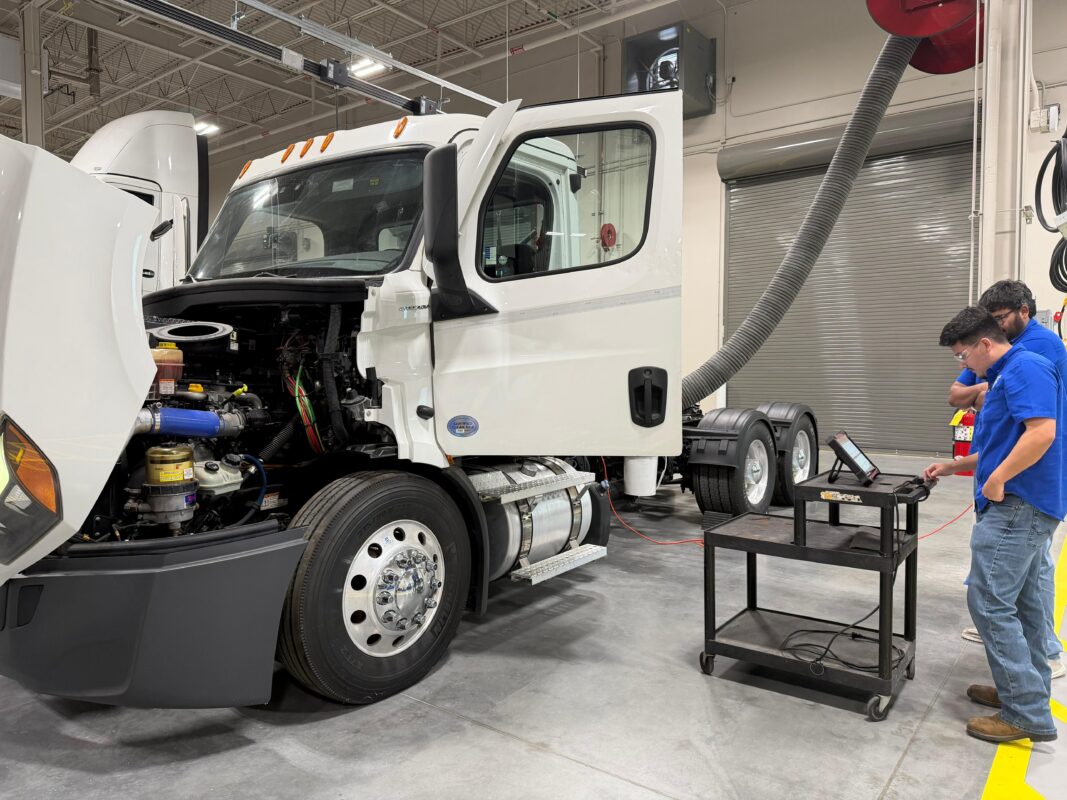
Students worked under the hood of a massive tractor-trailer as future diesel engine mechanics inside the Texas State Technical College Harlingen campus on Wednesday, as college executives discussed how they’re changing their approach to education in the Rio Grande Valley in the next room.
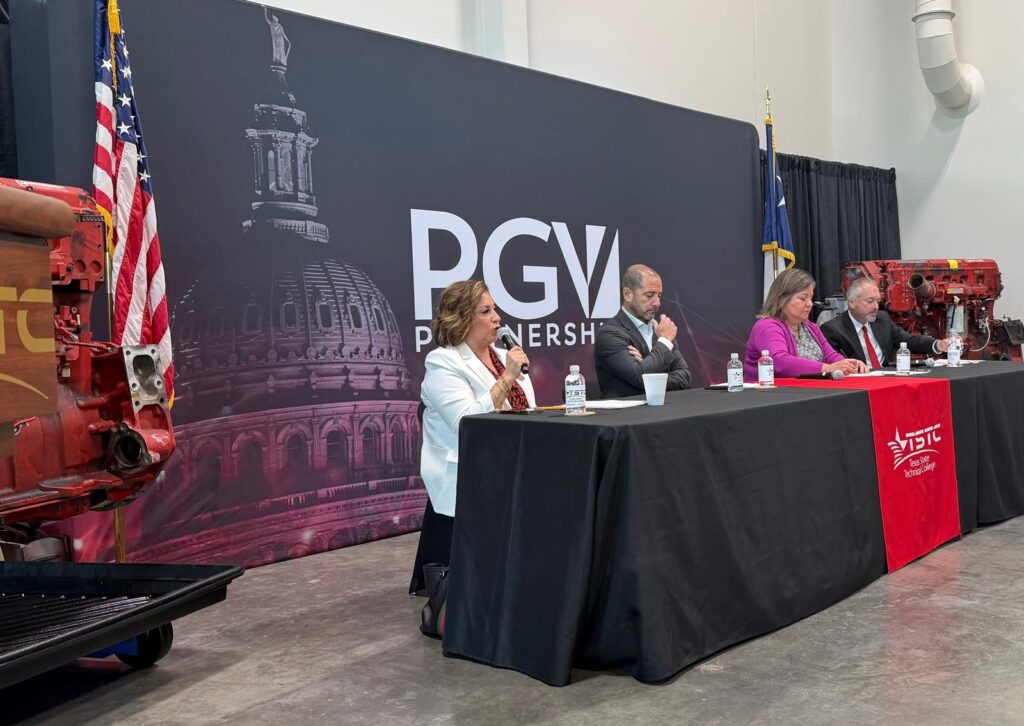
Photo Credit | Kristen Mosbrucker-Garza
The RGV Connect session, which focused on education, was hosted by the Rio Grande Valley Partnership, which expects to visit elected officials in Washington, D.C., next month to share insights, advice, and requests from businesses and economic development professionals. The group also connects industry and municipalities across the Valley with Texas lawmakers to gain perspective about what communities may need in the coming years.
That includes investments such as the $3.3 billion in tuition revenue bonds, known as capital construction assistance projects, under Senate Bill 52 in 2021, which enabled the expansion of Texas State Technical College’s Harlingen campus.
The expansion included $41 million for TSTC’s 84,000-square-foot Transportation Technology Center that hosts the automotive and diesel equipment technology programs, the $7.5 million and 7,000-square-foot electrical line worker and management technology program, and the $15.3 million renovation of its biomedical equipment technology, plumbing and pipefitting technology, and wind energy technology programs in a 34,000-square-foot facility. The projects were wrapped up by the time students began in fall 2025.
While jobs for diesel engine specialists are projected to grow 2% nationwide between 2024 and 2034, demand in Texas is projected to grow by 13% between 2022 and 2032, adding 2,620 jobs statewide. Some of that demand is tied to the oil and gas industry, as well as transportation and trade jobs, which are well-developed industries in Texas.
The demand for future diesel engine technicians is why the college invested in the training facility, Gina Cano-Monreal, provost of Texas State Technical College Harlingen Campus, said. That’s because the college is funded by its student outcomes, not enrollment.
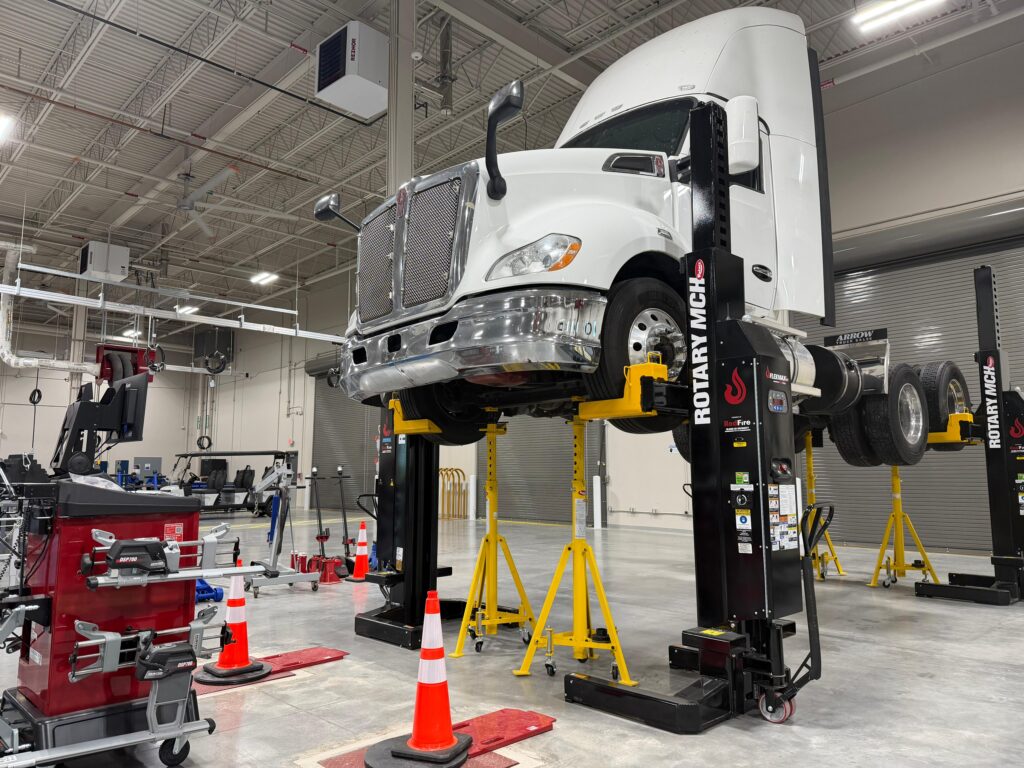
Photo Credit | Kristen Mosbrucker-Garza
“We’re always looking at what’s coming and what is the real need in the Rio Grande Valley. We already had an automotive technology program, a CDL is part of our accelerated training option, but the component that was missing was a diesel technology,” Cano-Monreal said. “If a student does not receive an offer of employment, they have the ability to come back and request their money back.”
The estimated cost of an associate’s degree in diesel engine technology at Texas State Technical College in Harlingen ranges from $11,000 to $16,500, according to its website.
In 2024, there were about 29,700 diesel engine mechanics across Texas, earning entry-level wages of $41,855; experienced mechanics earned $67,000, according to the BLS Occupational Employment Statistics Survey.
In South Texas, the hourly wage for entry-level bus and truck mechanics, including diesel engine mechanics, is $14.54 an hour; the mean is $20.73 an hour, and experienced technicians earn $23.83 an hour. So that’s annual salaries ranging from $30,200 to $45,700 in the Valley without overtime, which is common in the industry.
The rapid adoption of generative artificial intelligence has changed the calculation for some prospective vocational education track students, even those who earned college credits for courses while in high school using dual enrollment programs, she said.
About one in four students at high schools across the Valley earn an associate’s degree before graduation.
“Some of it is because they’re worried a little bit about what AI might change in a career that they were thinking about going into,” she said. “You can’t prompt [AI] the ability for somebody to be able to fix your plumbing needs or change out your HVAC system; those are all the things that we need a skilled workforce to still do.”
About 60% of students across the Valley graduated high school with industry credentials in 2023, up from 28% in 2019, according to a recent report by RGV Vision. That’s higher than the Texas average of 48%.
Still, educational attainment in the Valley lags behind state and national averages. For individuals 25 years and older, about 6.5% hold an associate’s degree, 13.8% hold a bachelor’s degree, nearly 5% hold a master’s degree, 1% hold a professional degree, and less than 1% hold a doctorate as their highest educational attainment.
About 26% graduated from high school, but the remaining 28% have less than a high school education under their belt in the workforce, Valley-wide.
Educational attainment in Hidalgo, Cameron, Willacy, and Starr counties has risen over the past decade, but still lags behind that of Texas. Hidalgo and Cameron county residents have the highest percentages of higher-education degrees — about 20% each. But Starr County remains at about 13% and Willacy 12%, according to U.S. Census data.
DATA – LINK to educational attainment in the RGV story too.
“That means a lot of folks don’t have a degree in our area,” said Paco Sanchez, CEO of the RGV Partnership. “That shows up in our salaries, with about one-fourth of residents living below the poverty line. But there’s an opportunity for us to improve our situation. Our state and country have committed to workforce development credentials with value, targeting high-demand job occupations.”
Even the philosophy of the University of Texas at Rio Grande Valley’s educational structure and career services model is expected to change in the coming months, said Ron Garza, senior associate vice president for workforce and economic development at UTRGV.
“The reality is the traditional university infrastructure is designed to hand you a degree. But the support really stops there,” Garza said.
But now, the goal is to show enrolled students not just an educational major or training, but also a sense of a career path, with at least five tangible jobs they can confidently apply for upon graduation and tie majors to jobs more clearly.
“Next fall, we’re rolling out a whole new infrastructure that every student by the time they graduate, not only will they finish their academic journey, but career readiness is going to be added,” he said about the career services department. “The high pay and stable wage with your degree is what matters most.”

Kristen Mosbrucker-Garza
Reporter
Kristen Mosbrucker-Garza is a versatile multimedia news reporter who lives and works along the Texas-Mexico border in Hidalgo County. Mosbrucker-Garza is a news reporter for the Rio Grande Valley Business Journal. During her career she's worked for the McAllen Monitor, San Antonio Business Journal, The Advocate Newspaper in Louisiana, Phoenix New Times, and public media outlets in Baltimore and Philadelphia.
Most Read
- SpaceX’s futuristic city of Starbase finalizes massive 7,100-acre annexation. Here’s what we know.
- SpaceX reschedules Starship’s first flight around the Earth
- How much water does SpaceX need to operate near Brownsville? Nearly 20x its current use
- Could apartment-to-condo conversion help make $100K homeownership in the McAllen metro more affordable? One investor says yes.
- Crunch Fitness is expanding and struggling in the Valley. Here’s why
Get the latest business news delivered to your inbox every morning for free.
Try 30 Days Free!
Get full access to award-winning journalism covering business, real estate, health care, economic trends, and the people shaping the Rio Grande Valley.
30 Days Free!
$9.95/month
Limited time offer
Subscription renews after your 30 day free trial at $9.95/mo.
Included Benefits
- Unlimited access to all articles
- Daily business news and analysis
- Subscriber-only content and features
Stories That Matter
- Mission’s first Small Business Expo puts $25K on the line for local entrepreneurs
- Reynosa’s newest technical high school focuses on AI, semiconductors and bionics
- McCoy’s gives $10K, tools to launch Mid-Valley construction academy
- UT Health RGV performs new digestive procedure for first time in the Valley
- Starbase leaders approved a 45-year land deal with SpaceX for 166 acres, but what will be built there remains a mystery
- TSTC bets on advanced manufacturing to meet RGV’s industrial boom
- Pharr’s cross-border business push earns international recognition
- Pharr doubles bridge capacity as data centers and produce drive new trade demand
- Brownsville eases drought restrictions after nearly three years as Rio Grande reservoir levels improve
- Two Valley businesses turned mangonadas into a school-friendly popsicle. Now they want to take it nationwide