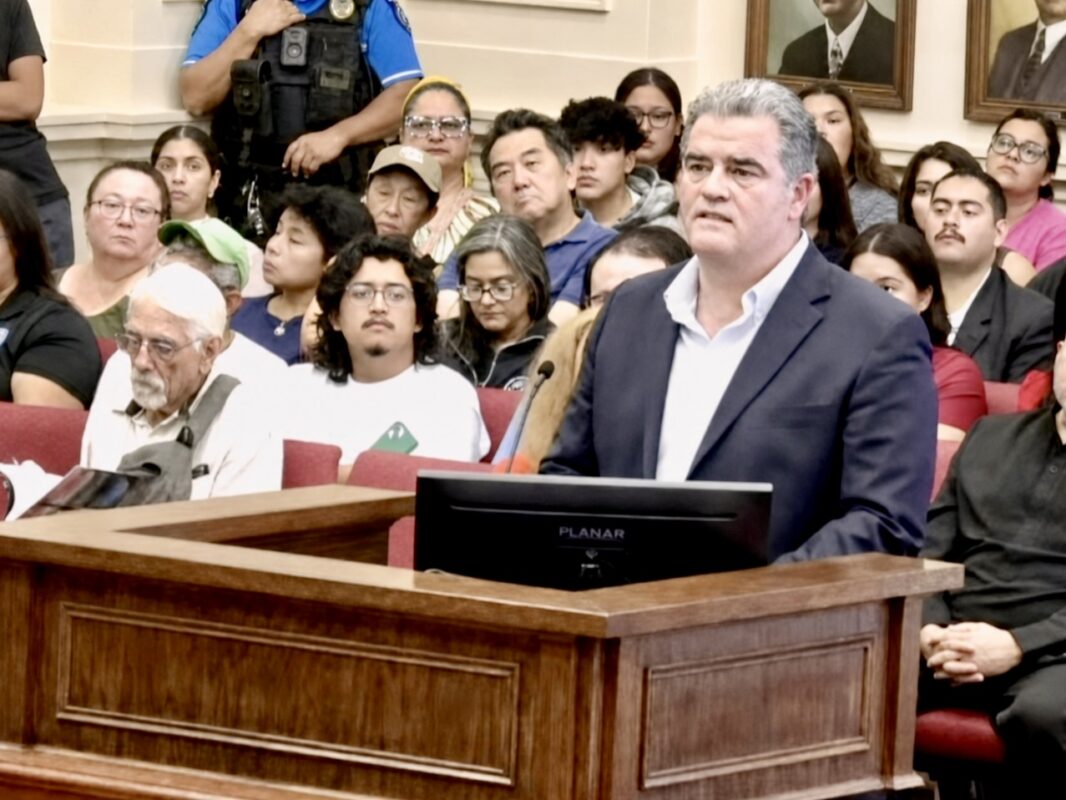
Three days after Brownsville commissioners approved a contentious agreement with SpaceX, some of the city’s most prominent business, economic development and workforce leaders packed Tuesday’s commission meeting with a message: They believe the $220 million water deal is worth it.
Representatives from the Greater Brownsville Economic Development Corp., Brownsville Chamber of Commerce, Workforce Solutions Cameron, local businesses and others took turns defending the agreement, which trades the city’s zoning control over roughly 444 acres near Starbase for up to $220 million from SpaceX toward major regional water and wastewater projects.
Their comments offered a stark contrast to Saturday’s heated special meeting, when commissioners approved the agreement after hours of public opposition and questions about how quickly the deal had been presented to the city.
Opposition remained Tuesday, with residents again criticizing the agreement and the process used to approve it. But much of the business community’s message focused on what the influx of private money could mean for a city facing both drought and rapid industrial growth.
Kris Wood, a Brownsville business consultant who attended Saturday’s meeting, acknowledged that concerns raised about the agreement, its process and timeline were legitimate.
But he told commissioners he believed they ultimately made the right decision.
“SpaceX’s commitment of up to $220 million represents an extraordinary private investment in critical water and wastewater infrastructure that has the potential to benefit this entire community for generations,” Wood said.
He argued that while the disannexation of the property received much of the attention Saturday, the longer-term significance could be the investment in Brownsville’s water capacity.
Business groups call water an economic necessity
For several speakers, the argument was straightforward: Brownsville cannot continue attracting major industrial projects, businesses and residents without expanding its water infrastructure.
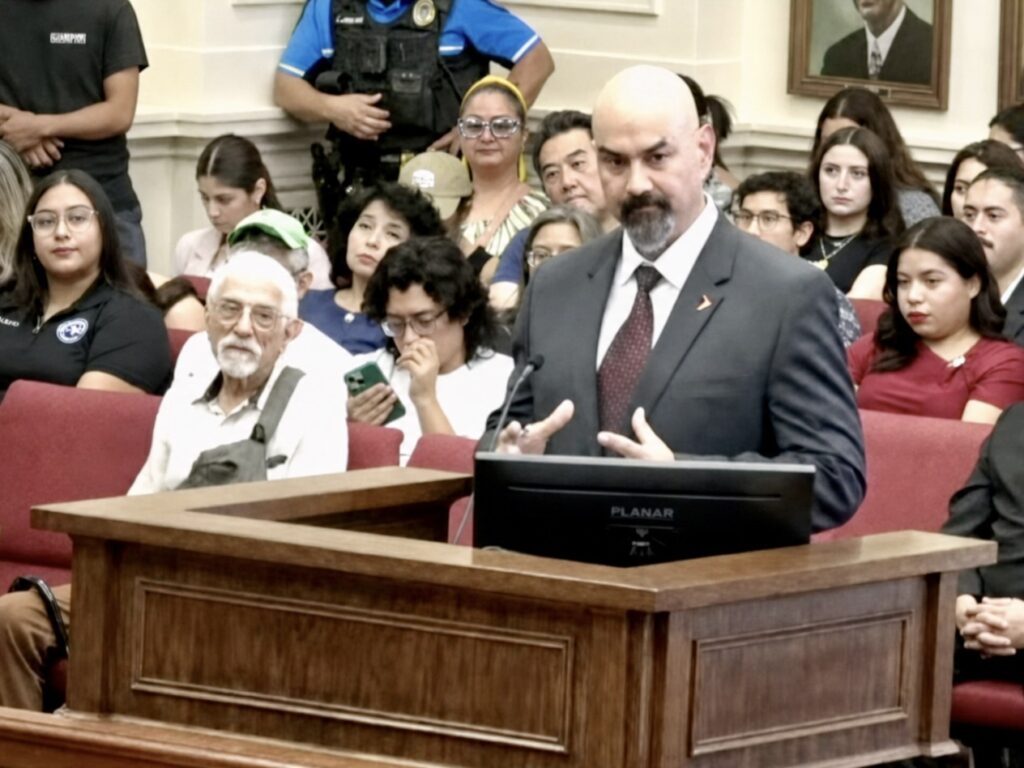
Gilbert Salinas of the Greater Brownsville Economic Development Corp. called water one of the fundamental requirements for building a larger economy.
“Most importantly, we’re going to need water,” Salinas said.
Salinas said investments in water infrastructure generate jobs, wages and additional economic activity, and predicted the decision could eventually be viewed as a turning point in Brownsville’s growth.
“In 30 to 40 years from now, people will look at 2026 as a year that we went from good to great,” he said.
Courtesy of | City of Brownsville video feed
Jerry Briones, also with the Greater Brownsville EDC, described the agreement as the largest private contribution to Brownsville’s water future in the city’s history.
“This is bigger than one company or project,” Briones said. “It is an opportunity to make a generational investment in Brownsville’s water infrastructure.”
Brownsville Chamber of Commerce Chairwoman Criselda Muñoz made a similar case from the perspective of existing and prospective businesses.
“Reliable infrastructure is the bedrock of sustainable prosperity,” Muñoz said.
She said insufficient water capacity could eventually become a bottleneck for housing, commercial expansion and job creation as Brownsville grows.
Esmeralda Villarreal, president and CEO of the Brownsville Chamber, said the organization’s members have identified water resource management as one of their top priorities.
“From a business perspective, water is infrastructure and infrastructure is economic development,” Villarreal said.
She said businesses need confidence that Brownsville will have enough infrastructure to support future investment and expansion.
Nearly as much new capacity as Brownsville uses today
The scale of the proposed water investments was also put into perspective Tuesday.
Jane Lozano of the Greater Brownsville EDC said the two projects contemplated by the agreement could add approximately 18 million gallons per day of water capacity — about 8 million gallons through wastewater reclamation and roughly 10 million gallons through expansion of the Southmost Regional Water Authority plant.
That’s the first phase of the water improvements. The plan would actually add 28 million gallons, with 20 million from the brackish water plant and 8 million from potable reuse of old wastewater.
Brownsville currently uses about 21 million gallons per day, Lozano said.
Meanwhile, SpaceX expects to use about 2 million gallons per day.
The additional capacity, Lozano said, could help accommodate residents while positioning Brownsville for more business investment and job growth.
Under the agreement approved Saturday, SpaceX could contribute up to $220 million toward the water projects.
Several speakers emphasized that because the money would come from a private company, Brownsville could make improvements without financing the entire investment through debt.
Joanna Rangel of the Greater Brownsville EDC estimated that financing $220 million in infrastructure through utility revenue bonds could cost ratepayers about $15 million annually for 25 years, totaling more than $370 million in principal and interest. That’s roughly $4,000 per ratepayer over the term of the capital investment.
Contractors see opportunity beyond SpaceX
The support Tuesday also came from businesses that have experienced the effects of the region’s recent industrial growth firsthand.
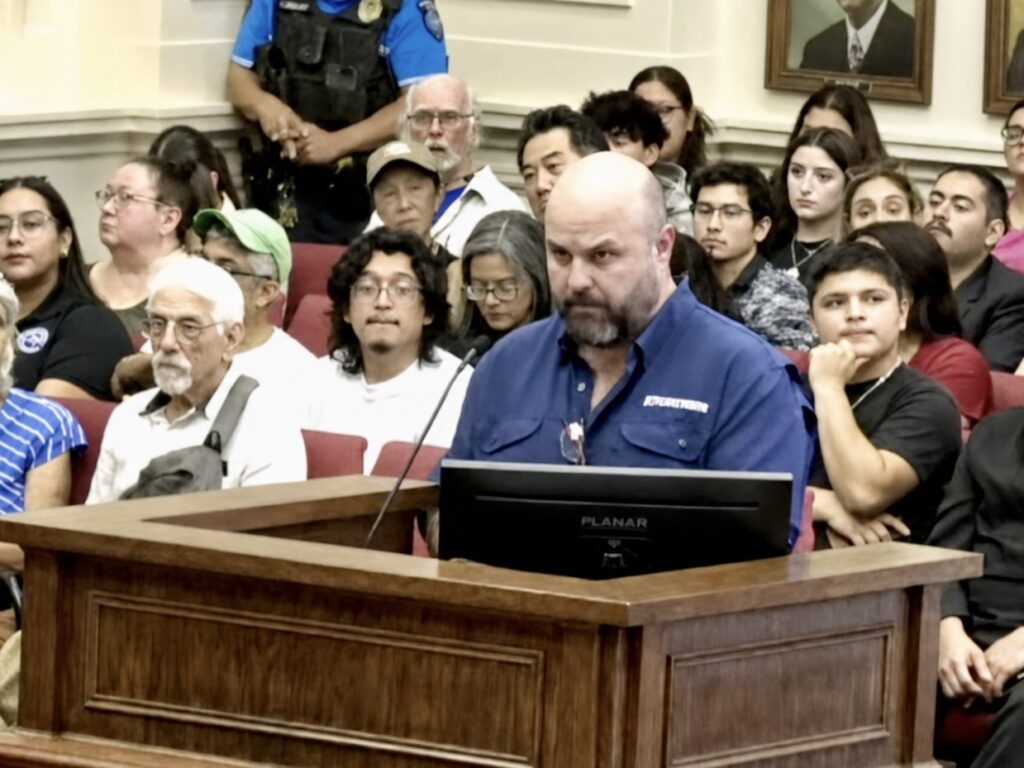
Eliud Cavazos, CEO of 57 Concrete, said his Rio Grande Valley ready-mix company has grown to more than 250 employees since it started in 2020 and operates more than 67 trucks.
Cavazos argued that the impact of a large company investing in the Valley extends beyond the jobs it creates directly.
“When a company of that caliber commits to a region, it changes what the region is capable of,” Cavazos said.
Courtesy of | City of Brownsville video feed
Large industrial customers, he said, force manufacturers, contractors and laboratories serving them to improve their processes, standards and workforce.
“This kind of investment doesn’t just create jobs,” Cavazos said. “It creates better jobs.”
Those include quality-control technicians, laboratory workers, skilled operators and drivers who can build careers in the Valley rather than leaving the region for opportunities elsewhere, he said.
Jason Medina, director of STX Metal Trades LLC and blue-collar worker who said he has spent his career supporting infrastructure projects around the country, also backed the agreement.
“It’s no secret our city is growing,” Medina said. “It’s growing at such a fast pace that we have never seen before.”
That growth, he said, “does not suggest a stronger infrastructure; it demands it.”
Workforce leaders prepare for the jobs
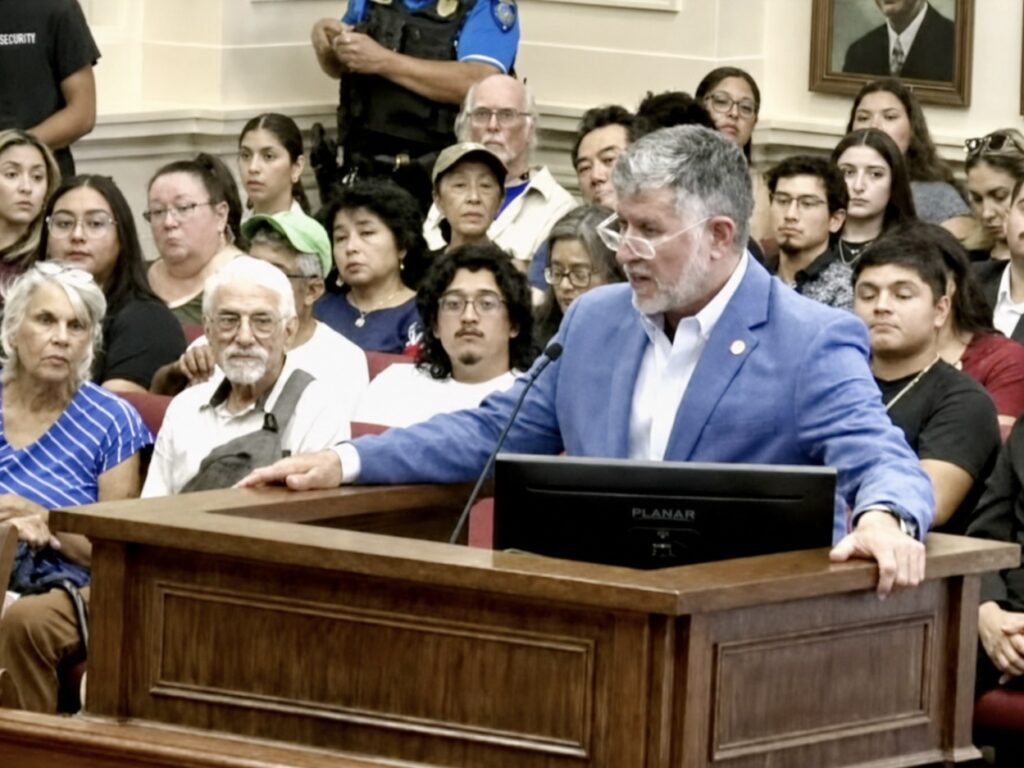
Rafael Vela, CEO of Workforce Solutions Cameron, said his organization is preparing for the workforce needs that could accompany investments tied to the agreement.
Vela said Workforce Solutions Cameron plans to work with the Texas Workforce Commission, local schools, training providers, trade organizations and employers to prepare Brownsville and Cameron County residents for resulting job opportunities.
“A healthy workforce depends on a steady cadence of opportunity,” Vela said.
Courtesy of | City of Brownsville video feed
Major infrastructure investments can enable workers to remain employed, build skills and move from one project to another without leaving the region, he said.
“Projects like this help our workers stay employed, build skills, and move from one opportunity to the next,” Vela said. “Here, not in other places.”
Opposition to the deal remains
The wave of business support did not erase the opposition that dominated much of Saturday’s meeting.
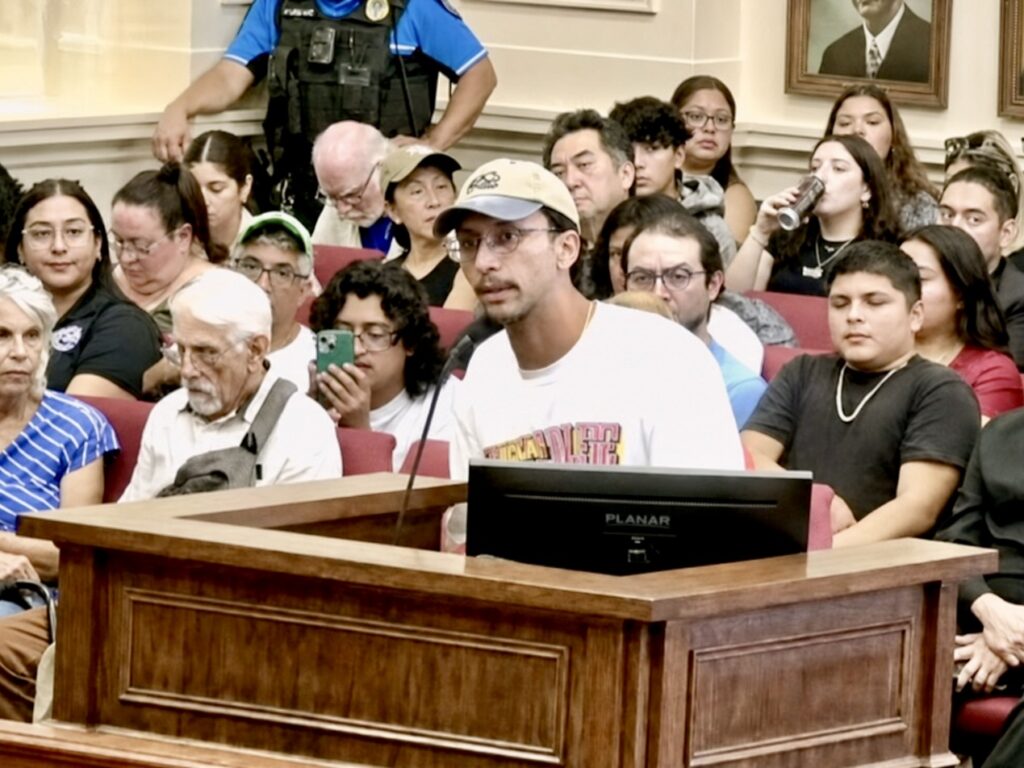
Resident Alexis Diaz told commissioners Tuesday that frustration over the decision remained “palpable” among people he had spoken with.
He criticized commissioners for agreeing to the deal after a SpaceX representative told them Saturday that the company needed a decision that day.
“The basic morality of just giving away land or property because of a threat is insane,” Diaz said.
Courtesy of | City of Brownsville video feed
He urged commissioners to take a more skeptical approach toward major corporate projects and called for a longer moratorium as the city considers restrictions on data centers and other development.
The disagreement reflects the broader debate Brownsville is confronting as billions of dollars in industrial development reshape the city: how quickly to accommodate that growth, what infrastructure will be required to sustain it and what the community should receive in return.
For Cavazos, the concrete company CEO, the $220 million agreement represents an unusual reversal of the traditional economic-development model. Cavazos’s company is a subcontractor with SpaceX and has a yard active on Texas Highway 4, Boca Chica Boulevard, the road to Starbase and SpaceX.
“For many years, communities like ours are being told the same thing: We build infrastructure first, give up incentives, then hope the investment follows,” Cavazos said. “Here, it happens the other way around.”

RGV Business Journal Staff
Staff
Most Read
- Is SpaceX quietly building a data center at Starbase? Job postings offer clues
- 25 Mexican businesses eye McAllen expansion after city pitches U.S. market entry program
- SpaceX’s futuristic city of Starbase finalizes massive 7,100-acre annexation. Here’s what we know.
- McAllen metro keeps selling more homes as Brownsville-Harlingen market sees 17% drop through August
- Rio Grande LNG moves closer to getting even bigger at Port of Brownsville
Get the latest business news delivered to your inbox every morning for free.
Try 30 Days Free!
Get full access to award-winning journalism covering business, real estate, health care, economic trends, and the people shaping the Rio Grande Valley.
30 Days Free!
$9.95/month
Limited time offer
Subscription renews after your 30 day free trial at $9.95/mo.
Included Benefits
- Unlimited access to all articles
- Daily business news and analysis
- Subscriber-only content and features
Stories That Matter
- Texas transportation leaders to discuss Rio Grande Valley infrastructure at Mission summit
- South Texas College plans $4.7M makeover of cosmetology, security facilities in McAllen
- Mission’s first Small Business Expo puts $25K on the line for local entrepreneurs
- McCoy’s gives $10K, tools to launch Mid-Valley construction academy
- UT Health RGV performs new digestive procedure for first time in the Valley
- TSTC bets on advanced manufacturing to meet RGV’s industrial boom
- Pharr’s cross-border business push earns international recognition
- Brownsville eases drought restrictions after nearly three years as Rio Grande reservoir levels improve
- Edinburg ISD rejects nearly $6M offer for prime land near La Sienna despite $15M budget deficit
- Texas A&M’s $53.5M McAllen research center will tackle water, food security and Valley health