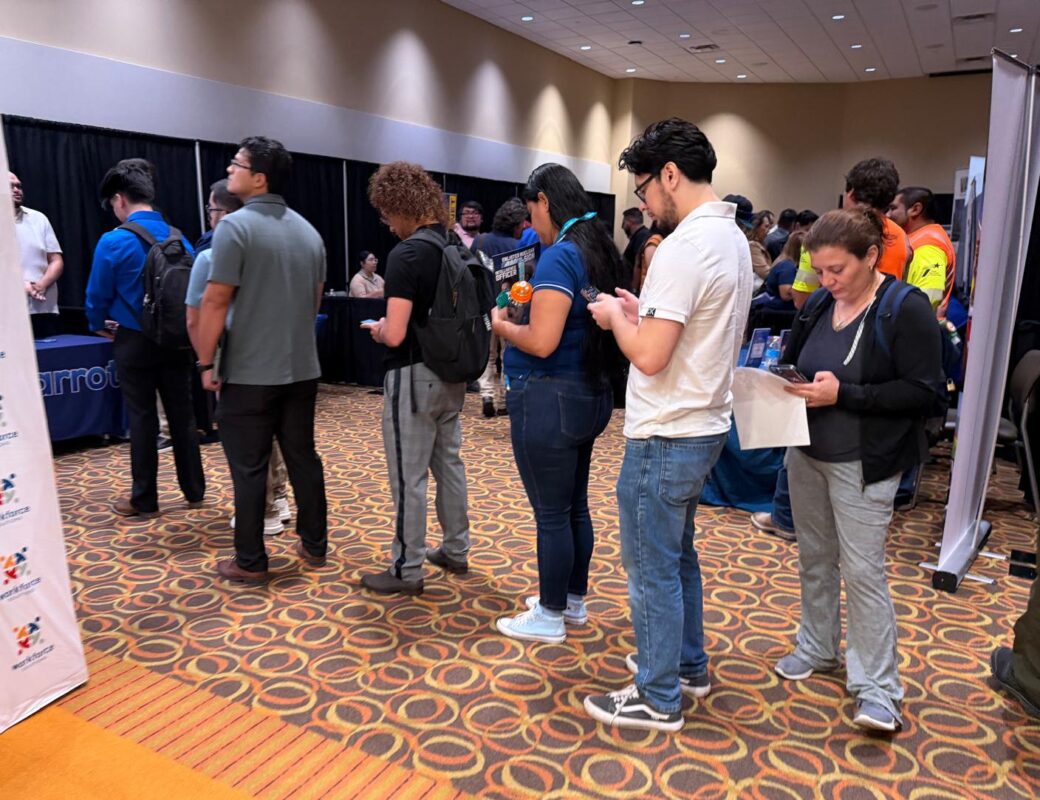
Yael Alarcon Mata, who hails from Mission, graduated from the University of Texas at Rio Grande Valley in May 2026.
Now the 22-year-old is on the hunt for his first job in the technology industry, armed with a bachelor’s degree in computer engineering focused on software and experience in C++, a standard but notoriously difficult programming language. So far, his work experience includes the college library.
On Thursday morning, he stood in line for a chance to speak with recruiters for Doctors Hospital at Renaissance at the Edinburg Conference Center at Renaissance about available careers in the healthcare sector — a major local employer in the healthcare industry — that dominates the job market in the Valley.
The Edinburg Economic Development Corporation hosted the STEM- and IT-specific job fair that included employers ranging from Spherion, a technology industry staffing business, to Blue Parrot Software, a local company in Edinburg. But about two dozen other area employers also looked for technology talent.
Raudel Garza, executive director of the Edinburg EDC, said he’s heard from employers that the technology industry workforce, specifically cybersecurity, is what businesses need more than ever right now,. That’s why the local economic development arm of the city hosted an industry specific job fair.
Alarcon, the UTRGV graduate and jobseeker, envisions a career in hardware manufacturing, such as designing central processing units, otherwise known as CPUs or the “brain” of machines, from computers to servers, or even GPUs, which are graphics processing units or the tool that enables machines to process images or visual media.
High-profile companies like Nvidia manufacture these hardware tools used in everything from video games to artificial intelligence data center servers. But instead of working to improve the speed of data center processors, Alarcon prefers not to work in that side of the high-growth industry.
“It just takes up a lot of resources, and it’s going to harm us more than help us, especially with all the water it takes,” he said.
Instead, he’s interested in making computers more efficient and sustainable by using fewer resources.
“That’s kind of what you learn in the computer science degree: you’re trying to make things more efficient, run faster, and oftentimes bring cost down,” he said. “It’s the same with electronics; you’re trying to make a device that’s compact and spends the least amount of resources.”
In the next five years, Alacron said he does not expect to continue working in the Valley.
“There’s not much in what I want to do here,” he said. “There’s not really many options. I’m just looking for [a job] that’s for right now, at the moment, just to get some experience because most places require that.”
But it’s a competitive job market in tech, and many entry-level positions for junior software developers have been eliminated because it’s more efficient for companies to use generative artificial intelligence models for routine tasks than to teach a junior developer over the course of several months to a year with a mentor on the company’s technology stack.

Alarcon’s job hunt routinely offers entry-level roles that offer the lowest pay, but require several years of experience, which can feel like a conundrum, he said. He’s already sent out dozens of job applications online.
“You need five to ten years of experience, and I’m like, how?” he queried. “That’s why the unemployment rate is so high for the postgrad [workers].”
Alarcon said he would offer employers seeking to connect with next-gen talent to step back from automating screening resumes with artificial intelligence because it’s inadvertently making arbitrary decisions based on factors other than the candidate’s skills, education, or work experience.
“They’re not even looking at the resumes,” he said.
For example, Workday, a major automated screening company, is facing a lawsuit that claims it discriminated against workers with protected statuses in the U.S. because its AI models are allegedly biased.
In the 2023-2024 school year, there were nearly 200 graduates from the University of Texas Rio Grande Valley with degrees in either computer science, information technology, or computer systems security. Of that figure, 163 were bachelor’s degrees and 32 were master’s degrees.
As of July, the information sector in the McAllen-Edinburg-Mission metro area only employed about 3,400 workers. There are tech workers who may be classified under other industries, but that’s roughly the size of the market — compared to 98,900 workers in the private education and health services sector in the McAllen metro area.
In the Brownsville-Harlingen metro area, the information sector is even smaller. As of July, only about 1,400 jobs were reported in that industry. That’s compared to 46,900 jobs in private education and health services in the Brownsville metro.
People with expertise in computer science are not the only ones who work in the technology sector. There are those who do something known as vibe computer coding, which is when individuals with ideas guide generative artificial intelligence models to build automated tools that are often used for businesses. The skill is usually self-taught, unlike a computer programmer, and leverages AI to code using a series of prompts.
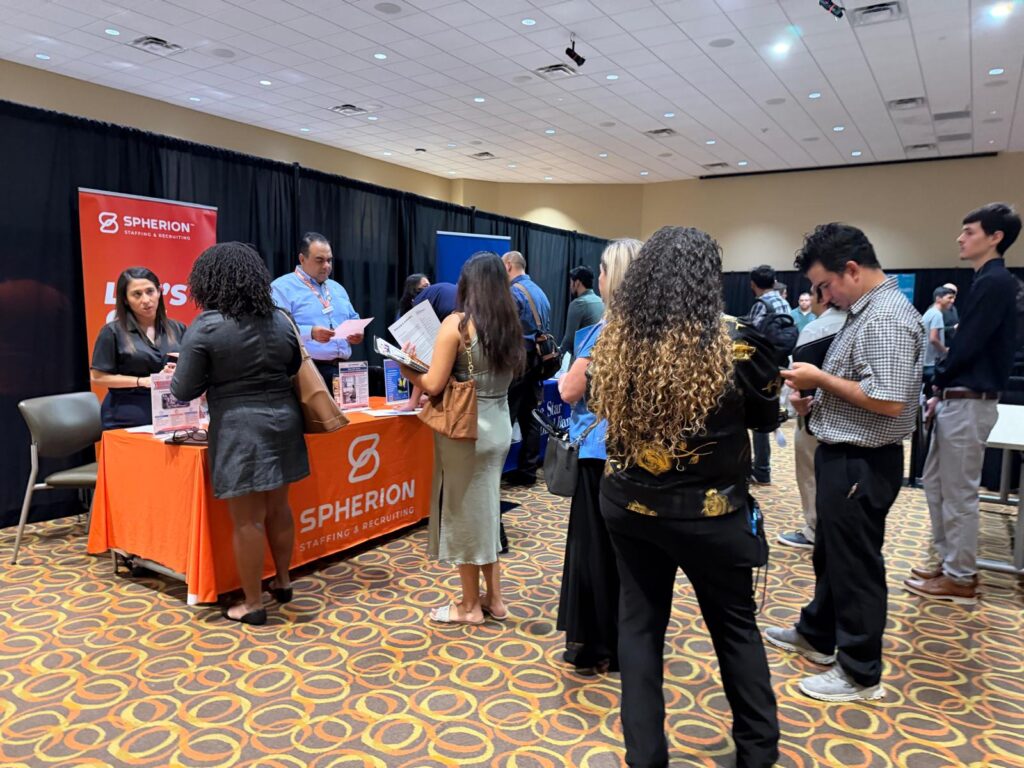
Daniel Rodriguez, who grew up in Edinburg and also graduated from UTRGV with a degree in finance in December 2024, reflects that trend. He has taken a different perspective on the use of technology and is already lining up contracting work for small businesses in the logistics industry with his vibe coding skills.
“I do controlled [computer] environments in folders and files for the AI to know exactly where to go and how to handle stuff [for a business],” Rodriguez said. “It’s a U-shaped curve: you [as an individual] at the top, then you give [AI] all the context step-by-step [of] what you want. But first you have to ask the questions on how to set it up the best, then you let AI do all the hard work in the middle, and it gives you an output, and then you verify what happened. You still keep the human in the loop — you are pretty much babysitting AI.”
The college graduate has already applied for more than 300 jobs in his field, but when he showed up to the job fair in Edinburg, he had a strategy: instead of asking the same obvious questions, he tried to make an impression as a unique and creative candidate who can problem-solve on the fly.
Rodriguez researched the available job openings before attending the fair and chatted with recruiters directly. Then he did his own due diligence to see if the recruiters would advocate for him to be considered for an interview.
In the next five years, Rodriguez said he’d love to work his way up to a top position in a company or build his own AI-driven agency to teach people how to use AI in a more effective way. And it’s not about spitting out graphic design template flyers and menus that draw on the same design principles to sell products, he said.
Rodriguez said he sees value in translating business problems that need solutions and plans to use artificial intelligence to streamline what the company needs as a personalized automation tool.
“AI is my intern, and you have to walk with it. Because if you ask it to grab a rock, it’s going to grab you the Grand Canyon,” he said.

Kristen Mosbrucker-Garza
Reporter
Kristen Mosbrucker-Garza is a versatile multimedia news reporter who lives and works along the Texas-Mexico border in Hidalgo County. Mosbrucker-Garza is a news reporter for the Rio Grande Valley Business Journal. During her career she's worked for the McAllen Monitor, San Antonio Business Journal, The Advocate Newspaper in Louisiana, Phoenix New Times, and public media outlets in Baltimore and Philadelphia.
Most Read
- Is SpaceX quietly building a data center at Starbase? Job postings offer clues
- 25 Mexican businesses eye McAllen expansion after city pitches U.S. market entry program
- Edinburg ISD rejects nearly $6M offer for prime land near La Sienna despite $15M budget deficit
- Developers begin $12M master-planned community near Rio Grande City
- 5×5 Brewing plots $2.5M comeback with new Edinburg brewpub near UTRGV
Get the latest business news delivered to your inbox every morning for free.
Try 30 Days Free!
Get full access to award-winning journalism covering business, real estate, health care, economic trends, and the people shaping the Rio Grande Valley.
30 Days Free!
$9.95/month
Limited time offer
Subscription renews after your 30 day free trial at $9.95/mo.
Included Benefits
- Unlimited access to all articles
- Daily business news and analysis
- Subscriber-only content and features
Stories That Matter
- Rio Grande Valley could add 109,500 residents by 2060, but not all counties are expected to grow
- UTRGV lands $2.2M to fight screwworms with drones, thermal imaging
- Day of the Dead generates $7.3M in Reynosa economic activity
- Weslaco opens new pathway to healthcare careers for 25 residents
- Downtown Weslaco bar Señor Barbas to close amid declining sales, staffing struggles
- Mission’s first Small Business Expo puts $25K on the line for local entrepreneurs
- McCoy’s gives $10K, tools to launch Mid-Valley construction academy
- UT Health RGV performs new digestive procedure for first time in the Valley
- TSTC bets on advanced manufacturing to meet RGV’s industrial boom
- Pharr’s cross-border business push earns international recognition