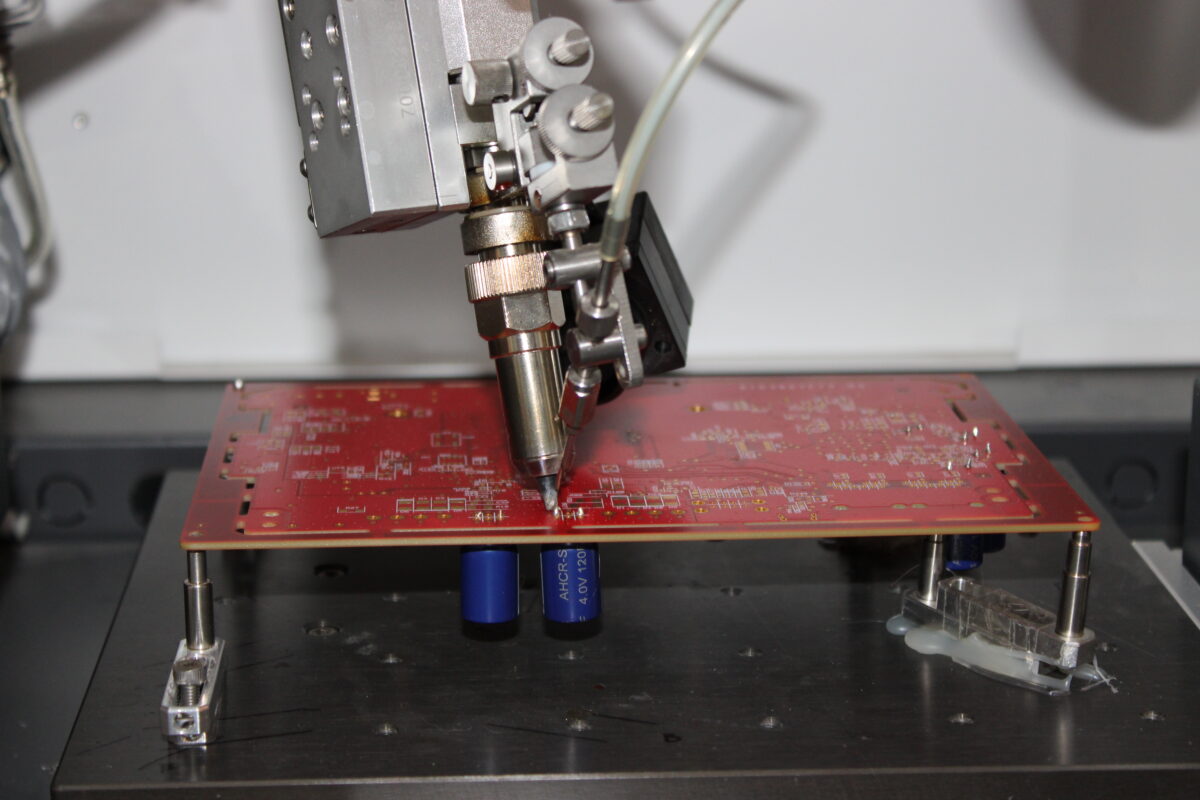
Smaller components and tougher quality requirements are driving demand for greater precision, traceability and efficiency as the city strengthens its role in North America’s manufacturing supply chain
REYNOSA, Tamaulipas — The challenge for Reynosa’s electronics industry is no longer simply producing more. It is producing with greater precision, documenting how each part was made and being able to trace what happened on the production line.
As electronic components become smaller and customers demand tighter quality controls, manufacturers are turning to systems designed to detect errors, capture production data and provide traceability throughout the assembly process.
That shift was on display Thursday at the Surface Mount Technology Association (SMTA) Reynosa Expo & Tech Forum 2026, the first event of its kind organized by the group in Reynosa, where suppliers from Mexico, the United States, Europe and Asia showcased technologies for electronics manufacturing.
But beyond the equipment on display, the event offered a broader look at what is changing inside manufacturing plants: precision, traceability and efficiency are becoming increasingly important to remain competitive.
Smaller components, greater precision
The miniaturization of electronic components is forcing manufacturers to increase the precision of their processes.
Marcela Silverio, Distribution Sales Manager at SMarTsol Technologies said electronic products are becoming increasingly smaller, raising the need to detect component shifts, placement errors and other deviations during assembly.
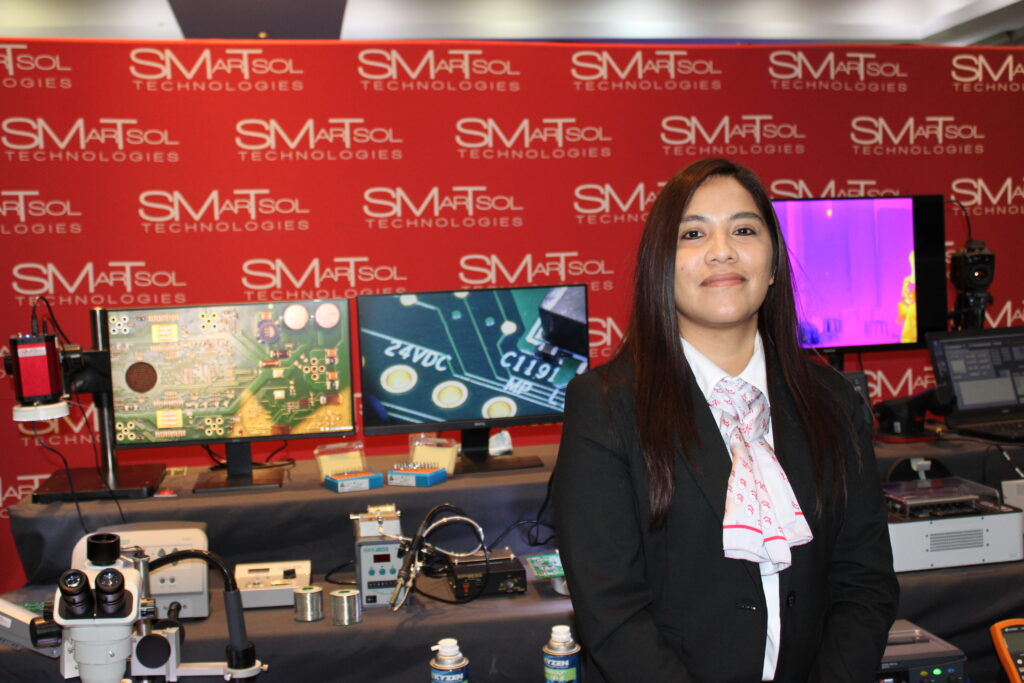
“The same industry is demanding new technologies because its products are becoming increasingly smaller.”
As a result, technologies that once may have been viewed as specialized are taking on a larger role in manufacturing operations. Solutions presented at the forum included equipment and systems for inspection, measurement, soldering, maintenance, automation and process monitoring.
The objective is not simply to make a production line faster. It is to reduce errors and generate information that can demonstrate whether a process met required specifications.
Precision has become a priority as products evolve and manufacturing requirements become more demanding, the SmartSol representative said.
Traceability down to the screw
One of the most significant changes is taking place in how manufacturers document their processes.
Iván Rivas, a sales agent with ITEC-MRO, Supply Solutions for the Latin American Market, said demand is growing for smart fastening systems capable of providing traceability.
“They are now demanding more technological equipment that provides traceability and greater precision in the work they perform.”
The technology can record how many screws were installed, the pressure used, which ones were accepted or rejected and connect that information to a specific unit. It can also record when the assembly took place and identify the supplier involved.
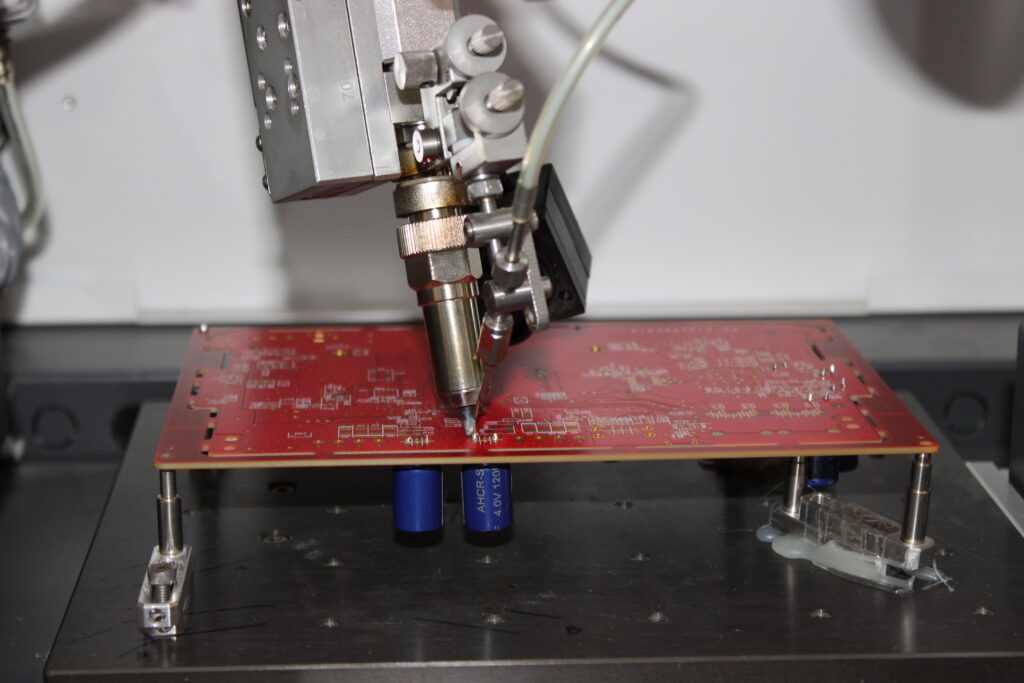
The value of that data becomes apparent when a manufacturer needs to investigate a quality issue.
“The industry is demanding more quality in our assemblies and in production”, Rivas explained.
Rather than relying solely on general production records, a company can reconstruct part of the process and determine what happened to a particular unit.
Rivas said that during his four years with the company, he has seen increasing demand for technology that provides traceability and greater precision in assembly processes.
For a manufacturing region that is part of supply chains constantly crossing the Mexico-U.S. border, that capability can be particularly valuable.
An international supply chain
The technology reaching Reynosa’s plants also reflects the international nature of the industry.
“We have very good equipment, very large equipment, many of them high-value and high-quality. Products come from Germany, China, Japan and other parts of Europe, ”Federico Robles, secretary of SMTA’s Northeast Mexico said.
“We are bringing international suppliers together on the same platform with the electronics maquiladoras.”, Ana María Mendoza, an SMTA Mexico representative said.
Robles said suppliers connected to the sector include companies from Germany, China, Japan and other parts of Europe.
Ana María Mendoza, an SMTA Mexico representative, said one of the association’s goals is to connect international suppliers with electronics maquiladoras in different regions.
The aim is to make it easier for engineers to find equipment, services and capital goods needed for their surface-mount technology, or SMT, production lines.
“We are bringing international suppliers together on the same platform with the electronics maquiladoras.,”
That connection carries particular significance in Reynosa. Buyers attending the event were not only asking about technical specifications. They also wanted to know about prices, delivery times and whether solutions could be purchased through Mexico or the United States, according to Rivas.
That places technology suppliers within a broader conversation about the competitiveness of border manufacturing.
Competing over pennies
Efficiency also has a direct impact on manufacturers’ decisions. Lázaro Garta, regional sales manager for DYMAX, said that in electronics manufacturing, even differences of a few cents can influence a customer’s decision to switch suppliers.
In that environment, technology investments are not evaluated solely on how much additional capacity they provide.
Manufacturers also consider how much the technology can help reduce waste, errors, downtime and quality problems.
Automation is part of that equation, but the technological transformation showcased in Reynosa extends well beyond robotics.
Suppliers demonstrated solutions for inspection, preventive maintenance, measurement, repair, soldering and process control.
The common objective is to make manufacturing operations more consistent and measurable.
Talent must keep pace
Technology, however, creates another requirement: workers capable of using it.
Víctor Manuel Ibáñez Dehesa, president of SMTA’s Northeast Mexico chapter, said the event also sought to connect students with industry professionals and companies.
For Garta, that connection should begin before students enter a manufacturing plant.
He said universities and companies should strengthen partnerships so students can gain exposure to the technologies they will encounter in the workplace.
The challenge is particularly important in an industry where technologies, inspection processes and analytical tools are changing rapidly.
Training is no longer limited to learning how to operate a machine. It also involves understanding the data it generates, interpreting the results and using that information to improve the process.
Reynosa in the Northeast electronics corridor
SMTA considers Reynosa, Matamoros, Monterrey and Saltillo among the major electronics manufacturing centers in northeastern Mexico.
Ibáñez Dehesa said Reynosa was selected for the first regional expo because of the city’s strong industrial presence.
Mendoza said SMTA has worked in Mexico for more than two decades and that its regional chapters seek to connect industry with suppliers and universities.
The expo therefore showed more than a collection of new technologies. It highlighted an industry seeking greater control over its processes while facing smaller products, more demanding customers and a supply chain increasingly integrated across Mexico and the United States.
The next competitive challenge
For U.S. companies that rely on Mexican suppliers, the ability to manufacture precisely and demonstrate how a product was made can be just as important as production cost.
A manufacturer capable of identifying which component was used, how it was assembled and when the process occurred has information that can become critical during a quality claim or production audit.
For Reynosa, that presents both an opportunity and a challenge. The opportunity is to strengthen its position within North American supply chains.
The challenge is turning technology adoption into a sustainable competitive advantage.
The question is no longer simply how much Reynosa can manufacture. It is how precisely, efficiently and traceably it can do it.

Anayancy Ulloa
Reporter
Anayancy Ulloa Luna is a contributor to the Rio Grande Valley Business Journal who hails from Reynosa in the Mexican state of Tamaulipas. Ulloa has a long history as a U.S.-Mexico region business expert in marketing, formerly the editorial director of Mexico Industry.
Most Read
- Edinburg ISD rejects nearly $6M offer for prime land near La Sienna despite $15M budget deficit
- Port of Brownsville approves $2M SpaceX pipeline deal, with millions more on the table
- What Toyota’s $3.6B San Antonio expansion could mean for the Rio Grande Valley
- McAllen’s nonstop Mexico City flight is back
- 5×5 Brewing plots $2.5M comeback with new Edinburg brewpub near UTRGV
Get the latest business news delivered to your inbox every morning for free.
Try 30 Days Free!
Get full access to award-winning journalism covering business, real estate, health care, economic trends, and the people shaping the Rio Grande Valley.
30 Days Free!
$9.95/month
Limited time offer
Subscription renews after your 30 day free trial at $9.95/mo.
Included Benefits
- Unlimited access to all articles
- Daily business news and analysis
- Subscriber-only content and features
Stories That Matter
- Port of Brownsville details SpaceX agreements worth more than $125M in potential revenue
- SpaceX makes history with first Starship catch at Starbase
- Mission’s first Small Business Expo puts $25K on the line for local entrepreneurs
- McCoy’s gives $10K, tools to launch Mid-Valley construction academy
- UT Health RGV performs new digestive procedure for first time in the Valley
- TSTC bets on advanced manufacturing to meet RGV’s industrial boom
- Pharr’s cross-border business push earns international recognition
- Brownsville eases drought restrictions after nearly three years as Rio Grande reservoir levels improve
- Texas A&M’s $53.5M McAllen research center will tackle water, food security and Valley health
- STC puts AI to work across 55 courses — from construction sites to car repair