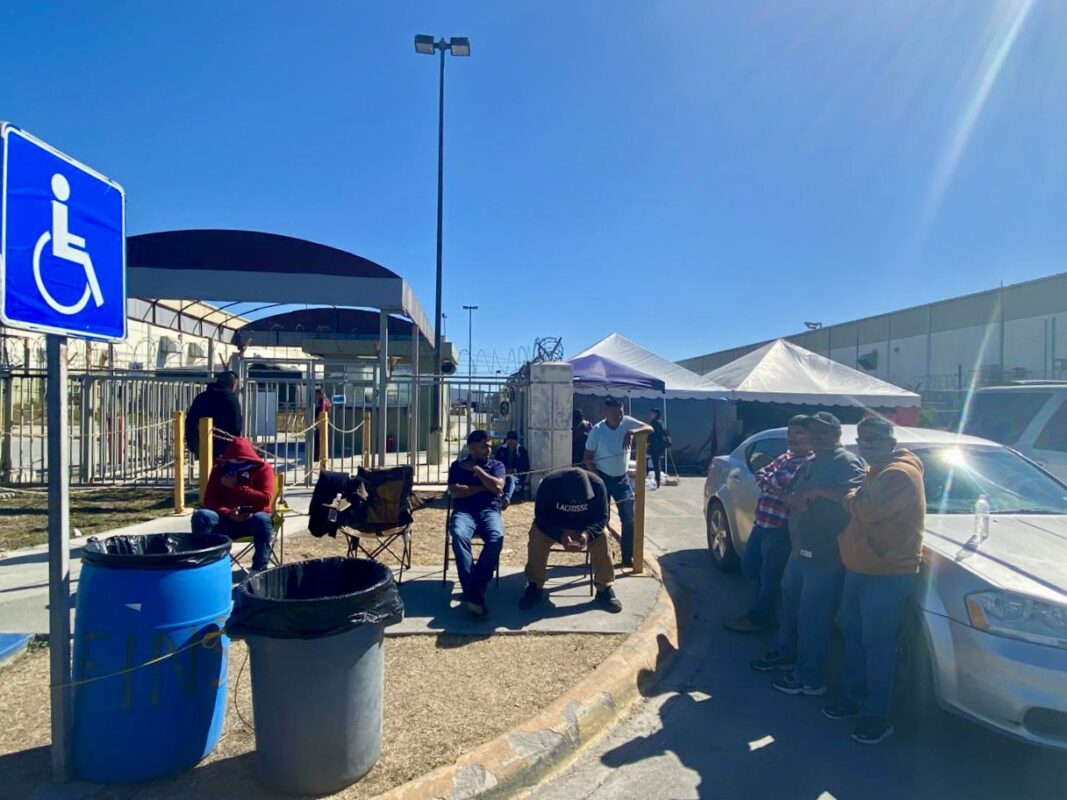
Outside the Tridonex plant in Matamoros on Friday, a group of workers waited listlessly under improvised structures. Some stood. Others sat. Most sought shade from the sun.
There were folding chairs, backpacks, and thermoses filled with coffee or water. Small groups rotated in shifts. There were no banners or chants. No music or shouting. What prevailed was waiting.
They’ve been doing that since Jan. 26, when operations at Tridonex plants 52, 53 and 60 in Matamoros halted.
Shocked employees, who say they abruptly lost jobs and access to their company-tied savings, have been safeguarding company assets while waiting for a conciliation hearing that will determine their futures.
That hearing is scheduled for Monday.
Long shifts and accumulated exhaustion
As the days pass, the number of workers guarding the plant has declined. To withstand physical and emotional exhaustion, employees organized themselves into eight-hour shifts. Some cover mornings; others stay overnight. The rest are trying to find temporary jobs or alternative sources of income while maintaining a presence at the plant.

Photo Credit | Anayancy Ulloa
The Rio Grande Valley Business Journal spoke to employees stationed there Friday morning. While some were willing to speak on the record, most spoke under the condition of anonymity. They’re concerned speaking out could hurt their future employment opportunities.
“It’s very tiring, but we also have to figure out how to bring something home,” a worker with six years under his belt said.
During the first two weeks, workers received partial payments for some of the days they worked. However, the outlook is now uncertain.
“The main concern is pay. A lawsuit can take years, and we can’t afford to stay idle without working,” he said.
Organization and legal path
Monday’s hearing is key to determining whether the company can reach an amicable agreement with workers or if they will be forced into a formal litigation stage, their legal representative, labor attorney Susana Prieto Terrazas said.
Prieto will travel to Matamoros to meet with the workers on Wednesday.
In the meantime, most employees have decided to remain united and move forward with a collective labor claim, led by union representation from SNITIS.
Last week, they began collecting the necessary documentation — payroll receipts, personal data and employment records — in case the conciliation process does not succeed.
Pragmatism amid a lengthy process
Among the workers, uncertainty prevails, but so does a pragmatic approach to the legal process. While the goal is to obtain full severance in accordance with the law, some acknowledge they would accept a partial payment if it allows them to meet immediate needs while searching for another post.
“We know what’s fair would be 100%, but if that’s not possible, and they offer even 50%, many of us would accept it,” another worker said. “A lawsuit can take years, and we can’t afford to remain without work.”
Other employees agreed that, given the difficulty of being hired elsewhere and the daily economic pressure, a partial settlement could represent a temporary alternative while their employment future is defined.
No communication from the company
Andrea Zúñiga, a worker in the imported components area, has nearly 15 years of service at Tridonex. She joined the company on Sept. 8, 2011, and remained in the same position throughout her career.

Photo Credit | Anayancy Ulloa
Since operations were suspended, she said, workers have received no direct information from human resources or company executives.
“They haven’t faced us or explained what’s happening,” she said, noting that their legal representatives have tried to contact the company to no avail.
Zúñiga explained that in recent weeks, payments have been partial and do not reflect full wages. While she has financial support from her husband, she said many of her coworkers relied entirely on that income.
“There are people with children in school and fixed expenses that don’t stop. The situation is very difficult,” she said. “The only certainty we have right now is waiting for what gets decided.”
Zúñiga said workers have made rough calculations of what their severance pay could amount to based on years of service. In her case, with nearly 15 years at the company, she estimated hers would be about $17,000, but emphasized it was only a rough projection.
“It’s just an estimate. We’re not asking for more than what’s fair under the law,” she said.
Long careers, an unexpected shutdown
Salvador Miranda González, 51, joined Tridonex on June 1, 2009. Throughout the last 16 years, he worked his way up from a general operator into the customer parts preparation area, a process he described as highly specialized and demanding.
Miranda González said that although the company had noticeably reduced material and made operational adjustments in recent years, no one anticipated a situation like the current one. In earlier periods, he said, when one production line stopped, workers were reassigned to other areas to keep operations running.
“We never thought it would end like this,” he said. “We’re waiting to be told what’s going to happen. We can’t anticipate something we still don’t know.”
Age, labor market and fear of rejection
Uncertainty weighs more heavily on older workers.
Eva Manríquez, a 52-year-old with eight years of service in the seals area, said she has decided to wait for Monday’s outcome before seeking another job.

Photo Credit | Anayancy Ulloa
“At this age, it’s not the same to go out and look for work,” she said.
Lidia Hernández Martínez, 60, worked nearly seven years as a material handler, supplying safety equipment and materials to various areas.
In recent years, she noticed the company began limiting how much safety equipment it doled out.
Still, she didn’t worry about job stability, until now. But she’s made a definitive decision.
“I’m not going to look for another job. I’m going to retire,” she said. “I thought I would stay here until the end.”
Solidarity among coworkers
Alejandro Ullua Rosales, who spent 12 years in the lathe and repair area, decided to set up a small support point where coworkers can find food, water or snacks during their shifts outside the plant.
“Everything is to support the coworkers who are here standing guard,” he said.
His household has multiple income sources, but two of his children are still in school, which adds financial pressure.
José Antonio Alonso Cabrera, 43, who worked nine years in the warehouse area, said workers continue showing up daily because they believe the livelihood of many families is at stake.
“We’re waiting for a resolution or a proposal, either for our jobs back or for severance,” he said.
Labor stigma and economic urgency
Several workers said that when they tried applying for jobs at other maquiladoras, they were seemingly rejected after they mentioned working at Tridonex or their union affiliation.
“They just ask where you worked and which union you belonged to, and that’s where the interview ends,” one worker said.
Another worker said he could wait for the hearing to begin before applying for other positions. He’s his family’s sole provider and he has a baby.
“Expenses don’t stop — diapers, milk, food, medicine. Right now there’s no income, everything is an expense,” he said.
Limited support
During the weeks of waiting, the municipal government has provided food to workers covering morning shifts. It’s support they appreciate but acknowledge is insufficient given the magnitude of the problem.
State labor authorities have also reached out to register workers for potential vacancies, though no placements have materialized so far.
“Even if you try to stay strong, spirits do drop,” the worker said. “But I’m not giving up. A family depends on me.”
Plant closure

Photo Credit | Anayancy Ulloa
Hopes of the plant’s reopening weakened following a message shared by their labor attorney, Prieto Terrazas. She told them there is zero chance that Tridonex will resume operations in Matamoros.
The union representative said the labor process in Mexico remains in the conciliation stage and noted that formal labor lawsuits can only be filed once that phase is exhausted. She added that any impact from the U.S. bankruptcy process would only be possible if workers first obtain a favorable ruling from Mexican labor courts.
“Bankruptcy in the United States has nothing to do with reopening your jobs. They were closed; the work is over for you,” she told employees.

Anayancy Ulloa
Reporter
Most Read
- How much water does SpaceX need to operate near Brownsville? Nearly 20x its current use
- Could apartment-to-condo conversion help make $100K homeownership in the McAllen metro more affordable? One investor says yes.
- SpaceX’s futuristic city of Starbase finalizes massive 7,100-acre annexation. Here’s what we know.
- Cameron County is negotiating a $20M Fluidstack data center donation after Harlingen waffles on the same offer
- Fluidstack breaks ground on $4 billion Cameron County AI data center
Get the latest business news delivered to your inbox every morning for free.
Try 30 Days Free!
Get full access to award-winning journalism covering business, real estate, health care, economic trends, and the people shaping the Rio Grande Valley.
30 Days Free!
$9.95/month
Limited time offer
Subscription renews after your 30 day free trial at $9.95/mo.
Included Benefits
- Unlimited access to all articles
- Daily business news and analysis
- Subscriber-only content and features
Stories That Matter
- What we know about Zoho Corporation and what could be built at its 1,000-acre campus
- SpaceX bought some water rights from the Rio Grande River. Here’s what we know.
- Foreign-Trade Zone No. 12 expands into Willacy County
- Mission’s first Small Business Expo puts $25K on the line for local entrepreneurs
- Reynosa’s newest technical high school focuses on AI, semiconductors and bionics
- McCoy’s gives $10K, tools to launch Mid-Valley construction academy
- UT Health RGV performs new digestive procedure for first time in the Valley
- TSTC bets on advanced manufacturing to meet RGV’s industrial boom
- Pharr’s cross-border business push earns international recognition
- Brownsville eases drought restrictions after nearly three years as Rio Grande reservoir levels improve