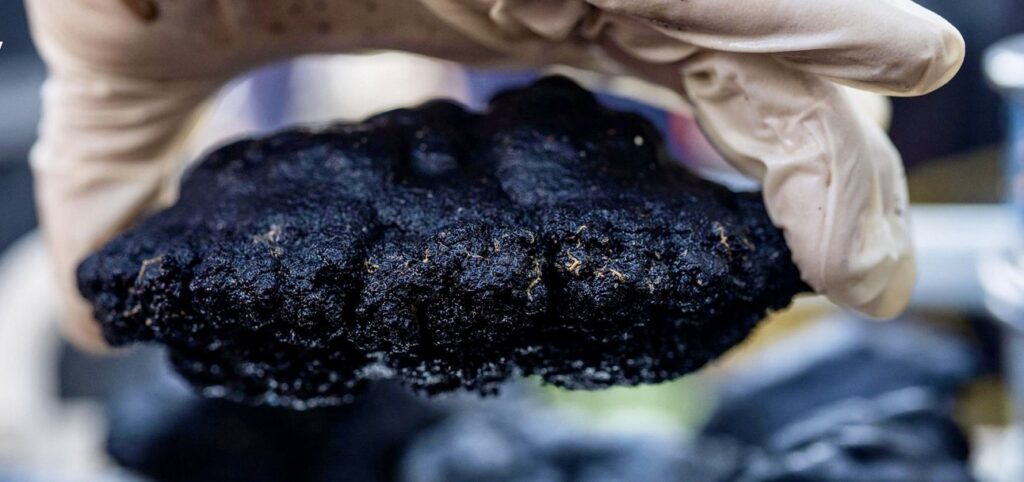
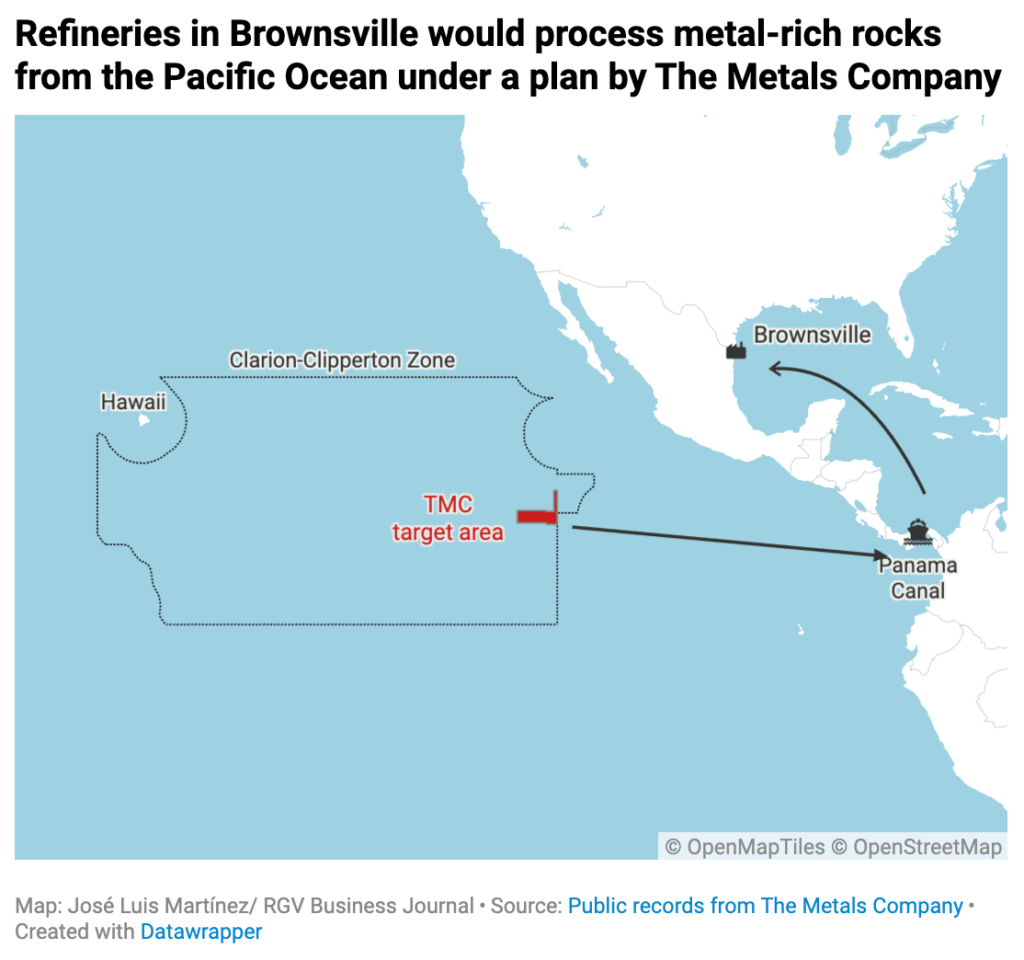
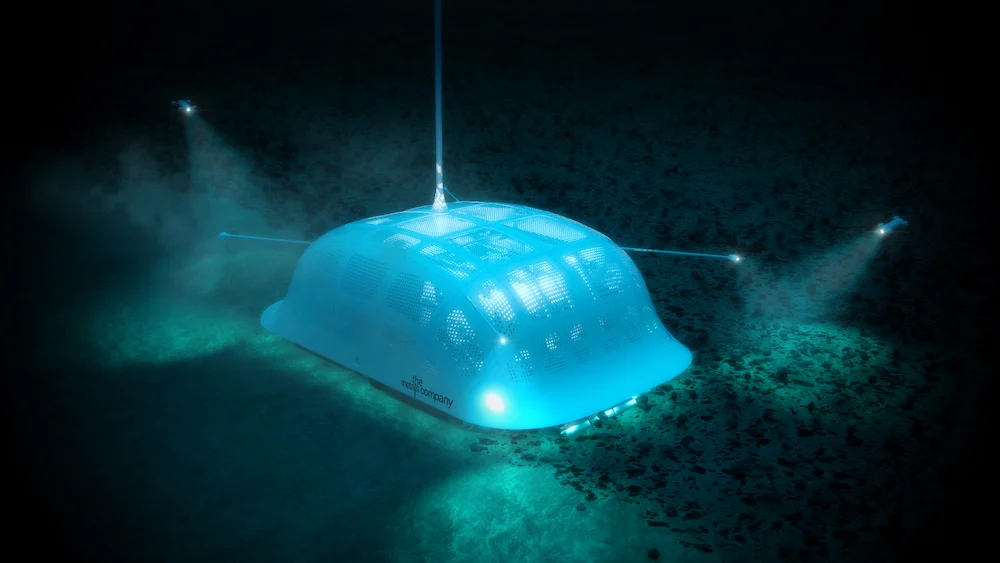
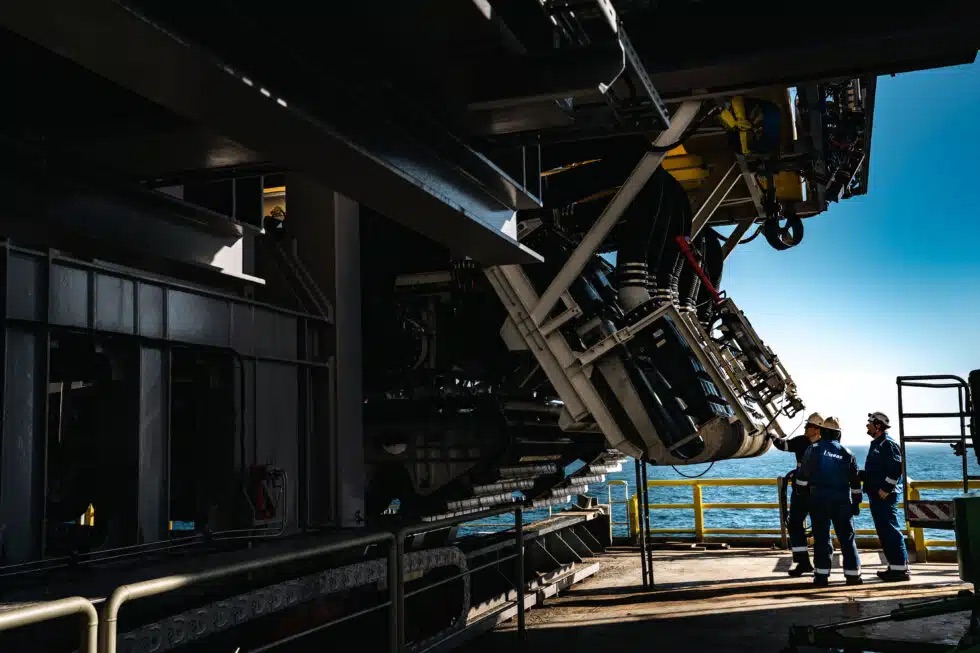
In the Pacific Ocean west of Mexico, a deep-sea mining company called The Metals Company Inc. (TMC) plans to lower a nearly 50-foot-wide vehicle to the seafloor more than two miles below the surface to collect metal-rich rocks known as polymetallic nodules.
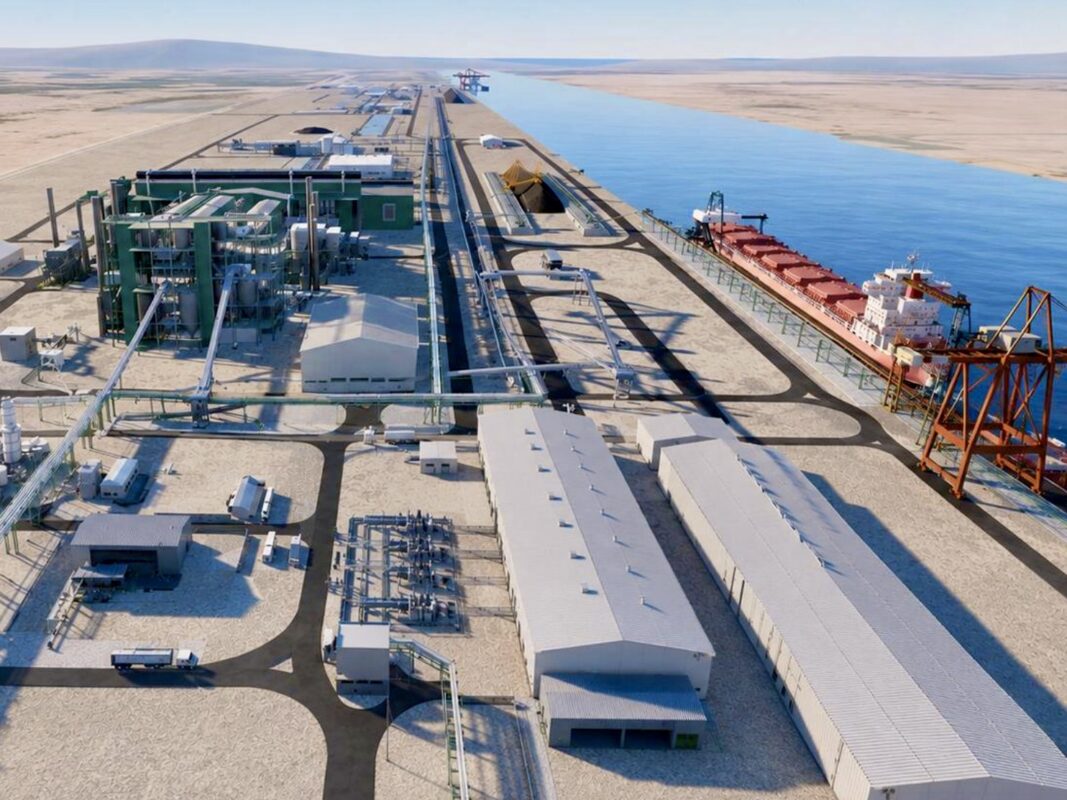
Once the nodules are brought up and loaded on a vessel, they would take an almost three-week trip through the Panama Canal to an industrial park dubbed Nodule City at the Port of Brownsville, where they would be refined into metals used in batteries and raw materials used in steelmaking, then sold commercially.
“It would be the first of its kind,” Yoram Carboex, a deep-sea mining historian formerly with the Norwegian University of Science and Technology, told the Rio Grande Valley Business Journal. While companies and governments have performed mining and processing tests on polymetallic nodules since the 1970s, Carboex said, TMC’s attempt to commercialize them has never been done.
If Nodule City comes to fruition in the coming years, Brownsville would become a key player in the long-dormant but reemerging deep-sea mining industry.
The plan comes as the Trump administration doubles down on deep-sea minerals, which it says it needs to strengthen the domestic critical mineral supply chain and counter China’s influence. Last year, Trump issued an executive order instructing agencies to fast-track deep-sea exploration licenses and commercial recovery permits allowed under federal law and to identify funding opportunities — both of which TMC is involved in.
In regards to the former, TMC submitted a consolidated application for an exploration license and commercial recovery permit earlier this year and expects to have it approved in 2027.
For the latter, TMC said it’s actively engaged in funding processes with various federal agencies. Federal lobbying records from this year show that in the first half of the year, TMC paid $180,000 to lobby the White House, various federal agencies, and the Export-Import Bank of the United States for issues surrounding financing for domestic processing of minerals.
And TMC notes that those processes are key for the onshore project to become a reality. So far, TMC said that it has not made any capital commitments and that future capital spending on the onshore project is contingent on government funding.
Nodule City
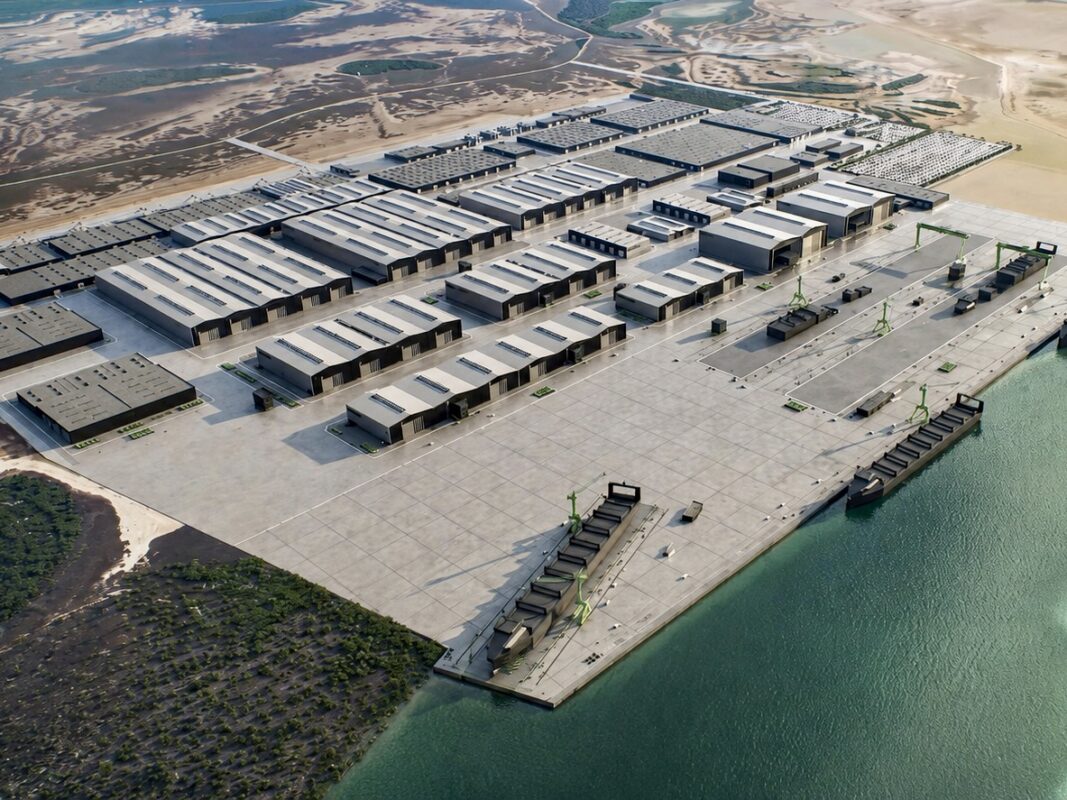
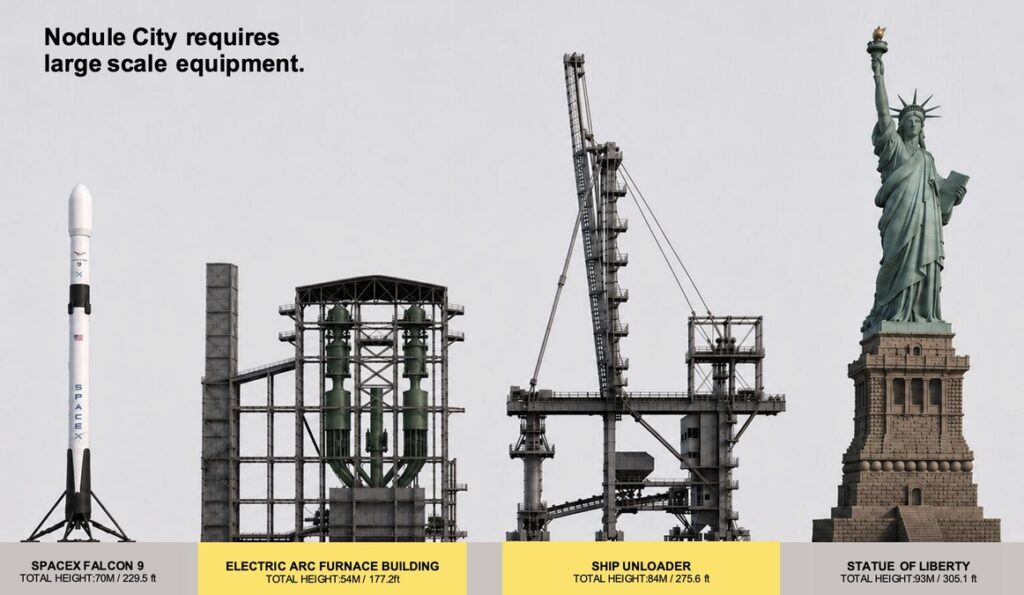
TMC’s vision in Brownsville is an industrial park on 1,466 acres sitting near NextDecade’s LNG terminal and Saronic Technologies’ recently announced Port Alpha, according to a company presentation to investors. The company said earlier this month it has an exclusive right of negotiation on a lease option for the two parcels it’s seeking.
Beyond its own refineries, TMC says the park would be designed “to support other NOAA permit holders and U.S. project developers, providing shared port, materials-handling, utility, and logistics infrastructure to catalyze a reliant domestic supply chain for critical minerals.”
Examples of such critical minerals include those found on polymetallic nodules: cobalt, nickel, copper and manganese, all of which the U.S. currently relies on imports to meet domestic supply, according to federal data.
TMC is also making headway in Brownsville.
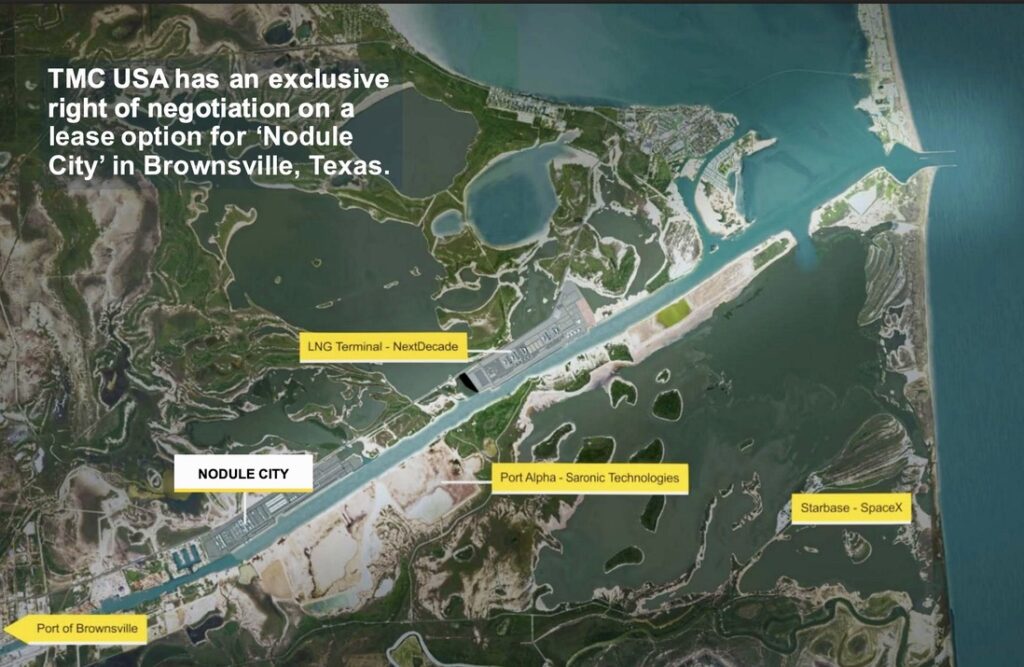
In early August, the company said internal prefeasibility-level engineering for the industry park was near completion and that a separate feasibility-level engineering study for the first smelting stage of the refining process is underway. TMC’s application notes that it expects to have processing capacity in 2028.
On Aug. 5, the five-member Board of Commissioners for the Brownsville Navigation District unanimously approved a memorandum of understanding with TMC and American Electric Power for a Large Load Power Study. According to meeting minutes, the Port of Brownsville will advance the $100,000 initial study fee to American Electric Power, which will later be reimbursed by TMC.
TMC’s consolidated application is accepting public comments until Oct. 19. TMC expects the U.S. National Oceanic and Atmospheric Administration to certify its application in October, but the agency would still need to prepare an environmental impact statement and have another public comment period before the permit is approved.
If no U.S. government funding is obtained, TMC said it has a fallback to initially send nodules to facilities in Japan and Indonesia, with some of the intermediate material later sent to Brownsville.
The Port of Brownsville said in a statement that it could not share any information regarding The Metals Company project due to ongoing negotiations and an NDA established with the company.
TMC did not respond to requests for comment.
Legal questions
While the U.S. is not a member of the International Seabed Authority — a United Nations-backed body of governments that establishes rules for activities in international waters — the country is using a 1980 federal law to allow companies to move forward with deep-sea exploration and commercial recovery plans.
However, the ISA’s Secretary-General expressed concerns last year over TMC’s use of the U.S. law, arguing that it constitutes a violation of international law. The U.S. contends that it’s not part of the international arrangement.
The deep-sea mining historian, Carboex, said that those two different legal systems could lead to situations of international disagreement, but he notes those dynamics are difficult to predict.
Environmental group coalitions have also condemned the company for seeking the U.S. route, calling for a global moratorium or precautionary pause on deep-sea mining before fully understanding the effects on deep-sea habitats.
Carboex noted that pressure from environmental advocacy groups is stronger than in decades prior. While groups in prior decades called for environmental regulations and monitoring, they didn’t outright oppose deep-sea mining, whereas now there’s a greater call for halting operations and greater environmental scrutiny.
While TMC has conducted its own environmental impact review, the federal government will conduct its own during the permit application process.

José Luis Martínez
Reporter
José Luis Martínez is a Houston-based journalist and contributor to the Rio Grande Valley Business Journal. He has previously worked for Law360, the Houston Landing and the Connecticut Mirror, and his work has also appeared in the Texas Observer.
Most Read
- Is SpaceX quietly building a data center at Starbase? Job postings offer clues
- 25 Mexican businesses eye McAllen expansion after city pitches U.S. market entry program
- SpaceX’s futuristic city of Starbase finalizes massive 7,100-acre annexation. Here’s what we know.
- McAllen metro keeps selling more homes as Brownsville-Harlingen market sees 17% drop through August
- Rio Grande LNG moves closer to getting even bigger at Port of Brownsville
Get the latest business news delivered to your inbox every morning for free.
Try 30 Days Free!
Get full access to award-winning journalism covering business, real estate, health care, economic trends, and the people shaping the Rio Grande Valley.
30 Days Free!
$9.95/month
Limited time offer
Subscription renews after your 30 day free trial at $9.95/mo.
Included Benefits
- Unlimited access to all articles
- Daily business news and analysis
- Subscriber-only content and features
Stories That Matter
- South Texas College plans $4.7M makeover of cosmetology, security facilities in McAllen
- Mission’s first Small Business Expo puts $25K on the line for local entrepreneurs
- McCoy’s gives $10K, tools to launch Mid-Valley construction academy
- UT Health RGV performs new digestive procedure for first time in the Valley
- Edinburg ISD rejects nearly $6M offer for prime land near La Sienna despite $15M budget deficit
- TSTC bets on advanced manufacturing to meet RGV’s industrial boom
- McAllen’s nonstop Mexico City flight is back
- Pharr’s cross-border business push earns international recognition
- Brownsville eases drought restrictions after nearly three years as Rio Grande reservoir levels improve
- Texas A&M’s $53.5M McAllen research center will tackle water, food security and Valley health