In March 1972, the mother of a South Texas child noticed a sore on her daughter’s head, tucked in the girl’s hair about four inches above her right ear.
The woman cleaned the wound and rubbed the scab off.
That’s when she saw the worms.
Screwworms. Burrowing around in her daughter’s flesh.
A New World Screwworm fly had apparently come along and landed on the girl’s head, likely finding some sort of small cut that was already there. It lay eggs that would become little wriggling maggots that feasted on the flesh in and around the girl’s wound.
She was later taken to a hospital, not seriously ill, contemporary reporting indicates.
That girl was one of many hosts — sometimes human, but much more common in livestock and wildlife hosts — that screwworms fed upon in Texas before a national eradication campaign cleansed them from the U.S. all the way down to Panama.
For decades, the U.S. has been largely free of the threat of screwworms — so much so that few people in the Rio Grande Valley have paid it any mind lately.
Until now.
Screwworms have for years been slowly creeping back through Central America and Mexico, cropping up as close as 70 miles from the Texas border. That prompted Gov. Greg Abbott to issue a disaster declaration to prevent the spread of the pest on Jan. 29.
The U.S. Department of Agriculture estimates screwworm could cost Texas cattle producers $732 million and the Texas economy $1.8 billion per year.
Cattle industry organizations predict screwworm infestations that go beyond Texas’ borders could cost the economy over $10 billion.
At least 11 cases of screwworms have been detected in the Mexican border state of Tamaulipas since late December, a growing number that’s increasingly caused officials and people in the cattle industry to view screwworms reappearing in Texas as a question of when, rather than if.
Texas Agriculture Commissioner Sid Miller called a Texas screwworm infestation “inevitable” in an interview last month.”
“They’re here,” he said. “It’s upsetting that this is happening in the winter months when that fly activity is supposed to be less active. This tells me that, you know, farmers and ranchers and pet owners, people in the wildlife business, you better get ready — cause it’s coming.”
That news leaves Texas cattle raisers with a central question: what will the screwworm look like when it gets here?
A smell you won’t forget
Longtime McCook cowman Robert Kotzur knows how screwworms look — though appearances aren’t the first thing that comes to mind when he and others familiar with screwworms think about them.
Courtesy of | USDA
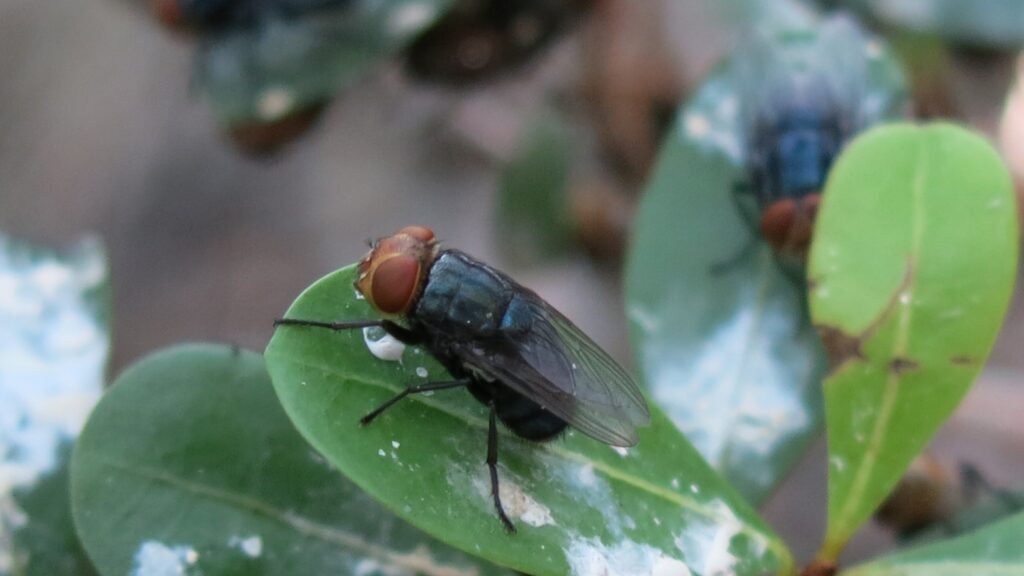
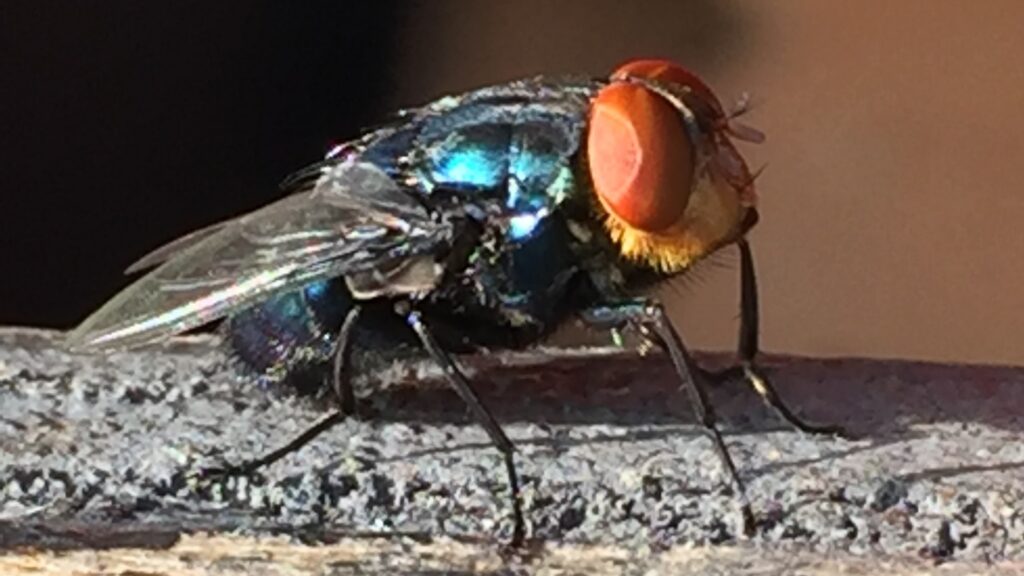
As a mature fly, the screwworm sports three black stripes on its back, bulbous orange eyes and an iridescent blue-green body.
In its larval stage it’s little different than any other maggot: mealy white, less than an inch long. Its defining feature, a protruding spiral spine that gives it the first part of its scientific name: cohcliomya hominivorax, the “spiral shelled maneater.”
The maneating part gives the pest its reputation and leads to the smell.
Few people talk about how a screwworm looks, but they all talk about how it smells.
They talk about carrion. Rot. Death. Decay.
A cow with a screwworm infestation looks like it’s fused with a piece of roadkill, the corruption and the worms and the stink slowly spreading through its hide from what might have been a minor wound.
The fly lays its worms in any sort of cut, and within a day those eggs hatch into maggots with tusk-like mandibles, feeding at the tissue and mortifying the corpse of a living animal.
Kotzur places the scent one step better than the smell of a rotting carcass.
He remembers in the early 1970s, when he was in high school, that he would go to school half a day and come home for lunch before mounting a horse and checking cows out north of Edinburg.
That’s when, sometimes, they’d find the maggots.
If Kotzur and his brother found a cow with screwworms, they’d try to pen it up, or at least rope it and pin it down. Then they’d flush the infected wound with a solution, waiting for the dead maggots to bubble up out of the hole, before applying a salve.
“It’s a smell you won’t forget,” he said.
A misconception about screwworms is that they need a large, gaping wound to infest. That’s not true.
Naval infestations on newborn cows are particularly common. Small cuts can be infested, along with wounds from dehorned or branded cattle.
Kotzur remembers finding screwworms in cows’ gums. Apparently, they’d licked an infested wound and spread the worms to their mouths.
Sometimes, he says, ticks would feed on the ears of cattle. He says that would draw the flies, fecund with eggs.
“That was a stinky, nasty job, doing that,” he said. “Because that whole ear would be inflamed and it was pretty much rotten stuff in there. It’d be oozing liquid and everything else. You couldn’t really hold them down too well, you’d just keep spraying medicine in there until no live ones came out.”
If it didn’t heal deformed, a treated cow’s ear would look more or less the same afterward. Sometimes there would only be half an ear left.
Kotzur, who still works cattle, doesn’t remember any fatalities related to screwworms on his family’s spread. In fact, he kind of enjoyed cowboying during the screwworm days.
But he still owns cows and he’s not looking forward to a repeat experience.
“Well,” Kotzur says with a half-chuckle, “It took some work.”
A forgotten fight
Entomologist Sonja Swiger is the rare type of person who’s partial to blowflies and will defend the reputation of maggots — she sees the ecological role they play.
There was one particular blowfly, however, that Swiger learned about from textbooks during her grad school days she dreaded to encounter: the screwworm.

“I thought that I would never want to deal with this. Ever,” she said. “It’s grotesque.”
It doesn’t look like Swiger will get her wish.
As Texas A&M’s only extension livestock entomologist, she’s increasingly spending her time driving across the state educating people on screwworms.
Swiger has been working with the extension for 17 years. Before 2025, she had given a total of three presentations that mentioned screwworms.
Last year she gave 78.
“It’s literally taken over my life,” she said.
Swiger has never seen a live screwworm.
When she went to graduate school in the early 2000s, she read about the parasite in textbooks. Occasionally she would hear from an American scientist who worked with the Panama facility, but that was rare.
Firsthand knowledge of screwworms in Texas has become less and less common, which Swiger says likely puts Texas on the backfoot.
“We’ve not had the ability to do research with this fly or on this fly for a long time because of its absence from this country and its regulations. So it does put us at a disadvantage,” she said.
Screwworms haven’t been a focus for Texas or its agriculture industry because they haven’t threatened the state in almost three decades.
In the 1950s, screwworms were a well-established pest in the U.S., wreaking tens of millions of dollars worth of damage in the cattle industry every year.
But then, two USDA entomologists came up with a novel idea to eradicate them.
The female screwworm flies only mate once. If you bred a whole lot of screwworm flies and sterilized the males, the entomologists thought, you could flood an area with them. Those sterile flies would theoretically compete with their wild-born peers so successfully that they would prompt a population collapse.
The theory proved wildly successful in practice.
After a few test runs, the government began dumping sterile screwworm flies from airplanes by the tens of millions across the southern U.S., shifting efforts south as the pest was eliminated.
Courtesy of | U.S. Department of Agriculture
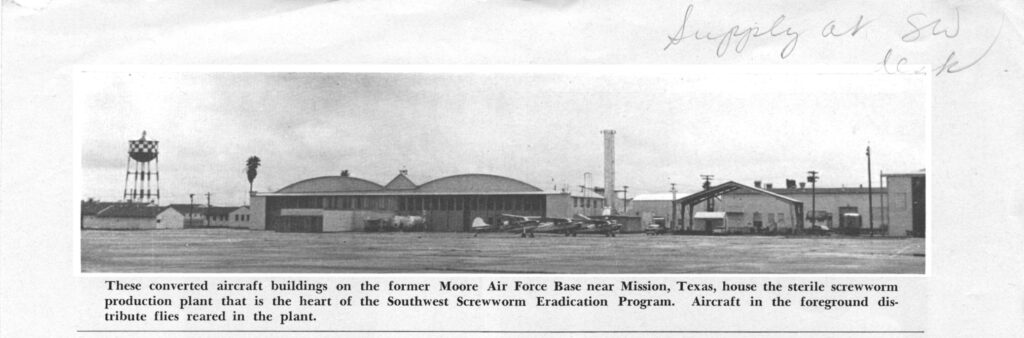
By the 1960s, the government opened a new facility at Moore Air Base, which sits just northwest of Mission. The base would become the epicenter of the fight against screwworms until the 1980s.
By 1986, the U.S. had been screwworm-free for four years and numbers in Mexico had decreased so much that efforts began to focus on Central America.
A dispersal facility in Panama is as far south as eradication efforts got.
It’s the only operational facility in North America, dispersing about 100 million sterile flies per week.
Despite those efforts, in 2021, screwworm infestations breached the Darien Gap in Panama, gnawing gradually northward before finally winding up on Texas’ doorstep.
Swiger said Texas likely erred by not retaining knowledge it garnered from fighting screwworms for decades in its own backyard.
“We have very few experts still alive who dealt with this fly or are willing to talk about it,” she said.
Advantages and uncertainty
Texas has a couple advantages in its potential fight against screwworms.
The main one is that the sterile fly technique that eliminated screwworms from Texas decades ago still works, and there’s still some infrastructure in place that deploys it.
Courtesy of | USDA
The USDA announced in early February that it will begin releasing sterile flies from the Panama facility in northern Mexico and southern Texas.
In addition to the Panama facility, there’s a $21 million ongoing renovation at a facility in Metapa, Mexico. That facility should begin producing between 60 and 100 million sterile flies as early as this summer.
A third facility will be closer to home.
The USDA is planning for the construction of another sterile fly production facility at Moore Field near Mission.
When complete, that one is slated to produce 300 million sterile flies per week.
The USDA announced Friday that it’s shifted the dispersal of the 100 million sterile flies it can produce to the Texas-Mexico border.
“We’ll have the resources. We’ll find a way,” Swiger said. “It just takes a lot of work on the part of the humans to control this fly. It’s just something that has to be managed.”
That doesn’t mean an outbreak would be easy, and managing the flies is a worry for South Texas ranchers.
“If I had to put it one way, there’s a lot of uncertainty in the ranching community,” Hidalgo County Farm Bureau President Isaac Sulemana said. “We are confident that we’ve had to deal with this before and we were successful, but we’re unsure of how modern management practices are going to allow us to address this.”
The cattle industry is a dominant economic force in Texas with a $15 billion-plus economic impact.
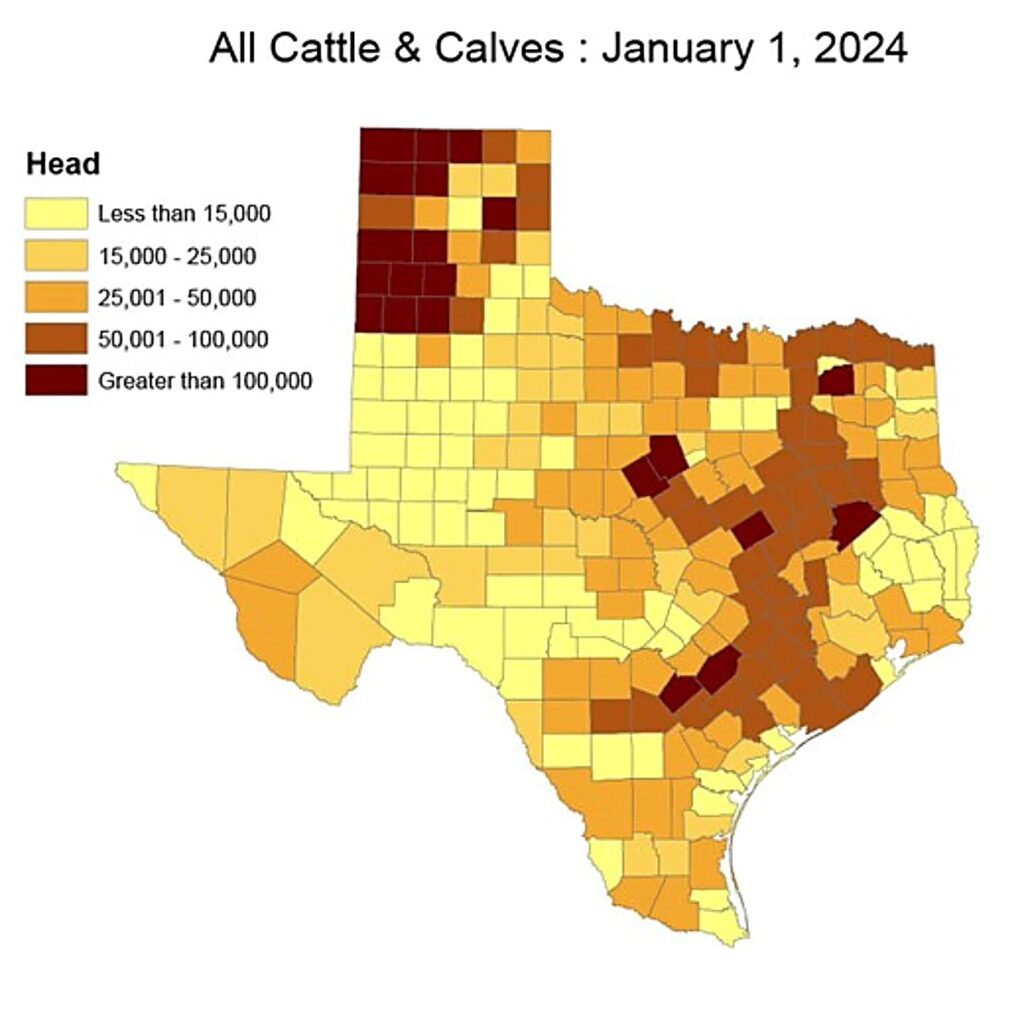
According to the USDA, there’s between 50,000 and 100,000 head of cattle in Hidalgo and Starr counties. Cameron and Willacy counties have less than 15,000 each.
Sulemana says South Texans who run cattle in that area have a small advantage: they’re used to dealing with fever tick quarantines.
“So we have a little more handling capacity. We’re used to quarantines, we’re used to coordinating with state and federal authorities, but we don’t know how intensive this would be,” he said.
Swiger says a year ago she was optimistic about Texas’ response to screwworms.
She’s less optimistic now.
“It will definitely be bad before it gets good. And that’s an unfortunate reality,” Swiger said.

Matt Wilson
Reporter
Most Read
- SpaceX’s futuristic city of Starbase finalizes massive 7,100-acre annexation. Here’s what we know.
- SpaceX reschedules Starship’s first flight around the Earth
- How much water does SpaceX need to operate near Brownsville? Nearly 20x its current use
- Could apartment-to-condo conversion help make $100K homeownership in the McAllen metro more affordable? One investor says yes.
- Crunch Fitness is expanding and struggling in the Valley. Here’s why
Get the latest business news delivered to your inbox every morning for free.
Try 30 Days Free!
Get full access to award-winning journalism covering business, real estate, health care, economic trends, and the people shaping the Rio Grande Valley.
30 Days Free!
$9.95/month
Limited time offer
Subscription renews after your 30 day free trial at $9.95/mo.
Included Benefits
- Unlimited access to all articles
- Daily business news and analysis
- Subscriber-only content and features
Stories That Matter
- Tamaulipas is rethinking how it sells its cattle. A $44.5M project would keep more of the business at home
- Brownsville is changing its drainage fee. Businesses could pay more as the city looks to raise $6.2M a year
- Mission’s first Small Business Expo puts $25K on the line for local entrepreneurs
- Reynosa’s newest technical high school focuses on AI, semiconductors and bionics
- McCoy’s gives $10K, tools to launch Mid-Valley construction academy
- UT Health RGV performs new digestive procedure for first time in the Valley
- TSTC bets on advanced manufacturing to meet RGV’s industrial boom
- Pharr’s cross-border business push earns international recognition
- Brownsville eases drought restrictions after nearly three years as Rio Grande reservoir levels improve
- Texas A&M’s $53.5M McAllen research center will tackle water, food security and Valley health