The future competition for young professionals along the U.S.-Mexico border may not be another job candidate.
“The competition is no longer going to be another human being. It will be a computer or an artificial intelligence system,” Abraham Walter Rico Murrieta, a senior manager of foreign trade and legal representative of LG Electronics Reynosa, told the Rio Grande Valley Business Journal.
Industry, trade and academic leaders across the border region say artificial intelligence is no longer theoretical. It is actively reshaping hiring expectations, workforce training and classroom instruction on both sides of the Rio Grande.
More preparation, less margin for error
Rico said the structural shift has been building for years as manufacturers anticipated automation would replace certain operational roles while creating demand for higher-skilled positions in programming, analytics, maintenance and systems operations.
“The more prepared you are, the more knowledge and skills you have, the greater your ability to move forward. Otherwise, unemployment is coming,” he said.
He added that many students do not fully understand the speed of change.
“They still cannot visualize how complicated the future ahead of them will be,” he said.
Manufacturing employers are now prioritizing digital literacy and technical specialization. Automation, Rico said, is forcing educational institutions to align programs more closely with industry needs.
Colleges respond with applied AI training
At South Texas College, administrators say artificial intelligence is already embedded in workforce development programs.
“Artificial intelligence is on everyone’s lips, but there is still a lot of misunderstanding about how to really use it and how to take advantage of it in daily work,” Carlos Martínez, a training specialist at the Center of Advanced Training & Apprenticeship at STC, said.
Martínez said the challenge is not awareness but application.

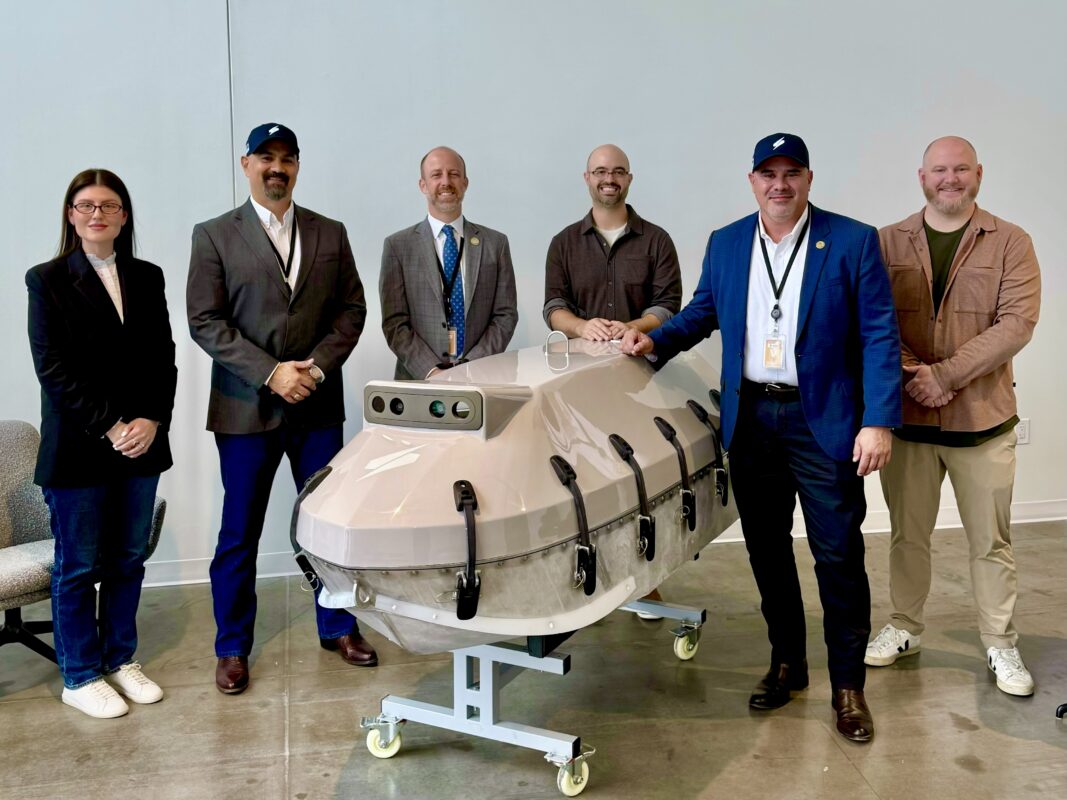
Photo Credit | Anayancy Ulloa
“AI is not used the same way in manufacturing as it is in cybersecurity or administrative areas,” he said. “The key is understanding how to integrate it to make processes more efficient, not to see it as a substitute for human talent.”
To meet growing demand, STC launched a community course, “Essentials of AI,” through its Continuing Education & Workforce Development division.
“Today, virtually all industries are interested in artificial intelligence because it is a tool that helps improve processes, automate tasks and work more efficiently,” said Irma Rosales, project training specialist at the Center of Advanced Training & Apprenticeship.
She said the goal is to make AI practical and accessible for workers without technical backgrounds.
“It’s not just about knowing what artificial intelligence is, but learning how it can be applied in different work environments and in businesses of all sizes,” Rosales said.
Educators face their own learning curve
Across the border in Mexico, faculty at the Instituto Tecnológico de Matamoros are also undergoing formal training.
Felipe Flores Gloria, director of planning and outreach at the institution, said the Tecnológico Nacional de México has implemented phased instruction — first online, then in person — to prepare professors to integrate AI tools into coursework.
“We have to prepare ourselves so our young people graduate with that level of competitiveness,” he said.
Workshops now focus on AI-assisted lesson design, project development and grading tools.
Flores Gloria said one of the biggest challenges is learning how to communicate effectively with AI systems.
“The most complicated part is the famous prompt — knowing exactly what you want to do with artificial intelligence,” he said.
Faculty members are using a range of tools for text generation, design and evaluation. But the rise of AI has introduced new academic concerns.
“They are turning in very complete assignments, but the question is: Did they read it? Did they understand it?” Flores Gloria said.
He said institutions must balance tool usage with actual learning outcomes, particularly as students often adapt to technology faster than instructors.
Productivity gaps widen
Flores Gloria said the strategic use of AI is already creating measurable differences in output.
“A student who uses artificial intelligence can develop a project in two hours; another who does it the traditional way may take days. Who is the company going to prefer?” he said.
Rather than restricting the technology, he argued, schools must teach students how to use it responsibly and effectively.
Trade sector: AI becomes operational requirement
In the customs and logistics sector, artificial intelligence is also moving from optional to essential.

“Agencies will have to function as a more robust filter, delivering more precise, structured and efficient information,” said Jorge Torres, president of Interlink Trade Services.
Torres said regulatory complexity and U.S. compliance requirements are accelerating adoption.
The company is testing pilot programs aimed at reducing manual processing.
“The idea is to reduce the manual operational burden so staff can focus on higher value-added tasks,” he said.
Still, he emphasized that human expertise remains critical.
“We will still need people who understand regulations, the law and who have analytical capacity. A computer cannot replace that,” Torres said.
Interlink maintains partnerships with STC, Texas A&M University and The University of Texas Rio Grande Valley to help prepare students for a workforce increasingly shaped by automation and regulatory oversight.
A regional competitiveness test
Across manufacturing plants, classrooms and customs offices, leaders describe the same transition.
Artificial intelligence is not eliminating the need for workers.
But it is redefining what skills are required.
In the Reynosa–Matamoros border region — where manufacturing, trade and logistics drive economic output — competitiveness may depend less on labor volume and more on how effectively workers integrate AI into daily operations.
The competition, leaders say, is no longer only between people.
It is between people who understand how to use technology — and those who do not.

Anayancy Ulloa
Reporter
Most Read
- How much water does SpaceX need to operate near Brownsville? Nearly 20x its current use
- Could apartment-to-condo conversion help make $100K homeownership in the McAllen metro more affordable? One investor says yes.
- SpaceX’s futuristic city of Starbase finalizes massive 7,100-acre annexation. Here’s what we know.
- Cameron County is negotiating a $20M Fluidstack data center donation after Harlingen waffles on the same offer
- Fluidstack breaks ground on $4 billion Cameron County AI data center
Get the latest business news delivered to your inbox every morning for free.
Try 30 Days Free!
Get full access to award-winning journalism covering business, real estate, health care, economic trends, and the people shaping the Rio Grande Valley.
30 Days Free!
$9.95/month
Limited time offer
Subscription renews after your 30 day free trial at $9.95/mo.
Included Benefits
- Unlimited access to all articles
- Daily business news and analysis
- Subscriber-only content and features
Stories That Matter
- SpaceX bought some water rights from the Rio Grande River. Here’s what we know.
- Foreign-Trade Zone No. 12 expands into Willacy County
- Mission’s first Small Business Expo puts $25K on the line for local entrepreneurs
- Reynosa’s newest technical high school focuses on AI, semiconductors and bionics
- McCoy’s gives $10K, tools to launch Mid-Valley construction academy
- UT Health RGV performs new digestive procedure for first time in the Valley
- TSTC bets on advanced manufacturing to meet RGV’s industrial boom
- Pharr’s cross-border business push earns international recognition
- Brownsville eases drought restrictions after nearly three years as Rio Grande reservoir levels improve
- Texas A&M’s $53.5M McAllen research center will tackle water, food security and Valley health