Foreign trade between Mexico and the United States did not stall in 2025 after new U.S. tariffs took effect — but it did fundamentally change how business moves across the border.
Customs operators say trade adjusted toward fewer border crossings, heavier regulatory requirements, and higher-value transactions, a shift driven largely by tariffs imposed under Section 232 of the U.S. Trade Expansion Act and stricter compliance enforcement.

“Volumes or the number of operations may have declined, but value increased,” said Jorge Torres, president of Interlink Trade Services. “There are fewer crossings, but larger transactions.”
Torres has more than three decades of experience in foreign trade. Interlink Trade Services operates logistics facilities in the Rio Grande Valley, with warehouses in McAllen, Pharr, and Brownsville, and handles customs clearance at all U.S. ports of entry.
This story examines how border trade adapted to tariffs in 2025, what official customs data show about transaction volume and value, and how companies in regions such as Reynosa and Matamoros are preparing for tighter oversight and the 2026 review of the U.S.-Mexico-Canada Agreement.
A structural shift, not a collapse
The changes became more visible beginning in March and April, following the rollout of new tariffs affecting steel, aluminum, and certain automotive products. While the measures increased costs, Torres said they did not produce a generalized downturn in trade activity.
Instead, they reshaped it.
“Before, it was one tariff classification per product; now you can have up to five tariff classifications, plus additional breakdowns,” he said.
Those changes have been compounded by stricter documentation requirements related to country of origin, steel and aluminum content, and data on metal smelting and pouring — adding layers of complexity to every transaction
A learning curve at the border
Torres said bottlenecks and delays marked the first months after the tariffs were changed as companies adjusted to the new rules.
“At the beginning, there were many bottlenecks and variations, but as companies better understood the requirements and integrated systems, processes became more streamlined,” he said.
Even with those improvements, Torres emphasized that foreign trade operations in 2025 remain significantly different from 2024, with higher administrative burdens and a sharper focus on regulatory compliance.
What the data show
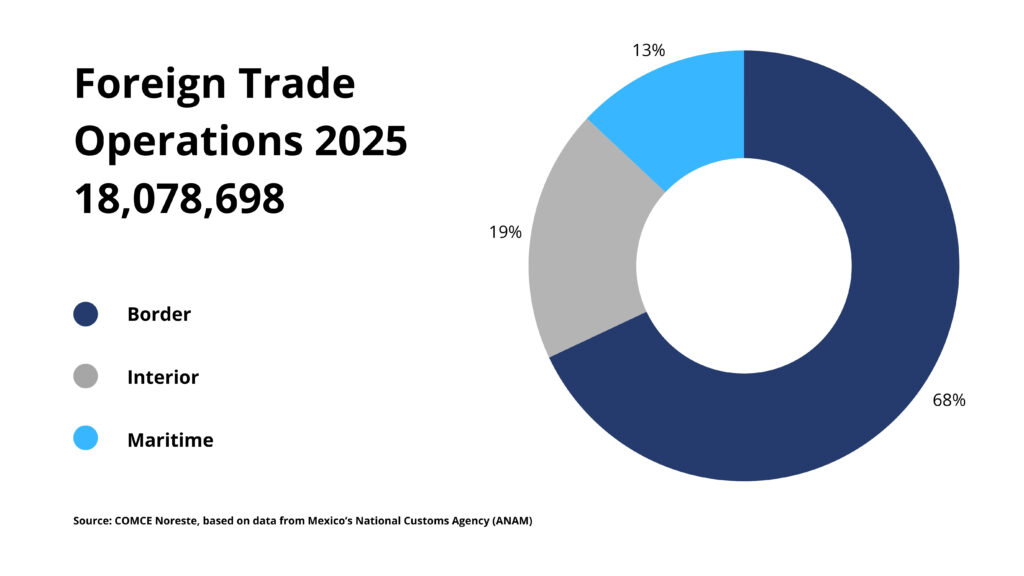
Official figures support the industry’s assessment.
Data published by COMCE Noreste, based on Mexico’s National Customs Agency, show that from January through October 2025, the country’s 50 customs offices processed 18.1 million foreign trade operations — a decline of between 1.5% and 2.3% compared with the same period in 2024.
Border customs accounted for 68% of operations, inland customs 19%, and maritime ports 13%.
At the same time, total customs revenue reached 1.2 trillion pesos — about $70.6 billion — a 20.7% increase year over year. The rise reflects higher average transaction values and more intensive monitoring rather than higher volume.
“It’s not that trade has fallen; what changed is the structure,” Torres said. “There are fewer crossings, but larger, more complex, and higher-value transactions.”
Compliance becomes strategic
Looking ahead to 2026, Torres expects tariffs and heightened oversight to remain in place, alongside ongoing U.S. negotiations with other countries and the scheduled USMCA review.
In that environment, customs compliance has moved from an operational concern to a strategic one, he said.
“Audits and reviews have increased. Failing to comply properly can lead to fines, penalties, and lost opportunities,” Torres said.
For border manufacturing hubs such as Reynosa and Matamoros, the shift also presents an opportunity — particularly for companies that strengthen binational coordination and adapt to more complex logistics requirements.
Preparing for the USMCA review
Beyond tariffs, the most consequential change on the horizon is the USMCA review scheduled for 2026, said Flor Torres Álvarez, a foreign trade and customs specialist and founding partner of CIC World Trade Services, S.C.
She said early signs of increased pressure are already emerging.

“Companies cannot wait for the formal review to begin. Clear signs of increased pressure on rules of origin, customs compliance, traceability, and labor and environmental obligations are already emerging,” she said.
The review, she warned, could reshape North American production chains, particularly amid rising protectionist pressures and stricter oversight.
Torres said the process is already pushing companies to rethink sourcing strategies, including relocating suppliers within North America — and in some cases within the United States — to meet rules-of-origin requirements and reduce logistical risk.
Álvarez said one of the primary risks is a reduction or suspension of preferential trade benefits, which would trigger immediate tariffs and higher costs in sectors such as automotive manufacturing, steel, advanced manufacturing, and logistics.
“Greater documentary requirements are expected to prove regional content, increasing operational complexity and the risk of noncompliance,” she said.
She added that IMMEX companies will face stricter expectations in 2025 and 2026 to demonstrate real operations, verifiable production processes, and complete documentation.
“It’s not just about producing or exporting, but about being able to demonstrate, with clear and verifiable information, the origin, compliance, and legality of every transaction,” she said.
Supply chains adjust
Tariffs and regulatory shifts have also forced companies to redesign supply chains, said Jorge Antonio Chico Martínez, commercial manager at Global FWD International, a logistics and foreign trade firm with operations in Reynosa.
Beyond higher costs, Chico said uncertainty has been the biggest challenge.

“Operating the way we used to is no longer viable. The entire logistics chain has to be reassessed because scenarios change quickly and risks are greater,” he said.
As a result, smaller, urgent shipments have declined, replaced by more consolidated movements.
“There is more consolidation. That raises the value per transaction, but lowers the volume of crossings,” Chico said.
He said the trend reflects a broader global shift toward nearshoring and regional suppliers.
“Having closer, reliable suppliers with lower logistical risk is a real advantage today,” he said.
Export value continues to rise
Despite fewer operations, export values continue to grow.
Data from Mexico’s National Institute of Statistics and Geography show exports from Mexican states rose 9.2% year over year in the third quarter of 2025, reaching $152.6 billion.
Chihuahua, Coahuila, Nuevo León, Baja California, Jalisco, and Tamaulipas accounted for 64.8% of total exports, underscoring that the trade adjustment has been structural — not a decline in economic output.
For border regions such as Reynosa and Matamoros, the outcome will depend on whether companies can turn stricter compliance and higher transaction value into long-term competitive advantage.

Anayancy Ulloa
Reporter
Most Read
- SpaceX is giving Brownsville $220M for water projects. In exchange, the city gave up zoning control of 444 acres near Starbase
- SpaceX seeks to take zoning control over nearly 450 acres from city of Brownsville as a ‘regional’ water deal takes shape
- Port of Brownsville could soon host Nodule City, a first-of-its-kind commercial deep-sea mining hub
- Cameron County is negotiating a $20M Fluidstack data center donation after Harlingen waffles on the same offer
- How much water does SpaceX need to operate near Brownsville? Nearly 20x its current use
Get the latest business news delivered to your inbox every morning for free.
Try 30 Days Free!
Get full access to award-winning journalism covering business, real estate, health care, economic trends, and the people shaping the Rio Grande Valley.
30 Days Free!
$9.95/month
Limited time offer
Subscription renews after your 30 day free trial at $9.95/mo.
Included Benefits
- Unlimited access to all articles
- Daily business news and analysis
- Subscriber-only content and features
Stories That Matter
- McAllen’s $204M water investment expects to seek construction bids in 2027
- Saronic lands Navy landing craft contract, first build at Brownsville’s Port Alpha
- The Rio Grande Valley’s tech industry is small but growing — meet some of the next-gen workforce
- Entrepreneurs enter Mission EDC’s ‘Shark Tank’ competition for $25K top prize
- Mission’s first Small Business Expo puts $25K on the line for local entrepreneurs
- Reynosa’s newest technical high school focuses on AI, semiconductors and bionics
- McCoy’s gives $10K, tools to launch Mid-Valley construction academy
- UT Health RGV performs new digestive procedure for first time in the Valley
- TSTC bets on advanced manufacturing to meet RGV’s industrial boom
- SpaceX reschedules Starship’s first flight around the Earth