The Point Isabel Independent School District board voted unanimously on Tuesday to grant $228 million in economic incentives, including property tax relief, to Saronic Technologies, which is proposing a $3.2 billion shipbuilding hub inside the Port of Brownsville that could create 10,000 jobs.
Without the abatement, Saronic would pay an estimated $517 million in school district property taxes through 2034.
But the deal was good for the community, especially students, Point Isabel Board President Heather Scott said.

Photo Credit | Kristen Mosbrucker-Garza
“What was presented was a very unique opportunity that has the potential to transform this region, not only for our students, our community, the state, the region as a whole,” Scott said. “Our hope is that we can partner with Saronic to help our students be better prepared for jobs in that industry, and then also everyone in the region. I think it’s a game-changer.”
The shipbuilder is eyeing the south side of the Brownsville Ship Channel, with plans to expand in four phases. The site would be located roughly between NextDecade’s Rio Grande LNG export terminal and SpaceX’s rocket building and launch site at Starbase near Boca Chica Beach.
The first phase of the shipyard would involve a 680-acre lease with the port, with the potential to lease 4,300 acres across the four phases of expansion.
Here’s how the phase-in project would break down:
- Phase 1: $788 million and 1,771 jobs
- Phase 2: $1.3 billion and 3,591 jobs
- Phase 3: $862 million and 3,214 jobs
- Phase 4: $281 million and 1,424 jobs
The types of jobs created would include steel fabrication and welding, panel assembly, hull erection, machinery installation, and vessel launches.
The company is also seeking a similar tax abatement deal with Cameron County. That incentive deal is up for a vote on March 24.
Saronic’s rapid growth
Saronic Technologies was founded in Austin in 2022 as a defense industry technology startup.
Since then, the company has raised more than $845 million from dozens of investors. Its biggest financing round closed in 2025, with a total of $600 million raised.
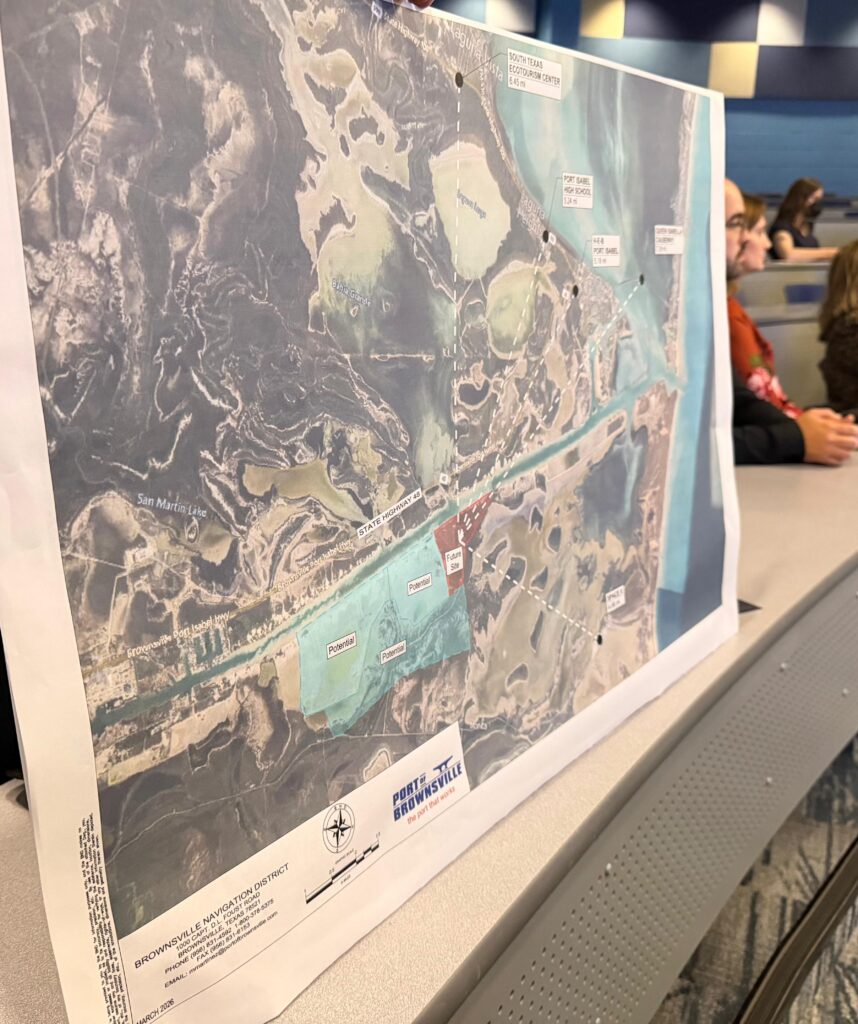
Photo Credit | Kristen Mosbrucker-Garza
“We’ve raised a lot of capital where we have the ability to mobilize that capital in a way that impacts communities like Brownsville, but more importantly, we’re not SpaceX. We don’t have an unlimited budget,” Doug Lambert, co-founder and chief operating officer of Saronic, told board members at Tuesday’s meeting.
The Donald Trump administration’s Big Beautiful Bill included billions for autonomous naval defense technology — including $2.1 billion for medium-sized unmanned surface vessels, $1.7 billion for workforce development for shipbuilding, and $1.3 billion for the expansion of unmanned vehicle production.
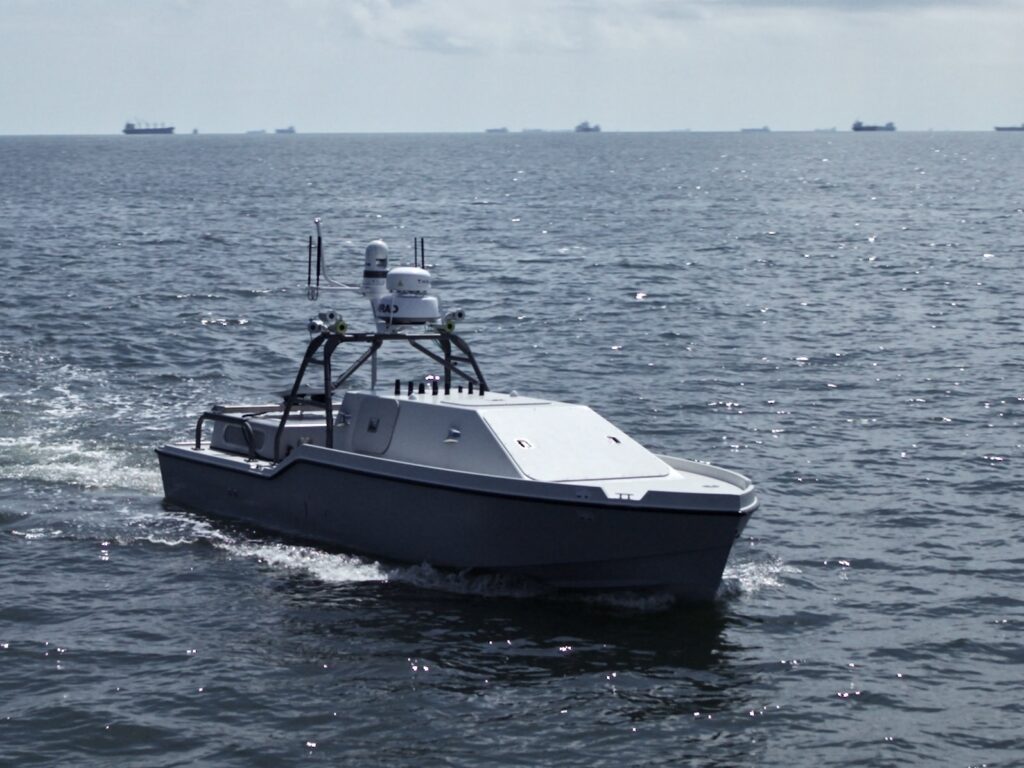
Last year, the U.S. Navy awarded the company a $394 million contract to produce autonomous surface vessels — or drone boats that can maneuver through the ocean on a mission without human intervention — by 2031.
The Navy contract is for its Corsair drone boat, which is 24 feet long and can carry 1,000 pounds for more than 1,000 nautical miles. The U.S. Navy secretary boasted that the Corsair was developed from prototype to production in less than a year, which is a significantly faster cycle than the defense industry standard.
Courtesy of | Saronic Technologies
Saronic blends technology with manufacturing vessels, which have historically relied on ship captains. Instead, the vessels rely on cameras, radar, and computer programming models.
“Today, if you look at large ships, they spend a lot of time in the dry docks. And the reason for that is that there’s so many different analog components with high failure rates,” Saronic Chief Technology Officer Vibhav Altekar said. “The focus of our software is to make sure that a human operator can understand when a particular system is about to fail before it actually fails.”
Building autonomous vessels that navigate open-ocean waters is especially challenging, as there are no cell phone towers and even satellite internet access is limited. The saltwater interrupts antenna signals, company officials said.
Competition continues for Port Alpha site
Saronic was considering more than a dozen sites for Port Alpha, Port of Brownsville CEO William Dietrich said.
“We have got to take into consideration that when these projects come in, we’re competing with numerous states,” Dietrich said.
The company’s economic incentives application indicates it’s looking at sites in Texas, California, and Virginia. The company had initially also considered Louisiana, but it was not a finalist for Port Alpha, the application indicated.
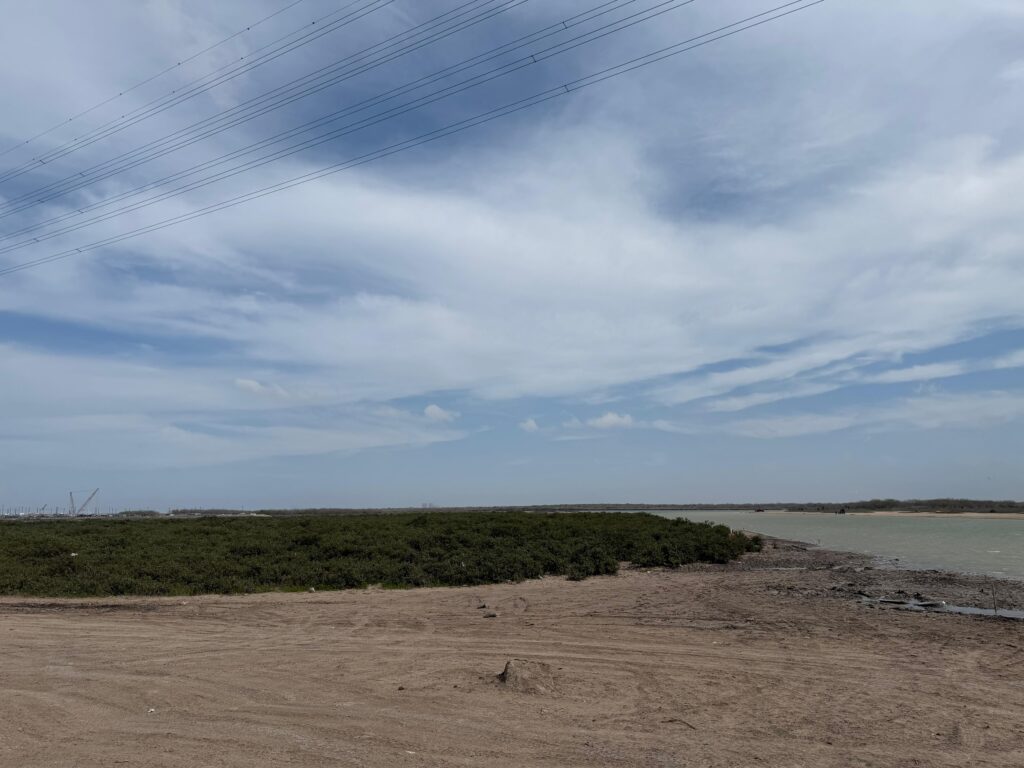
Photo Credit | Kristen Mosbrucker-Garza
“From my understanding, we were competing with 15 other sites, so incentives have everything to do with it,” Dietrich said. “I really want to commend Point Isabel; this is a generational decision they made.”
The port has been working on the deal for the past nine months, which is an accelerated timeline compared to other projects.
“Saronic is a very fast-moving company,” Dietrich said. “It usually takes years for something like this to happen.”
In December, Saronic announced plans to acquire a Louisiana shipyard for $300 million to build its autonomous surface vessels, known as Marauders, which are 180 feet long and can travel up to 5,400 nautical miles either autonomously or remotely. The Louisiana facility “complements Saronic’s plans for Port Alpha,” according to a company blogpost.
The Louisiana site began manufacturing with about two dozen workers and now employs more than 200 people, according to the company.
“This gives us an opportunity to really try out some of these advanced manufacturing techniques in a smaller scenario to then bring them to an opportunity like Brownsville to build larger and larger and Panamax-sized ships in a way that is kind of novel to the United States to really reindustrialize the maritime industry,” Lambert said about how the Louisiana site would compliment its Port Alpha project.
Building the shipyard workforce
Saronic said it’s been working on upskilling the workforce who may have experience building the last generation of vessels.
The average annual wage for the Brownsville project is expected to be about $75,500, according to the company’s application.
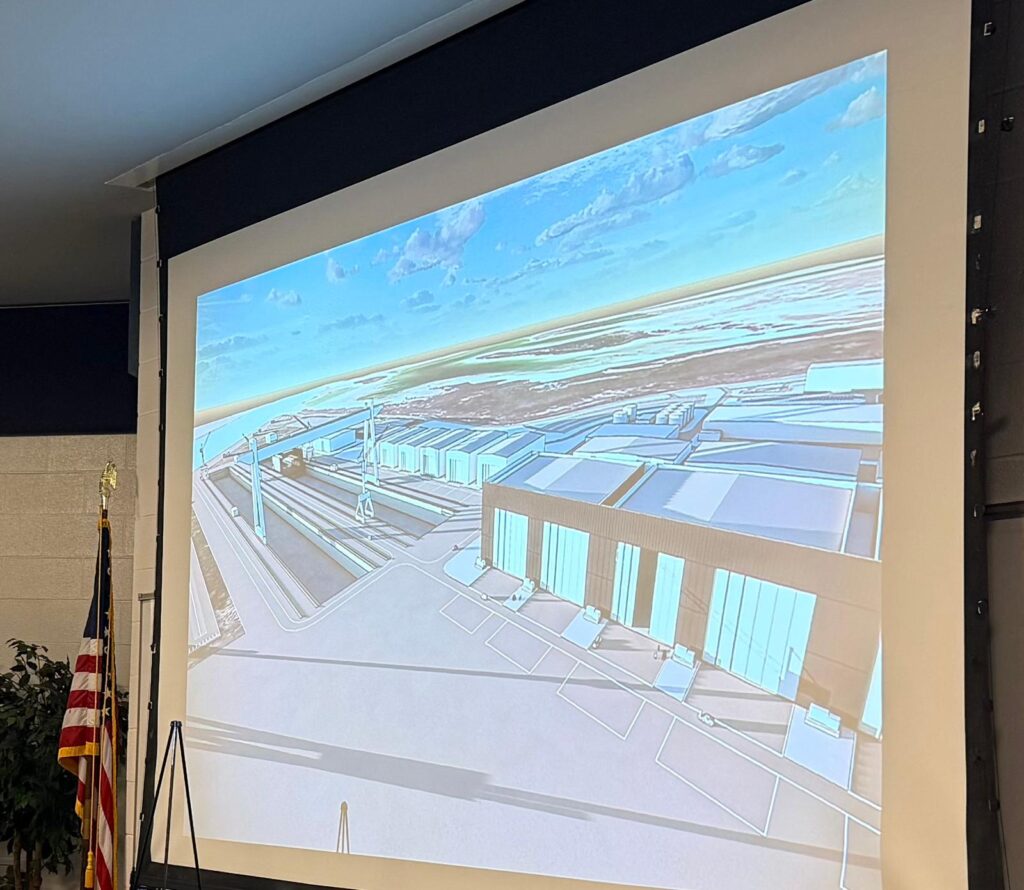
Photo Credit | Kristen Mosbrucker-Garza
“We have welders who are becoming engineers, we have technicians who are growing in their careers and performance. And that’s something that’s incredibly important to Saronic, and we have a robust kind of jobs skill training pipeline that we’ve been prototyping here in Louisiana, and we could potentially bring here to Texas,” Lambert said.
Saronic touted that its employees are eligible for company stock and that it has plans for services in the commercial market to avoid reliance on defense industry contracts.
It’s already started hiring employees for Port Alpha in Austin, who are expected to relocate to the new port location in the coming months after a site is selected.
But there was some opposition to the proposal.
“The United States seems to have infinite money to invest in weapons of war and destroying human life and human dignity. So, I’m perplexed as to why they think they need to take tax money away from schools for our children to be educated,” Dr. Christopher Basaldú, co-founder of the South Texas Environmental Justice Network, told board members Tuesday. “I ask the board to vote no on this tax [abatement] so that any industry that comes to this area pays their fair share in their operations here because, if they are successful, they will create a lot of wealth for themselves, their investors.”

Kristen Mosbrucker-Garza
Reporter
Kristen Mosbrucker-Garza is a versatile multimedia news reporter who lives and works along the Texas-Mexico border in Hidalgo County. Mosbrucker-Garza is a news reporter for the Rio Grande Valley Business Journal. During her career she's worked for the McAllen Monitor, San Antonio Business Journal, The Advocate Newspaper in Louisiana, Phoenix New Times, and public media outlets in Baltimore and Philadelphia.
Most Read
- SpaceX’s futuristic city of Starbase finalizes massive 7,100-acre annexation. Here’s what we know.
- SpaceX reschedules Starship’s first flight around the Earth
- How much water does SpaceX need to operate near Brownsville? Nearly 20x its current use
- Could apartment-to-condo conversion help make $100K homeownership in the McAllen metro more affordable? One investor says yes.
- Crunch Fitness is expanding and struggling in the Valley. Here’s why
Get the latest business news delivered to your inbox every morning for free.
Try 30 Days Free!
Get full access to award-winning journalism covering business, real estate, health care, economic trends, and the people shaping the Rio Grande Valley.
30 Days Free!
$9.95/month
Limited time offer
Subscription renews after your 30 day free trial at $9.95/mo.
Included Benefits
- Unlimited access to all articles
- Daily business news and analysis
- Subscriber-only content and features
Stories That Matter
- Tariffs soared in 2025, but U.S. imports still grew. The AI boom and Mexico help explain why
- 25 Mexican businesses eye McAllen expansion after city pitches U.S. market entry program
- Rio Grande Valley cities saw a 5.5% increase in retail sales tax revenue through August 2026
- Valley builder leads charitable effort to restore San Antonio convent
- Mission’s first Small Business Expo puts $25K on the line for local entrepreneurs
- Reynosa’s newest technical high school focuses on AI, semiconductors and bionics
- McCoy’s gives $10K, tools to launch Mid-Valley construction academy
- UT Health RGV performs new digestive procedure for first time in the Valley
- TSTC bets on advanced manufacturing to meet RGV’s industrial boom
- Pharr’s cross-border business push earns international recognition