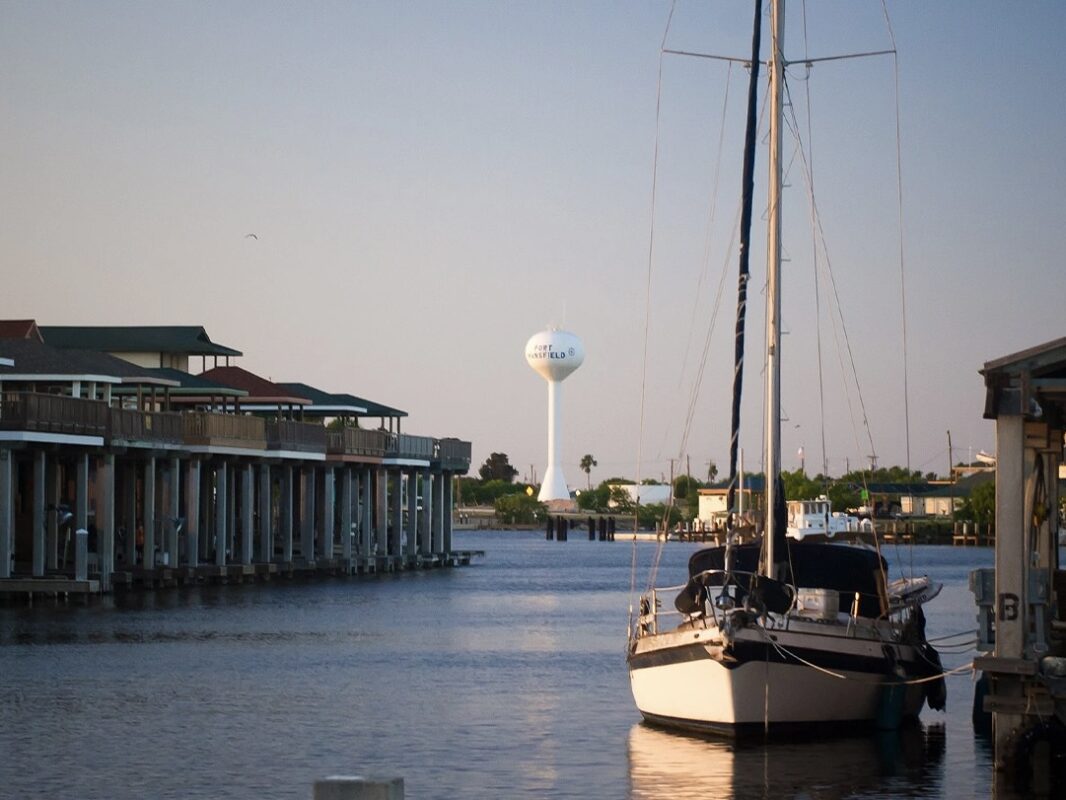
Drive east out of Raymondville on State Highway 186, and after twenty-seven miles of scrub brush and silence, you arrive somewhere that feels improbable.
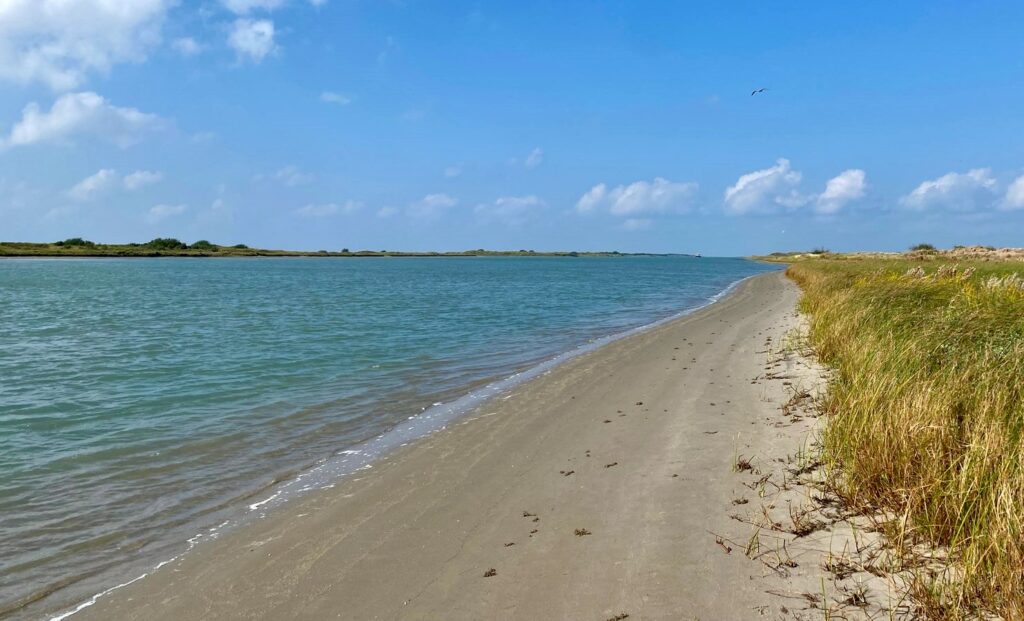
A small harbor town perched on the western shore of the Laguna Madre, staring across impossibly clear water toward the long spine of Padre Island.
Pelicans on wooden posts. Redfish pushing visible wakes through shallows so transparent you can count the seagrass below. The wind smells like salt and something you can’t quite name, but that indiscernible something has kept people coming back for decades.
Port Mansfield has maybe three hundred permanent residents.
It shouldn’t exist out at the end of a two-lane road in one of the poorest counties in Texas. But it does, and the story of how it got there begins with one man who refused to accept that “nowhere” was the final answer.
Built by vision, shaped by water
In the 1940s, a Raymondville real estate developer and mayor named Charles R. Johnson looked at the coast of Willacy County and decided it deserved a port.
Courtesy of | National Park Service | Thomas DiGiovannangelo
The geography and location defied his logic. But Johnson lobbied Congress, and he got one.
Port Mansfield opened in 1950.
According to the Texas State Historical Association, it was named in honor of U.S. Rep. Joseph J. Mansfield, who introduced the legislation that extended the Gulf Intracoastal Waterway from Corpus Christi to the Rio Grande.
The port’s original name, Red Fish Landing, turned out to be more prophetic than anyone intended.
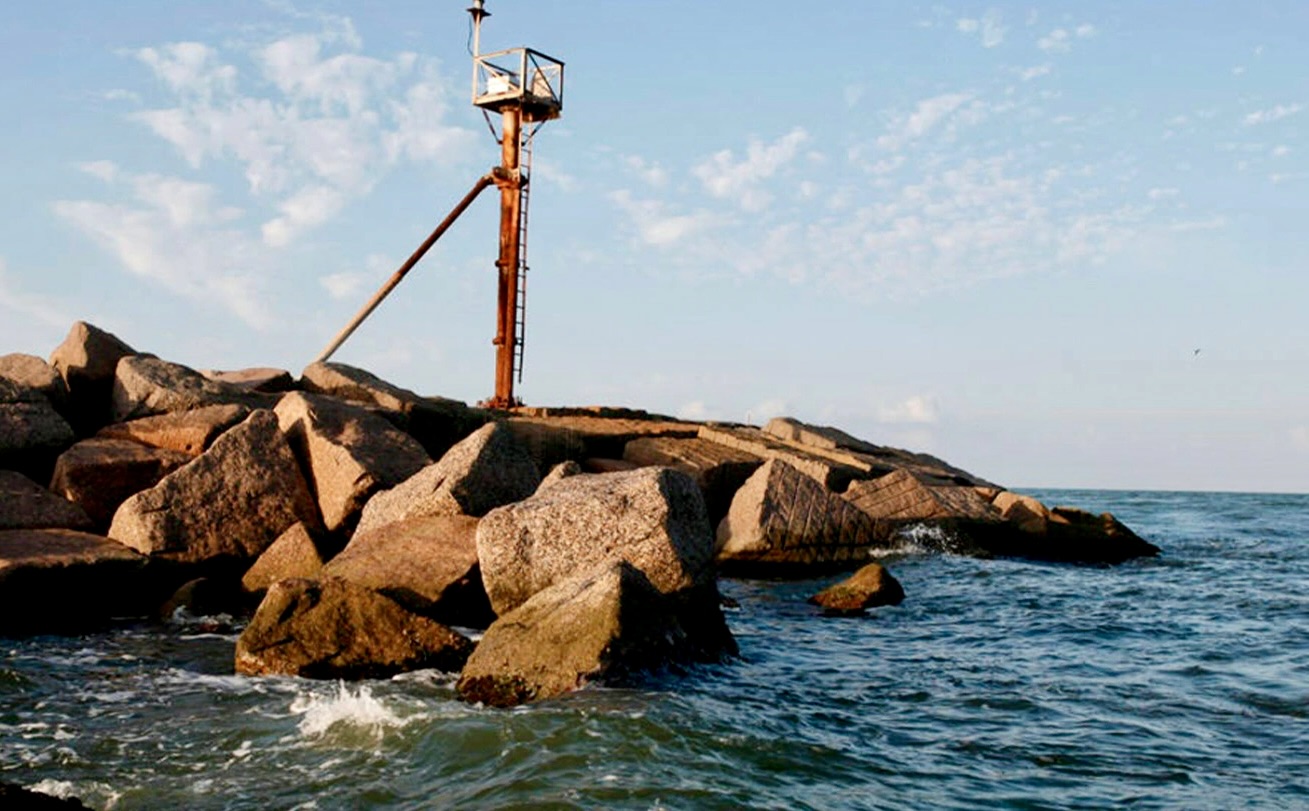
The real turning point came in 1962, when the Army Corps of Engineers cut a channel through Padre Island to the Gulf.
The tidal exchange that followed transformed the Laguna Madre into one of the finest shallow-water fisheries in North America. Redfish, speckled trout, flounder, brown shrimp, they came in abundance. And while the commercial port that Johnson had dreamed of never quite materialized, something more valuable did.
The economy that emerged
The Laguna Madre is one of only a few hypersaline lagoons on the planet.
Protected on both shores by Laguna Atascosa National Wildlife Refuge to the west and Padre Island National Seashore to the east, the laguna supports vast seagrass beds, endangered seabirds, and marine life that draws researchers and anglers from across the country.
For the fishing guides who work these flats, this isn’t ecology. It’s their mortgage and car payments.
Courtesy of | Surf Forecast feed
“It’s a pristine fishery,” Miller Bassler told port officials, according to its website.
Bassler is a retired businessman who started going to the port in the 1990s and eventually leased a home on the harbor.
“The water and the beauty of this place is addictive,” he said. “And the peace and quiet is very much appreciated.”
For much of the Rio Grande Valley, defined by agricultural labor, border economics, and historically persistent poverty, Port Mansfield has long served as a communal pressure valve.
You didn’t need wealth to visit. You needed a truck, a rod, and enough cash for gas.
That democratic simplicity is woven into the town’s identity, and it built a real economy based on tourism and recreation.
Visitors to Cameron and Willacy Counties generated more than $240 million in 2021, according to the Port of Port Mansfield’s website. The tiny harbor punches well above its weight with that total.
Pressure to industrialize
But the navigation district never entirely let go of Johnson’s commercial ambitions. With Willacy County consistently ranking among the poorest counties in Texas, the pressure to do something bigger has always been real.
The port sits on over 1,760 acres of developable land, midway between the Ports of Brownsville and Corpus Christi.
On paper, according to Texas A&M University, that’s a legitimate argument.
The problem is Brownsville.
Courtesy of | Port of Brownsville
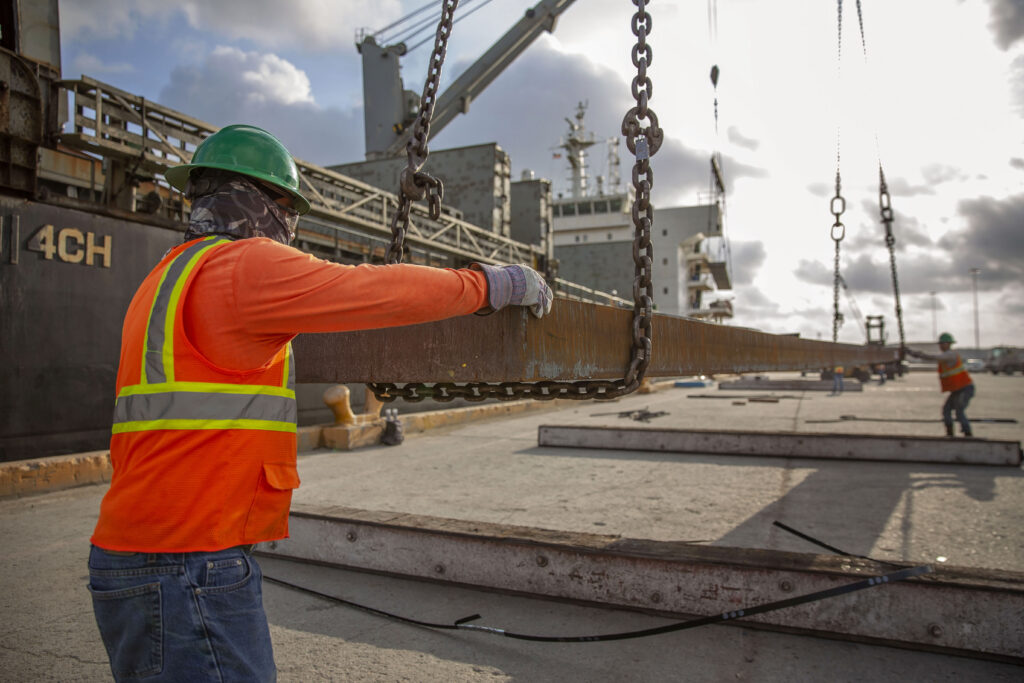
Sixty miles south, the Port of Brownsville contributes approximately $12 billion to the Texas economy and supports more than 66,000 jobs, according to its own figures.
Massive infrastructure is in place, and Port Mansfield faced a daunting marketing and economic development challenge to begin attracting transportation businesses to choose the little community instead of Brownsville.
But Brownsville has deep water, rail connections, and a channel deepening project underway.
Port Mansfield has a federally authorized depth of seventeen feet and the same two-lane road it’s always had.
No honest reading of those facts suggests Port Mansfield can compete on cargo. The only real question was whether the navigation district understood that.
The deal that ignited the town
In December 2023, the board answered that question in a way that lit the town on fire.
The district signed a 50-year marine terminal services agreement with a company called North American Standards, leasing about 3.4 acres of harbor property for just $1,400 a month, with a promised percentage of cargo revenue once operations began. The plan was to move commercial container barges through Port Mansfield.
The reaction was immediate and volcanic.
“It makes no sense,” Bassler is quoted in the port’s website.
His wife Kathie was blunter at a board meeting, her remarks recorded on the same site.
“It cannot and should not be destroyed by forcing and squeezing in an ugly, loud, potentially environmentally dangerous industrialized container port with, possibly, hundreds of 18-wheelers a week arriving in our tiny town,” she said.
The residents didn’t just complain. They organized. The Concerned Citizens of Port Mansfield was born. They filed public records requests, dug into the district’s finances, and showed up at every board meeting.
And then Patrick Tyler got involved.
A community organizes
Tyler is not a typical Port Mansfield retiree. The former New York Times foreign correspondent who had reported from Beijing, Moscow, and Baghdad, settled there in 2004, drawn by the fishing and the quiet.
When the navigation district pushed forward, Tyler did what any former war correspondent might do and started a newspaper.
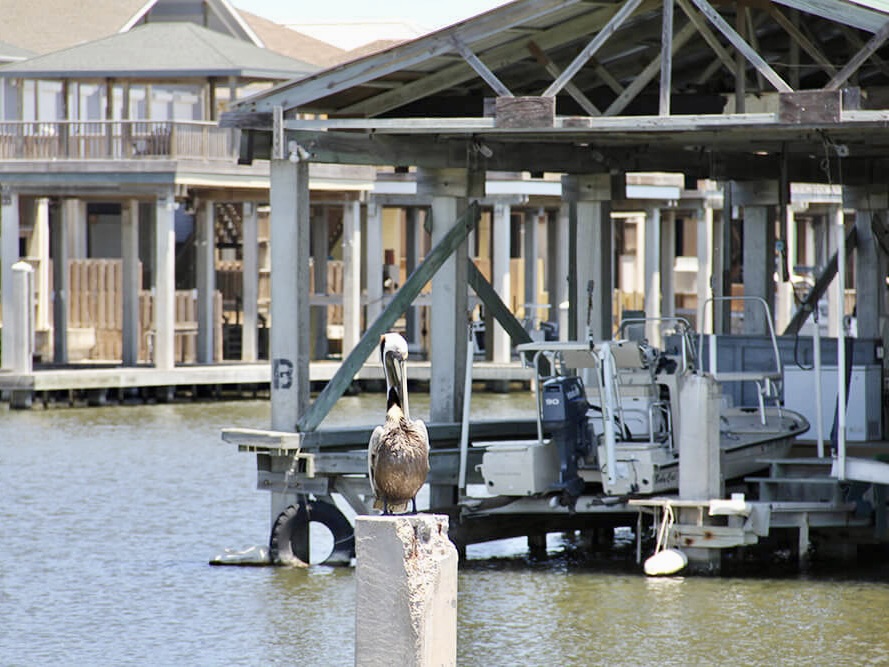
Courtesy of | Port of Port Mansfield.
He and other residents launched the Willacy County Examiner to, as he explained to GovExperts, “start writing stories about what’s happening here and educate the people in Raymondville about how off the rails this place is.”
Port Director Ron Mills called the paper “scarily inaccurate,” according to GovExperts, insisting the environmental concerns were being addressed.
The tension kept escalating.
Jack Ficklen, a carpenter who had been coming to district meetings for decades, watched the packed room with amazement.
“Now it’s a crowd,” he said, according to the port’s website. “Literally, for 25 years, there was myself and another fella that were the only people that ever came to these meetings.”
Tyler — whose words were recorded by the Texas State Historical Association — put the political bottom line plainly when he said, “We vote these gentlemen and ladies into office. And we control policies in the end. Maybe we’ve gotten lazy. But we can stop it.”
The political turning point
They could, and they did stop it.
The Concerned Citizens backed candidates in the November 2024 navigation district board election, and voters removed board chairman Chad Kinney.
In January 2025, the new board voted to terminate the contract with North American Standards, which also failed to pay a required $300,000 deposit.
The container port plan was dead.
“It didn’t make a lot of sense bringing the big container barges in,” new board chairman Eric Kennedy told the Texas Almanac. “We don’t really have the infrastructure for it.”
Twenty-plus residents who had come to watch the meeting cheered.
Bassler allowed himself a quiet moment of satisfaction.
“I never lost faith,” he told the Texas Almanac.
Then, characteristically, he looked ahead.
“It’s a pristine fishery. It’s one of a kind in the United States,” he said in a local TV news interview. “We’re going to keep fighting if we have to.”
Incorporation — and rejection
Some residents pushed further, filing for incorporation — the idea being that cityhood would free Port Mansfield from navigation district control entirely.
On November 4, 2025, voters went to the polls. The result: 138 against incorporation, 90 in favor.
The fishing village would stay as it was.
Fishing guide Ruben Garza Jr., who had run for mayor on an anti-incorporation platform, explained his philosophy to the Texas General Land Office.
“Instead of butting heads, we have to work together as one because at the end of the day, it’s not about our pride. It’s about the people who live here,” he said.
The day after the vote, he was already back on the water.
“Just another beautiful day in Port Mansfield,” he said, according to the port’s website.
What the future holds
The underlying tensions haven’t disappeared.
Willacy County is still among the poorest in Texas. The navigation district continues to carry a mandate to generate economic activity. The channel requires constant, expensive dredging to stay open.
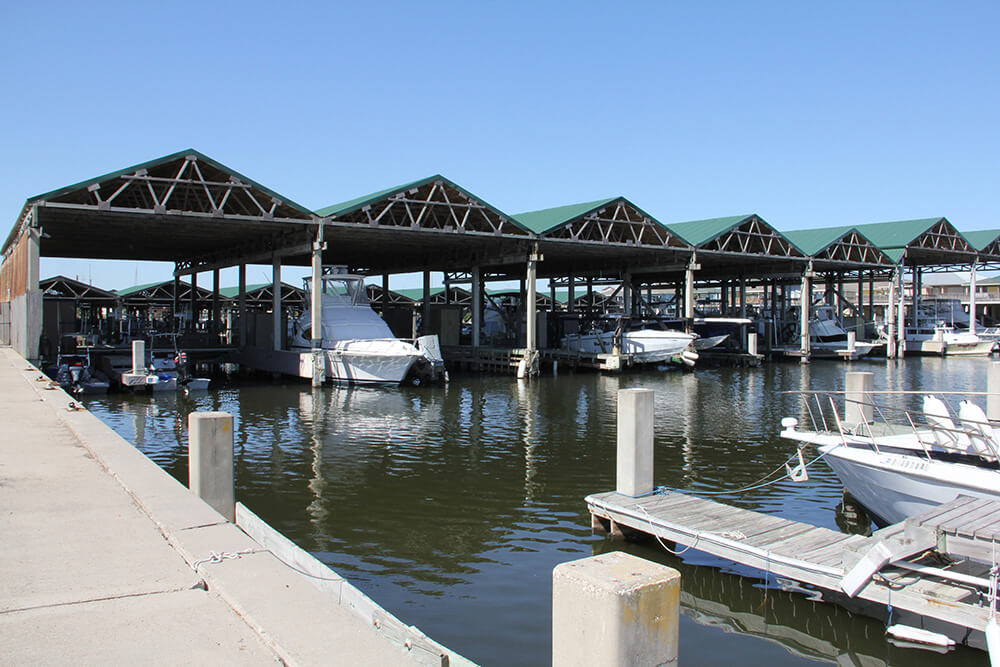
Courtesy | Port of Port Mansfield
These are real pressures, and they aren’t going away.
But the community of Port Mansfield has already shown what it knows how to do.
The best version of Port Mansfield’s future doesn’t chase Brownsville’s industrial model down a road that leads nowhere, or to overwhelming industrial activity.
It doubles down on what the place always was, which is a world-class fishing destination, a gateway to an extraordinary ecosystem, and one of the last genuinely quiet corners of the Texas Gulf Coast.
The barges on the Intracoastal Waterway still float past and don’t stop. They never really have. But the people who come to wade the clear flats, cast into the morning tide, and watch the sun drop behind Padre Island? They keep coming back.
That, ultimately, is the most honest economic development plan Port Mansfield has ever had, and probably the most durable one it will ever get.

James Moore
jmoore
New York Times bestselling author, Emmy-winning TV news correspondent, COO and co-founder of Rio Grande Valley Business Journal
Most Read
- SpaceX’s futuristic city of Starbase finalizes massive 7,100-acre annexation. Here’s what we know.
- 25 Mexican businesses eye McAllen expansion after city pitches U.S. market entry program
- Australian company plans to build a $607M lithium refinery at the Port of Brownsville. It’s a big bet on America’s battery future
- Starbase cancels meeting to consider annexing 444 acres relinquished by Brownsville
- SpaceX reschedules Starship’s first flight around the Earth
Get the latest business news delivered to your inbox every morning for free.
Try 30 Days Free!
Get full access to award-winning journalism covering business, real estate, health care, economic trends, and the people shaping the Rio Grande Valley.
30 Days Free!
$9.95/month
Limited time offer
Subscription renews after your 30 day free trial at $9.95/mo.
Included Benefits
- Unlimited access to all articles
- Daily business news and analysis
- Subscriber-only content and features
Stories That Matter
- Dickey’s Barbecue Pit to open new McAllen location inside Cambria Hotel
- NADBank opens $300M financing pipeline for water, energy projects along the border
- Is SpaceX quietly building a data center at Starbase? Job postings offer clues
- Engineering firm Garver opens $5M Harlingen office, plans up to 50 new jobs
- Mission’s first Small Business Expo puts $25K on the line for local entrepreneurs
- McCoy’s gives $10K, tools to launch Mid-Valley construction academy
- UT Health RGV performs new digestive procedure for first time in the Valley
- TSTC bets on advanced manufacturing to meet RGV’s industrial boom
- Pharr’s cross-border business push earns international recognition
- Brownsville eases drought restrictions after nearly three years as Rio Grande reservoir levels improve