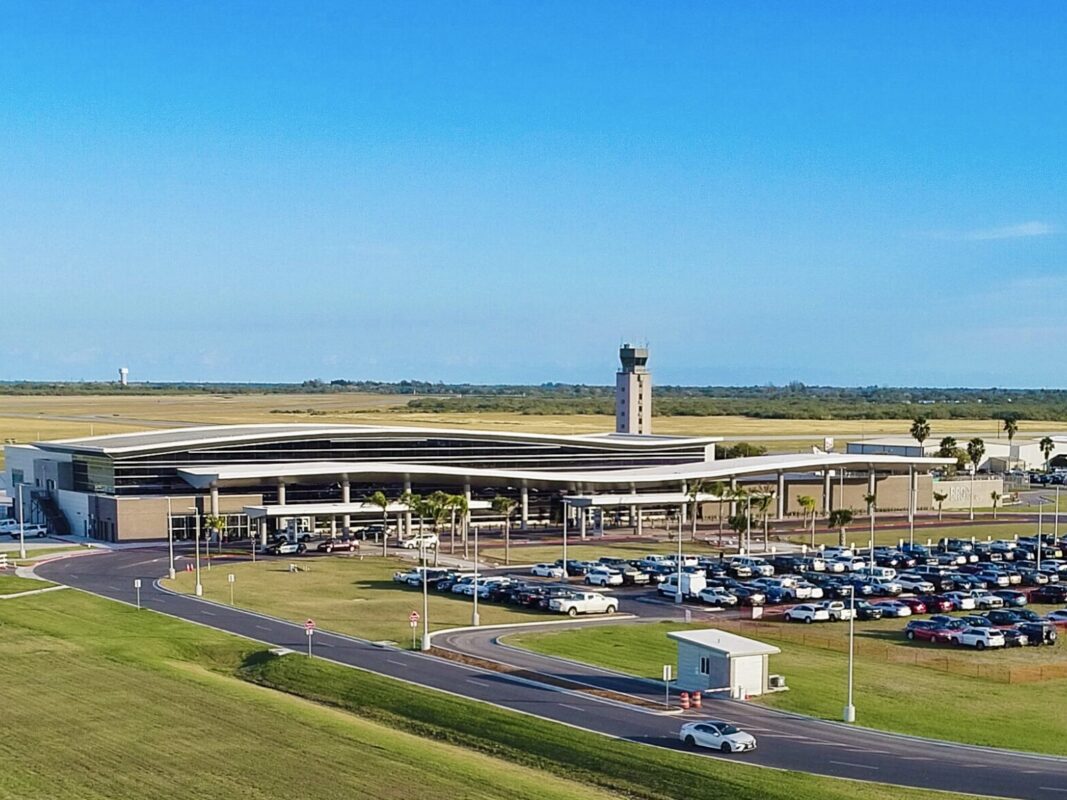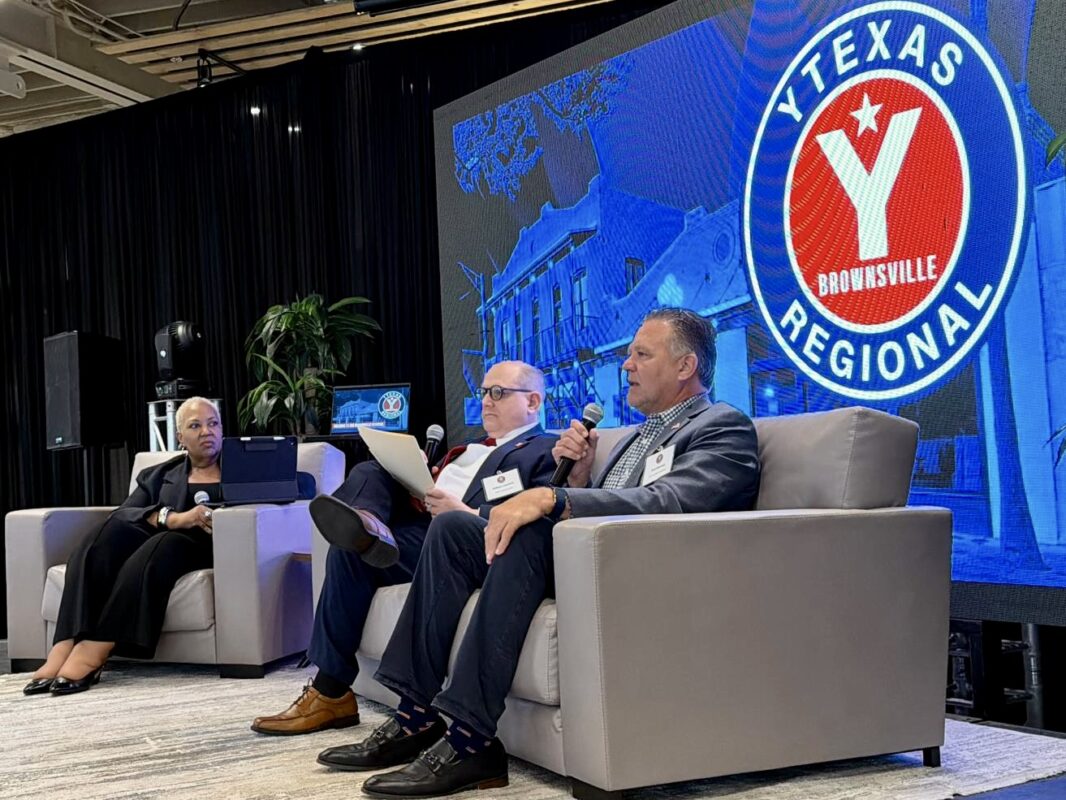
Dozens of business executives met in Brownsville to catch a glimpse of the changing economy during a recent YTexas conference — and infrastructure was a key theme during the event.
Access to it, from water to power and even the internet, will be in demand due to several major projects and corporate expansions at the Port of Brownsville.
America First Refining, the North Texas company behind a $3 billion to $4 billion oil refinery at the port, expects to contribute excess electricity to the grid, powered by otherwise unused hydrogen produced during the refining process of West Texas light shale oil.
Tom Ramsey, chief operating officer of America First Refining, told the crowd that he expects the company to process its own water. A refinery of its scale could require up to 5,300 acre-feet of water each year.
“We’re also working very closely with the port and the local utility on water supply and ensuring that if there’s things we need to do, investments we need to make as a private company to ensure there’s water for everybody — we will do that,” Ramsey said.
The new refinery is expected to produce excess electricity, and the company plans to sell that back into the local power grid, he said.
“To ensure we’re not drawing a bunch of power from the power grid and that’s affecting residents and other tenants at the port, we’re building our own power generation on our site at our cost,” he said.
America First Refining is also working on a workforce development and job training program and expects to generate high-paying jobs. The company expects to pay similar salaries to those in Corpus Christi and Houston to attract talent, Ramsey said.
“We’re going to be paying on wages that are very equivalent to what people would be paid if they left this local market in an area that frankly has a lower cost of living than some of the other larger cities in Texas,” he said. “We’re on a very accelerated schedule right now because we’re getting a lot of pressure from our new partner, to, you know, move faster.”
The city of Brownsville has been building out its internet infrastructure, including 100 miles of dark fiber, which would enable companies to access high speeds across the city. Brownsville was recently awarded nearly $22 million from the state of Texas for another 138 miles of fiber internet stretching all the way to the city of Starbase.
The city of Brownsville spans 139 square miles, and Mayor John Cowen estimated that only about 50% of the city has been built out with about 55,000 households citywide.
“Which is a great opportunity to say we want to dictate how we’re going to grow. We want to be very mindful and thoughtful about how we’re planning our housing, park systems, transportation networks so we lay the groundwork for the next 20, 30, 40 years of growth,” Cowen said. “We’re really going to need to really leverage the private markets here to work hand in hand to make sure we address the 25,000 jobs that are likely coming here within the next 5 years.”
When asked about the water infrastructure and availability, especially during a drought and projected water shortage, Cowen said he was confident that there’s enough water diversification in the works.
“I think Brownsville is very well positioned. We own our own municipal utility system that provides electric, water and wastewater,” he said.
He noted that AEP Texas has plans to bring a 765 kilovolt transmission line which would connect the Rio Grande Valley with power generation across Texas.
The brackish water desalination plant mostly owned by the city of Brownsville generates about one-third of the supply already, and there’s an expansion underway.
Cowen also mentioned the proposed RGV Desal LLC project, which could produce up to 100 million gallons of seawater each day from South Padre Island.
“That’ll provide a lot more resiliency to the area,” he said. “We don’t foresee any major challenges. But these projects take a long time.”
Inside the Port of Brownsville, the port’s top executive said he and the board of directors are wary about becoming too exposed to one industry — whether it’s shipbuilding or energy.
“We do not want to become the primary energy port. We want to be able to bring in advanced manufacturing and value-added industry,” Port of Brownsville CEO William Dietrich said. “Some industries go down, other industries move up, but it’s about being able to sustain any losses as we move along — to be able to have that flexibility in the ecosystem because everything’s changing every day.”

Kristen Mosbrucker-Garza
Reporter
Kristen Mosbrucker-Garza is a versatile multimedia news reporter who lives and works along the Texas-Mexico border in Hidalgo County. Mosbrucker-Garza is a news reporter for the Rio Grande Valley Business Journal. During her career she's worked for the McAllen Monitor, San Antonio Business Journal, The Advocate Newspaper in Louisiana, Phoenix New Times, and public media outlets in Baltimore and Philadelphia.
Most Read
- SpaceX is giving Brownsville $220M for water projects. In exchange, the city gave up zoning control of 444 acres near Starbase
- SpaceX seeks to take zoning control over nearly 450 acres from city of Brownsville as a ‘regional’ water deal takes shape
- Port of Brownsville could soon host Nodule City, a first-of-its-kind commercial deep-sea mining hub
- Cameron County is negotiating a $20M Fluidstack data center donation after Harlingen waffles on the same offer
- How much water does SpaceX need to operate near Brownsville? Nearly 20x its current use
Get the latest business news delivered to your inbox every morning for free.
Try 30 Days Free!
Get full access to award-winning journalism covering business, real estate, health care, economic trends, and the people shaping the Rio Grande Valley.
30 Days Free!
$9.95/month
Limited time offer
Subscription renews after your 30 day free trial at $9.95/mo.
Included Benefits
- Unlimited access to all articles
- Daily business news and analysis
- Subscriber-only content and features
Stories That Matter
- McAllen’s $204M water investment expects to seek construction bids in 2027
- Saronic lands Navy landing craft contract, first build at Brownsville’s Port Alpha
- The Rio Grande Valley’s tech industry is small but growing — meet some of the next-gen workforce
- Entrepreneurs enter Mission EDC’s ‘Shark Tank’ competition for $25K top prize
- Mission’s first Small Business Expo puts $25K on the line for local entrepreneurs
- Reynosa’s newest technical high school focuses on AI, semiconductors and bionics
- McCoy’s gives $10K, tools to launch Mid-Valley construction academy
- UT Health RGV performs new digestive procedure for first time in the Valley
- TSTC bets on advanced manufacturing to meet RGV’s industrial boom
- SpaceX reschedules Starship’s first flight around the Earth