A Note from the Rio Grande Valley Business Journal’s Founders
A year ago this week we published our first stories. The premise was simple and, to some people, improbable. Three million people live along this stretch of the border, on both sides of the river, and they had no central publication for business news.
That absence never made sense to us. The four counties of the Rio Grande Valley move sixty-seven billion dollars in trade with Mexico every year. Mexico is the largest trading partner of the United States, worth $935 billion annually to the American economy, and $272.3 billion of that lands in Texas. SpaceX put its launch facilities on the coast near Brownsville and helped turn that city into what one economic analysis called the second-best location in the country to manufacture a product. Multinational corporations, customs brokers, developers, venture investors and Mexican industrialists were all making decisions here. None of them had a reliable place to read about it, and the border, from El Paso to Brownsville, is now the busiest economic corridor in the Western Hemisphere.
The idea had been sitting between us for more than a decade. We met during the immigration crisis of unaccompanied minors arriving from Central America, one of us managing the national press corps that descended on the Valley, the other running economic development for a city in the middle of it. We talked then about how badly the region was covered, and how much was happening that nobody outside it understood. Careers intervened. Covid intervened. A cancer diagnosis and a successful course of treatment intervened, and then, as those things sometimes do, clarified everything. One of us decided not to seek reelection as mayor. The other closed out a consulting practice. We started hiring.
What the year produced
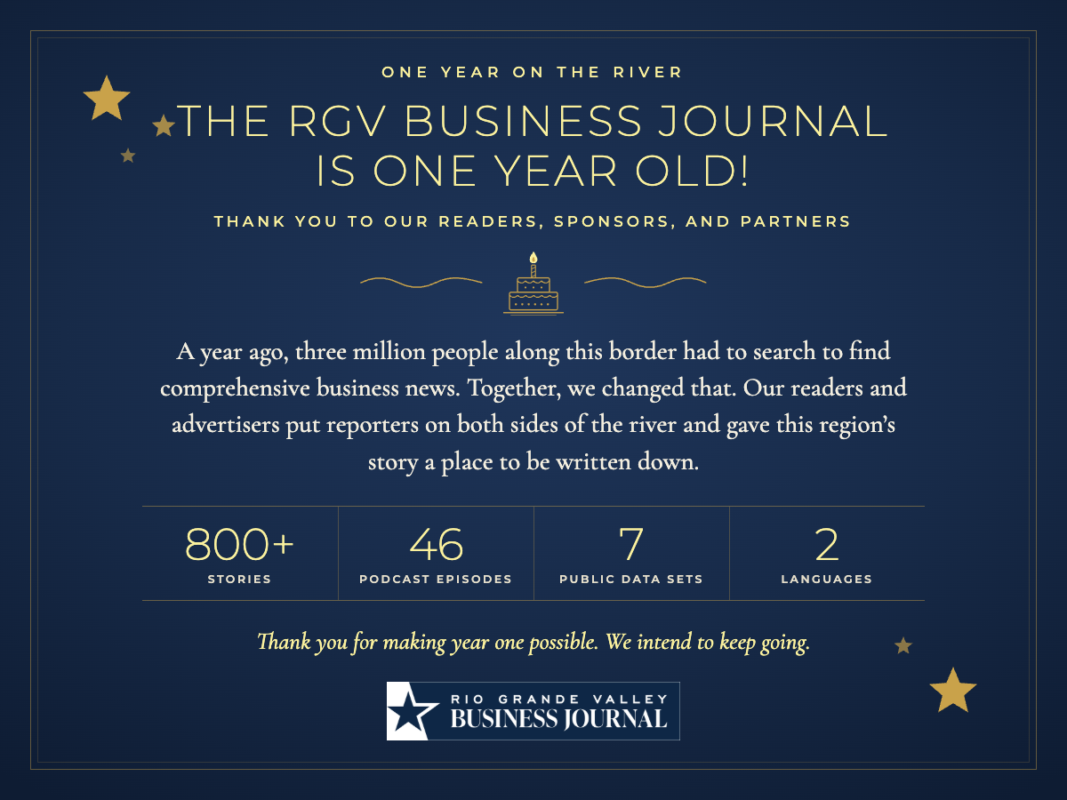
More than 800 stories. Forty-six podcast episodes. A morning newsletter that now reaches thousands of business leaders before the workday starts, six days a week, without fail. A Spanish edition. Seven public data sets covering border crossings, bank deposits, sales tax allocation, labor market trends, airport enplanements and regional demographics, which is the kind of unglamorous infrastructure a region needs, and nobody had bothered to build.
The stories found us faster than we could have planned. We reported the SpaceX water deal in Brownsville, the $220 million package and the 444 acres of zoning control the city relinquished, and we reported how much water the company will need, which is roughly twenty times its current use. We followed the data center boom from the first land options outside Harlingen through the first municipal moratorium in Texas, and we were there when the governor froze every state permit in the industry. We covered Saronic’s arrival at the Port of Brownsville and the Navy contract that followed it. We covered a proposed deep sea mining hub, a $607 million lithium refinery, an LNG terminal pushing for round-the-clock construction, and a Reynosa technical high school built around artificial intelligence and semiconductors.
We also covered the things that do not announce themselves with a groundbreaking. Citrus orchards cleared after a century. Farmers in northern Tamaulipas leaving nearly half their sorghum acreage unplanted. A concrete company that filed for bankruptcy protection with a full order book and no crew to fill it. A report putting the economic cost of immigration enforcement in this region at $180 million over three and a half years. That story is not a political story. It is a labor story, a construction story and a housing story, and we covered it that way.
The reporter in Mexico
One of the decisions we are proudest of is the least visible one. We are the only publication on this border with a reporter working in Mexico.
Reynosa and Matamoros are not adjacent to the Valley economy. They are inside it. The maquiladoras, the freight, the supply chains, the water negotiations and the labor market are one system that happens to have an international boundary running through the middle. Covering the northern half and calling it complete has been the standing failure of border journalism for fifty years. Our correspondent files from Reynosa, in Spanish and English, on manufacturing, agriculture and cross-border trade, and those stories consistently tell our readers things they cannot get anywhere else.
What comes next
The business community has found us. Economic development corporations, ports, banks, hospitals and universities have become partners. Sources return our calls. Officials now assume we will be in the room. A year ago, none of that was true.
The next step might be a reach but the market is demanding it. The absence we started with does not stop in Starr County. Laredo has no business publication. El Paso is thinly served. The Trans-Pecos towns, Del Rio and Alpine and Marfa and Fort Davis, have none at all. The same trade corridors, the same water pressures, the same manufacturing shift out of Asia and into northern Mexico run the entire length of the Texas border. We are beginning work to cover all of it, perhaps as the Rio Grande Business Journal.
That will take capital, more reporters and more time. We are working on all three.
What we know after a year is that the original premise was right. This region is not a footnote to the Texas economy. It is one of its engines, and it is being remade in real time by companies, agencies and governments on two sides of a river. Somebody should be writing it down.
We intend to keep doing that.

James Moore
jmoore
New York Times bestselling author, Emmy-winning TV news correspondent, COO and co-founder of Rio Grande Valley Business Journal
Most Read
- Port of Brownsville approves $2M SpaceX pipeline deal, with millions more on the table
- 5×5 Brewing plots $2.5M comeback with new Edinburg brewpub near UTRGV
- Hundreds are vying for jobs in Brownsville. Here’s what jobseekers are seeing in the market
- Workforce leaders say the Rio Grande Valley job market isn’t what you think
- What Toyota’s $3.6B San Antonio expansion could mean for the Rio Grande Valley
Get the latest business news delivered to your inbox every morning for free.
Try 30 Days Free!
Get full access to award-winning journalism covering business, real estate, health care, economic trends, and the people shaping the Rio Grande Valley.
30 Days Free!
$9.95/month
Limited time offer
Subscription renews after your 30 day free trial at $9.95/mo.
Included Benefits
- Unlimited access to all articles
- Daily business news and analysis
- Subscriber-only content and features
Stories That Matter
- Sluggish job growth in the Rio Grande Valley doesn’t reflect economic gains, Dallas Fed researcher says
- Mission’s first Small Business Expo puts $25K on the line for local entrepreneurs
- McCoy’s gives $10K, tools to launch Mid-Valley construction academy
- UT Health RGV performs new digestive procedure for first time in the Valley
- TSTC bets on advanced manufacturing to meet RGV’s industrial boom
- Edinburg is asking businesses what they need to grow
- Pharr’s cross-border business push earns international recognition
- McAllen files plans for $15.5M police firearms training facility
- Brownsville eases drought restrictions after nearly three years as Rio Grande reservoir levels improve
- Texas A&M’s $53.5M McAllen research center will tackle water, food security and Valley health