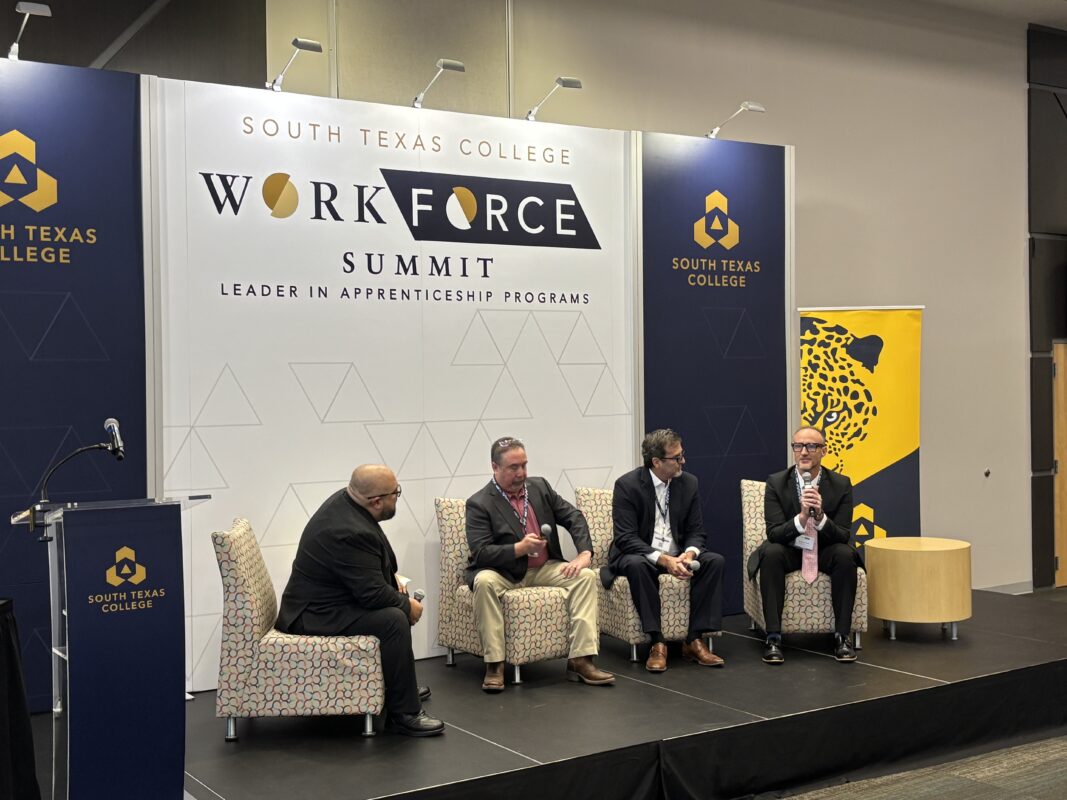
McALLEN — The audience Friday at South Texas College’s summit on the impact of artificial intelligence on workforce and economic development didn’t clap when panelists spoke about how much of their industry would require AI retraining.
The crowd didn’t clap when panelists talked about the sorts of things that AI is good at, and they didn’t applaud when they mentioned the reasons AI utilization is critical.
Instead, the crowd clapped when panelist Adam Copher told them what AI couldn’t do.
“We have to be careful — and I’ve heard a couple of our speakers already say it — AI will never replace human connection. Ever,” said Copher, chief nursing officer at South Texas Health System in McAllen. “And that is one of the things as a CNO that I love, is the meaningful connection with everybody I meet.”
Impact on the individual
The summit might have been focussed on AI’s economic impact, but lots of the panel talk centered around what impact the technology will have on the individual.
Panelists said they viewed AI as more of an augmentation to actual humans in the workforce rather than a replacement.
“The human is always gonna be in there,” said Reynaldo Anzaldua Jr., a cybersecurity and AI expert from the University of Texas Rio Grande Valley. “And you have to understand, in a certain way, that AI is not creative. It doesn’t have human intuition. So don’t get the idea that we’re gonna get replaced.”
Saying humans wouldn’t get replaced isn’t the same as saying jobs won’t get replaced.
Studies and reports differ on precisely what impact AI will have on the job market and whether jobs it eliminates will be replaced by openings elsewhere.
Those studies and reports largely agree the impact will be significant.
Panelists Friday didn’t disagree.
Reskilling pressures and economic transition
Both Copher and Anzaldua said they predict 100% of their industries’ workforces would require reskilling because of AI within the next five years.
Panelist Bob Anderson, vice president of supply chain and operations at Alps Alpine North America, put that number at 30% for his industry.
He said, however, that the change is inevitable. He also said it’s adaptable.
“You know, students maybe feel like the blacksmiths did — horse and buggy era, early 1900s — when the automobile was created. ‘Oh, we’re all going to be without jobs.’ The automotive industry created far more jobs than blacksmiths,” Anderson said. “This is similar. Embrace the change, look at what opportunities are there, and go for it.”
Ethics, security, and the urgency of adoption
The panel fielded a question from the audience on ethical concerns around AI and how ethics could be ingrained in the technology. The audience didn’t get any particularly straightforward answers.
The response was, essentially, that it’ll be complicated and likely fluid — but important.
“If we do not teach the AIs, or find a way to create a moral and ethical framework, we’re asking for trouble,” Anzaldua said.
Not exactly having that moral and ethical framework fully fleshed out doesn’t seem likely to slow the speed of AI’s adoption, based on the panel.
In at least some instances, the panel indicated, adopting AI and using it well means more than just an economic advantage — especially when competing against AI.
Anzaldua said bad actors are increasingly using AI in cyber attacks and that people simply can’t keep up unaided.
“They are so fast, so sophisticated, that the defenders have to know how to use AI on their side to defend against that. There’s no way a human can keep up with the complexity,” he said.
Higher educational entities in the Rio Grande Valley are increasingly offering coursework to train students to use and understand AI.
STC offers five courses that deal with AI within its bachelor of applied technology in computer and information technologies program, along with an AI in manufacturing course.
The college is also rolling out a committee on AI ethics.

Matt Wilson
Reporter
Most Read
- SpaceX is giving Brownsville $220M for water projects. In exchange, the city gave up zoning control of 444 acres near Starbase
- SpaceX seeks to take zoning control over nearly 450 acres from city of Brownsville as a ‘regional’ water deal takes shape
- Port of Brownsville could soon host Nodule City, a first-of-its-kind commercial deep-sea mining hub
- Cameron County is negotiating a $20M Fluidstack data center donation after Harlingen waffles on the same offer
- How much water does SpaceX need to operate near Brownsville? Nearly 20x its current use
Get the latest business news delivered to your inbox every morning for free.
Try 30 Days Free!
Get full access to award-winning journalism covering business, real estate, health care, economic trends, and the people shaping the Rio Grande Valley.
30 Days Free!
$9.95/month
Limited time offer
Subscription renews after your 30 day free trial at $9.95/mo.
Included Benefits
- Unlimited access to all articles
- Daily business news and analysis
- Subscriber-only content and features
Stories That Matter
- McAllen’s $204M water investment expects to seek construction bids in 2027
- Saronic lands Navy landing craft contract, first build at Brownsville’s Port Alpha
- The Rio Grande Valley’s tech industry is small but growing — meet some of the next-gen workforce
- Entrepreneurs enter Mission EDC’s ‘Shark Tank’ competition for $25K top prize
- Mission’s first Small Business Expo puts $25K on the line for local entrepreneurs
- Reynosa’s newest technical high school focuses on AI, semiconductors and bionics
- McCoy’s gives $10K, tools to launch Mid-Valley construction academy
- UT Health RGV performs new digestive procedure for first time in the Valley
- TSTC bets on advanced manufacturing to meet RGV’s industrial boom
- SpaceX reschedules Starship’s first flight around the Earth