By 2030, Texas is projected to have more data centers than any other state in the nation, outpacing Virginia, which has the most, according to research by real estate firm Jones Lang LaSalle.
That’s partly because Texas is enticing developers with cheap land and tax incentives that eliminate state use and sales taxes for data centers for 15 years.
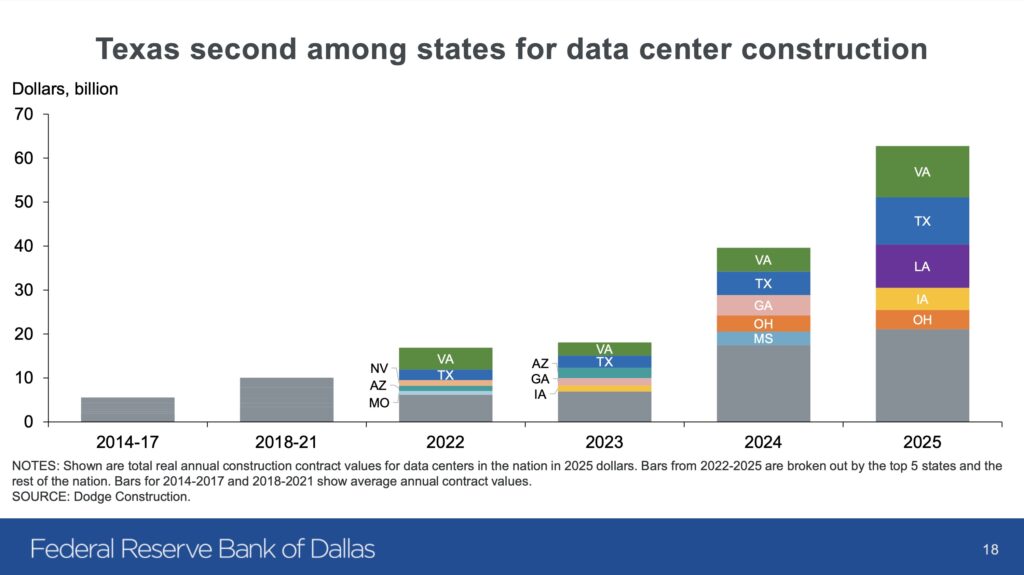
Data center construction growth across Texas has outpaced overall construction activity since 2022, researchers at the Federal Reserve Bank of Dallas found.
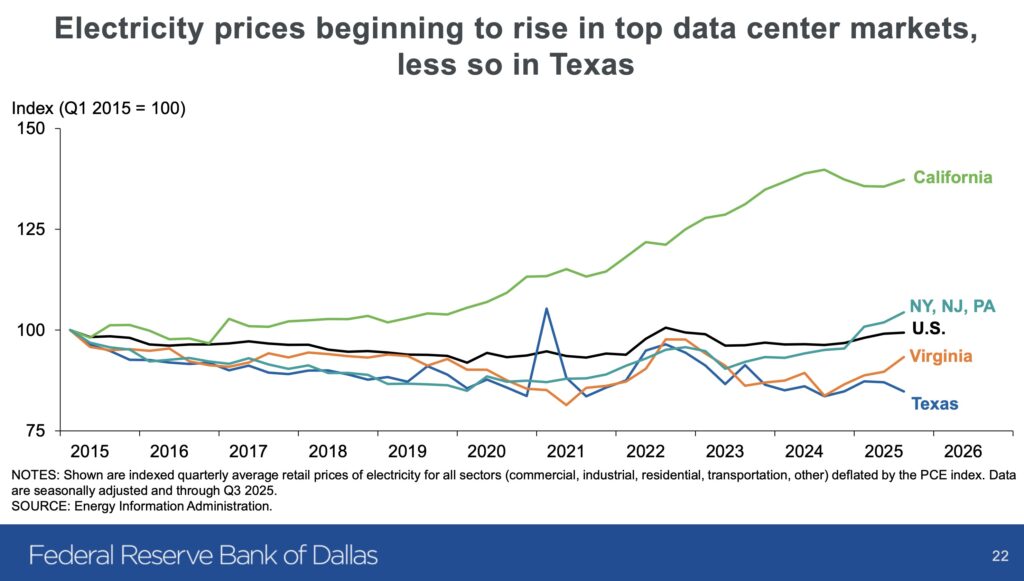
The surge in data centers across the state is expected to increase grid strain and electricity costs in Texas, though less so than in other states.
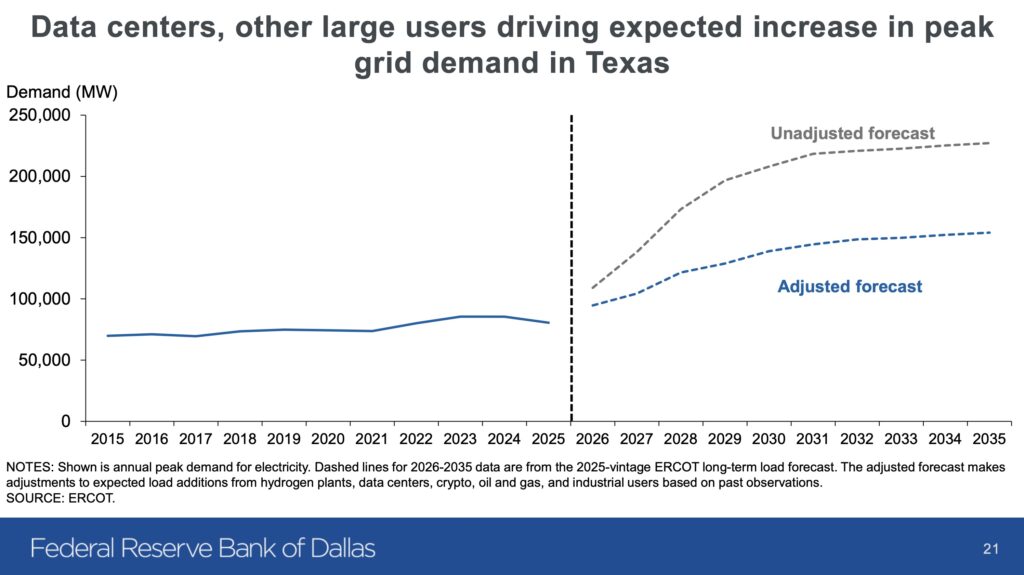
In the Rio Grande Valley, data centers are being proposed and built on agricultural land, drawing on water from drought-stricken counties, and some are connecting to a power grid that’s already strained by residential and commercial building growth due to a lack of a high-powered transmission line network.
There are several data centers already in the works, three of which would draw power from wind turbines and a fourth that would plug into the grid.
In Harlingen, the data center proposing to connect to the power grid is unpopular with both county and city leaders, following public outcry over strained resources and minimal job creation.
But there’s no regulation on the books to shape, limit, or ban data centers across the Valley. And it’s unclear whether the Harlingen data center will seek a property tax abatement as part of its financing strategy as well.
A different data center in Willacy County was awarded a property tax abatement in 2025.
That’s starting to change, as Harlingen leaders have drafted at least two ordinances that are expected to be combined in the coming weeks to regulate data center construction and operation.
While residents are pushing for a ban, city leaders say it’s illegal to stop a legal business from operating, and they expect pushback from the state on any data center restrictions.

Harlingen District 2 Commissioner Daniel Lopez, who is an attorney by trade, drafted an ordinance to regulate data centers, and the city’s attorney is expected to produce another one.
“After doing my research on data centers, you’ll find that they’re necessary if you watch Netflix, use Siri or Alexa, but they don’t necessarily bring the type of growth that a community wants,” Lopez said. “I tried to look at one of our biggest issues with data centers — think water consumption, energy consumption, then heat and pollution from generators, and light pollution.”
Lopez’s ordinance would require a special use permit mandating a landscaped buffer, annual audits, a sound absorption chamber, and a closed-loop water recycling system. It would also require a utility impact study, a decommissioning restoration bond, and either a contribution to a sustainability mitigation fund or a community benefit agreement. In the event of an emergency, the data center would be required to disconnect from the power grid and operate on backup generator power.
To mitigate the cost to the power grid, data center companies are now responsible for fees and interconnection to the Texas grid under Senate Bill 6.
But even these regulations won’t change the proposed data center’s plans because the site lies outside Harlingen city limits, the county doesn’t have zoning authority, the effluent water use deal is already under contract, and the city has no control over the deregulated power grid.
Scotland-based Eneus Energy, through its subsidiary RGV Property LLC, is under contract to purchase more than 1,700 acres northeast of the Valley International Airport from Stone Brothers in Raymondville by the end of April, according to Cameron County land records.
It was not immediately clear whether the site, spanning 12 parcels, is being used for agricultural purposes this year, as some farmers left land fallow due to a lack of water.
According to the company, the data center is in the initial planning and evaluation phase, noting the importance of proximity to fiber internet providers and a planned 765 kV transmission line from AEP Texas.
Eneus Energy is proposing 16 data center halls to power artificial intelligence, cloud, and data analytics. To do so, it will require 2 gigawatts of electricity, which could power about 250,000 homes.
The company anticipates spending $14 billion on capital investment in Cameron County by 2045, according to a report compiled by Mangum Economics in August 2025.
The company expects to employ 1,000 workers, including 360 jobs at the data center, during that time frame.
“Today’s data centers are exceptionally efficient, and with Eneus Energy’s development expertise, the RGV Data Center is being planned with a focus on responsible design and long-term operational flexibility,” the company’s website says. “The site is designed to support closed-cycle cooling systems that can utilize locally sourced reclaimed wastewater, avoiding reliance on the local potable water supply.”
In September, the company reached an agreement with the Harlingen Waterworks System, the City of Harlingen’s public water and wastewater utility, to supply treated effluent water for the proposed data center. Effluent water is non-potable wastewater suitable for industrial use. The project is expected to require about 4.6 million gallons of treated wastewater per day — a volume that could generate roughly $1.2 million a year for the water authority.
While some Harlingen leaders are trying to amend that contract, it’s unclear whether such a deal could be cancelled.
Some community members asked whether there was a valley-wide coalition of data center opponents, which appears to be building.
Weslaco resident Yvette Garcia has been keeping tabs on potential data center projects across the Valley. She said she’s concerned about water reliability the most.
“Every gallon of water diverted to cooling [data center] servers is water that is no longer available for residents, farmers for food production, livestock or ecosystems,” Garcia said, reading a letter she brought to the meeting for local leaders. “Our region is deeply rooted in agriculture, producing citrus, vegetables, cotton, sugarcane and supporting ranching operations. These farms and fields are not optional luxuries, they produce the food that feeds our community and contributes to the national food supply. Agriculture is already struggling due to water shortages and rising temperatures.”
As for whether she was confident that the proposed regulations would curb the potential issues, she said it’s good to have rules in place but is pushing for a moratorium — something that Harlingen leaders say they can’t enforce.
“We need a moratorium to stop all of these because this shouldn’t be anywhere in the Valley,” she said. “It’s not sustainable here.”

Kristen Mosbrucker-Garza
Reporter
Kristen Mosbrucker-Garza is a versatile multimedia news reporter who lives and works along the Texas-Mexico border in Hidalgo County. Mosbrucker-Garza is a news reporter for the Rio Grande Valley Business Journal. During her career she's worked for the McAllen Monitor, San Antonio Business Journal, The Advocate Newspaper in Louisiana, Phoenix New Times, and public media outlets in Baltimore and Philadelphia.
Most Read
- Is SpaceX quietly building a data center at Starbase? Job postings offer clues
- 25 Mexican businesses eye McAllen expansion after city pitches U.S. market entry program
- SpaceX’s futuristic city of Starbase finalizes massive 7,100-acre annexation. Here’s what we know.
- McAllen metro keeps selling more homes as Brownsville-Harlingen market sees 17% drop through August
- Rio Grande LNG moves closer to getting even bigger at Port of Brownsville
Get the latest business news delivered to your inbox every morning for free.
Try 30 Days Free!
Get full access to award-winning journalism covering business, real estate, health care, economic trends, and the people shaping the Rio Grande Valley.
30 Days Free!
$9.95/month
Limited time offer
Subscription renews after your 30 day free trial at $9.95/mo.
Included Benefits
- Unlimited access to all articles
- Daily business news and analysis
- Subscriber-only content and features
Stories That Matter
- Port of Brownsville approves $2M SpaceX pipeline deal, with millions more on the table
- New filings detail nearly $11M in UTRGV tennis, football stadium improvements
- Tamaulipas battles rising screwworm cases as cattle exports remain on hold
- Brownsville job fair to connect workers with more than 10,000 opportunities Thursday
- Mission’s first Small Business Expo puts $25K on the line for local entrepreneurs
- McCoy’s gives $10K, tools to launch Mid-Valley construction academy
- UT Health RGV performs new digestive procedure for first time in the Valley
- TSTC bets on advanced manufacturing to meet RGV’s industrial boom
- Pharr’s cross-border business push earns international recognition
- Brownsville eases drought restrictions after nearly three years as Rio Grande reservoir levels improve