
McALLEN — About 60 local restaurateurs gathered Monday to talk about a growing squeeze on their bottom lines — and how they’re trying to survive it.
At the center of that conversation were credit card swipe fees — the percentage restaurants pay to card networks and issuing banks on every transaction.
Those fees have climbed over the past two decades and now represent a major expense for restaurants nationwide, Texas Restaurant Association Chief Public Affairs Officer Kelsey Erickson Streufert said Monday at a McAllen town hall hosted by the association.

Photo Credit | Matt Wilson
Streufert said Visa and Mastercard control about 85% of the credit card market, which leaves restaurants with no real alternative to steep fees. She put the average processing fee at 2.35% and said it could be higher for small businesses.
“And that may sound like a small number, but the average restaurant profit margin is 5%,” she said. “So if you’re making 5% and giving 3.5% of that to Visa and Mastercard, what is left for you to run your business?”
Larry Delgado, who owns house. wine. & bistro. and SALT – New American Table, agreed that those fees are a threat.
Delgado said those fees translate to $120,000 to $130,000 a year for his businesses, money he could otherwise spend on training, new equipment, or employee raises.
“That keeps me up at night,” he said.
Retailers nationwide have long looked to combat swipe fees, leading to years-long litigation, appeals for customers to pay in cash and legislative efforts at reform.
Streufert described it as a David-and-Goliath fight.
On the one hand, she said, the credit card industry is very well-funded and fields its own arguments against reforming swipe fees.
On the other, there have been some bright points for the restaurateurs.
President Donald Trump has indicated support against swipe fees and the restaurant sector has allies in other industries.
Streufert was even optimistic about how negatively she viewed the situation. Any reform, no matter how small, would be a win.
“This issue is so bad that there are a lot of ways that we could make it better, and we are open to all of those ideas,” she said. “I guarantee you the other side is open to none of those ideas because they’re making a lot of money.”
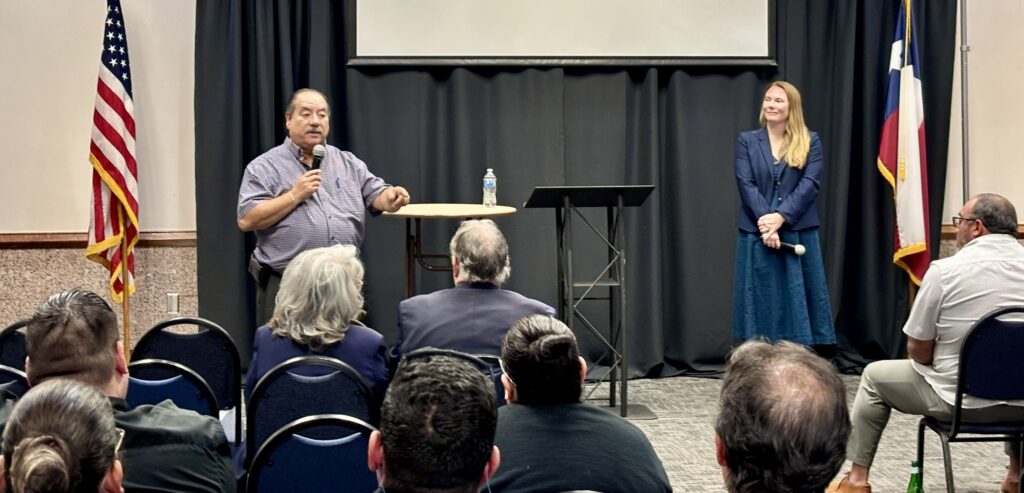
Photo Credit | Matt Wilson
The people at the town hall seemed to broadly agree that immigration policies that have disrupted other industries have had a chilling effect on the restaurant sector.
“There’s a tremendous amount of fear of going out and eating right now,” McAllen City Commissioner Tony Aguirre said. “Maybe in McAllen not as much, but in the surrounding cities of McAllen, there’s a lot of restaurants that are slow because people are afraid to go out and eat.”
Those concerns don’t mean Monday’s town hall was overly negative.
Streufert pointed to legislative wins for the TRA last year, including money-saving permit reforms and preventing new menu, signage, pricing and labeling mandates.
Monday’s meeting even turned up two prospective legislative contacts for the industry: both of the Rio Grande Valley’s state senators, who spoke at the town hall.
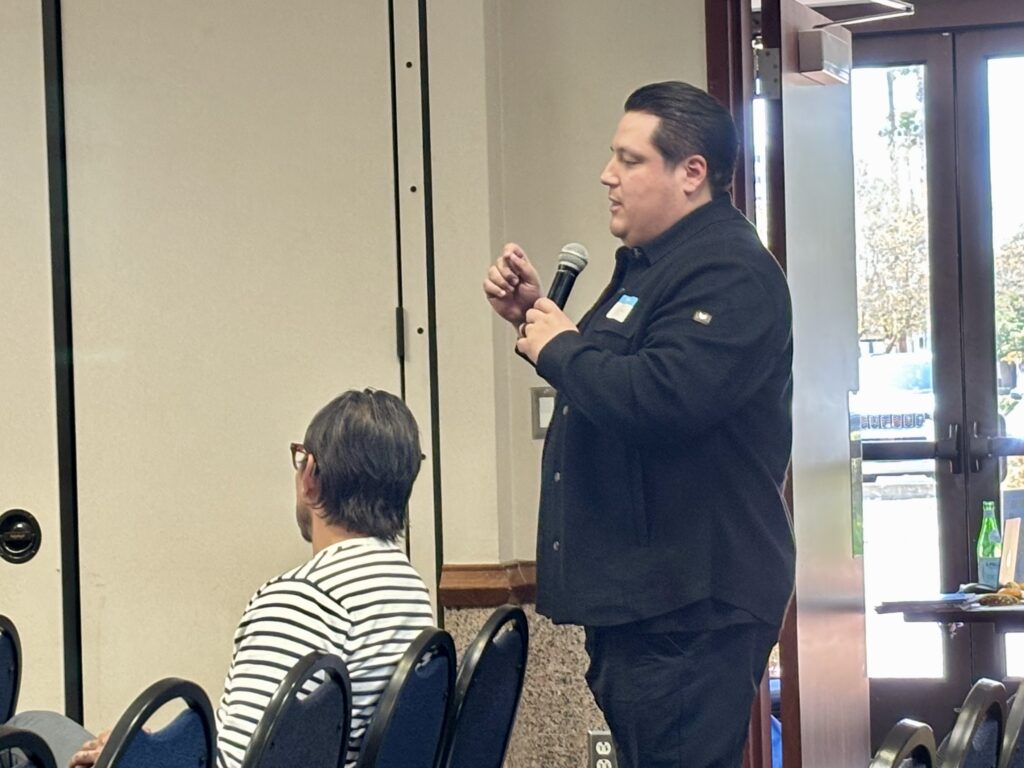
Photo Credit | Matt Wilson
Industry members also said they’re optimistic about restaurants, including Bob Lozano, CEO of F&P Group of McAllen.
Lozano said he thinks technology will be an important part of the restaurant industry’s path forward, including the adoption of AI. He said F&P identified $200,000 annually in software he intends to eliminate and replace with AI that’s significantly cheaper.
“We’re very pro-tech at F&P,” Lozano said. “We believe in technology, we believe that it’s a necessary way to do business for the future.”
Newer technology might drive business, but that doesn’t mean it will be easy for restaurants.
Lozano said traffic in his restaurants has been up for the past 36 months and that a bulk of that increase is because of third-party delivery services.
“We shifted from 1-2% [third-party delivery] to double-digits,” he said. “And so as our business shifts, what does that translate to in our business? It’s more labor hours, it’s more transactions, it’s more work because there’s more transactions — but there’s less profitability at the bottom line.”

Matt Wilson
Reporter
Matt Wilson is a Hidalgo County–based freelance reporter and contributor to the Rio Grande Valley Business Journal. He previously covered education and general assignment for The Monitor, frequently writing about the dramatic ways business changed during the coronavirus pandemic. Before that he worked as a reporter in rural Central Texas where he covered everything from house fires to school board meetings.
Most Read
- Is SpaceX quietly building a data center at Starbase? Job postings offer clues
- 25 Mexican businesses eye McAllen expansion after city pitches U.S. market entry program
- SpaceX’s futuristic city of Starbase finalizes massive 7,100-acre annexation. Here’s what we know.
- McAllen metro keeps selling more homes as Brownsville-Harlingen market sees 17% drop through August
- Rio Grande LNG moves closer to getting even bigger at Port of Brownsville
Get the latest business news delivered to your inbox every morning for free.
Try 30 Days Free!
Get full access to award-winning journalism covering business, real estate, health care, economic trends, and the people shaping the Rio Grande Valley.
30 Days Free!
$9.95/month
Limited time offer
Subscription renews after your 30 day free trial at $9.95/mo.
Included Benefits
- Unlimited access to all articles
- Daily business news and analysis
- Subscriber-only content and features
Stories That Matter
- Valley has a seat at the table in Austin, but TxDOT says leaders must get their act together
- Home sales down in McAllen metro, flat in Brownsville metro — see data
- Academy Award-nominated actor Terrence Howard to headline Social Fest in McAllen
- Mission’s first Small Business Expo puts $25K on the line for local entrepreneurs
- New filings detail nearly $11M in UTRGV tennis, football stadium improvements
- McCoy’s gives $10K, tools to launch Mid-Valley construction academy
- UT Health RGV performs new digestive procedure for first time in the Valley
- Tamaulipas battles rising screwworm cases as cattle exports remain on hold
- TSTC bets on advanced manufacturing to meet RGV’s industrial boom
- Pharr’s cross-border business push earns international recognition