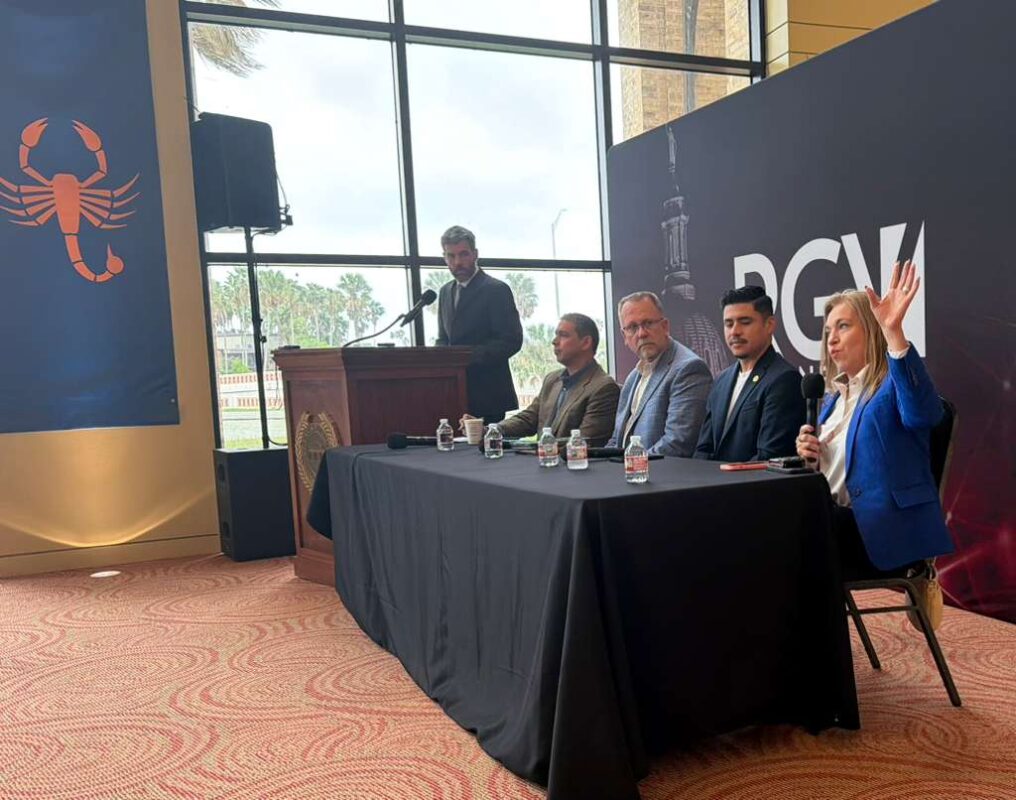
Dozens of leaders across the Rio Grande Valley leaned into a forum on water policy at Texas Southmost College in Brownsville on Wednesday as part of a series hosted by the Rio Grande Valley Partnership known as RGV Connect.
The regional advocacy organization plans to host similar events to tackle infrastructure — from water to roadways and even energy — to gauge which investments to push with lawmakers in Washington, D.C., and Austin.

The Texas Water Development Board estimates that by 2030, the planning region, which includes the Rio Grande Valley, will have a shortage of 924,400 acre-feet, and demand is projected to outpace supply until 2070.
That’s because demand for water is expected to top 1.79 million acre-feet by 2030, but there’s only 897,608 acre-feet available from surface water in the Rio Grande River, groundwater, brackish desalination, and water reclamation projects.
“You’re not going to run out of water. But the water that the Valley was built on, the unlimited water that created the magic Valley at the turn of the century, that the irrigation districts were built off of, that water is not what it once was,” Colin McDonald, a senior policy analyst for the Texas Water Foundation, said during the event.
Agriculture takes the biggest hit
Agriculture accounts for the greatest demand for water, at 1.3 million acre-feet, with an expected shortfall of 843,532 acre-feet by 2030. The estimate applies to Region M, which includes eight counties along the Rio Grande River from Laredo to Brownsville.
By comparison, municipal water use is expected to require 373,896 acre-feet in Region M by 2030, with a shortfall of about 69,000 acre-feet.
Not only are agricultural users at the end of the line for water delivery, but farmers also require the cheapest water available: raw surface water from the Rio Grande River delivered through a gravity-based canal system.

The Valley already lost its $100 million sugar cane industry when the sugar mill shut down in 2024.
“The sugar industry is not coming back. The citrus industry is probably the next one that is teetering. The permanent crops, like citrus trees and sugar cane, are the ones that are most vulnerable,” said Brian Jones, a Hidalgo County farmer and Texas Farm Bureau’s State Board Director for District 13, which represents South Texas.
Jones said water shortages accounted for $495 million of economic activity loss each year.
And citrus production has already declined: in 2020, there were 27,000 acres of citrus across South Texas, producing 11 million cartons of fruit. But in 2025, there were only 18,600 acres and 5.6 million cartons harvested.
“Our citrus acreage is not only declining, but there’s a loss of production. Now some of this is citrus being pushed out for development,” Jones said.
Some farmers in the Valley are growing less water-intensive crops, such as increasing the number of onions planted, from 5,100 acres in 2020 to 6,400 acres in 2025, he said.
“Our farmers are gambling on receiving the water allocation or rain to irrigate the crops. They’re switching over to onions,” Jones said.
But that has increased the supply of onions on the market, leading to cheaper onions.
Jones said that without sufficient water, shorter-season crops can oversaturate the market, leaving farmers with fewer options.
Projects aim to stretch supply
The water shortage has inspired some government entities, such as Hidalgo County, to get creative about reclaiming rainwater from the drainage ditch system.
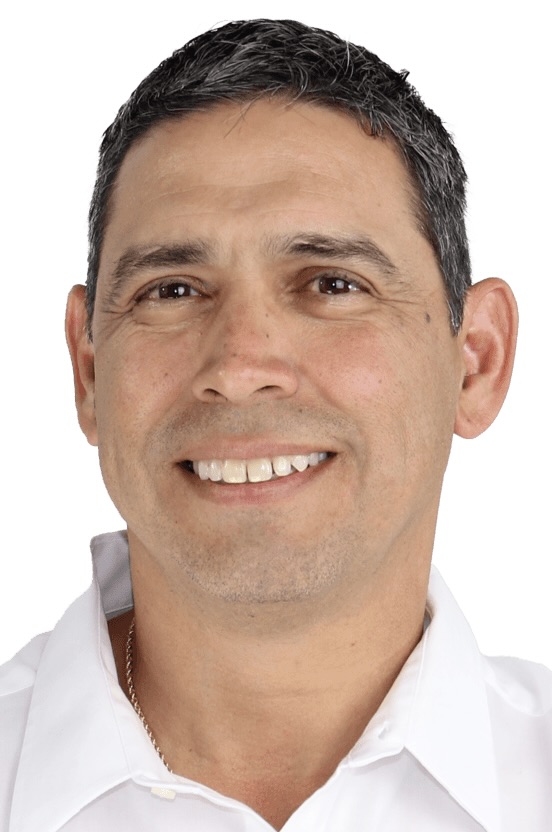
David Fuentes, the Hidalgo County commissioner for Precinct 1 and board member of Hidalgo County Drainage District 1, spearheaded the Delta Region Water Management Project, which would create four new water reservoirs and new water treatment plants.
The first water treatment plant for rainwater collected would cost $70 million.
“We’re going to take this water, we can repurpose it and sell it to a water supply to sell it to municipalities and offset the residential and commercial demand so agriculture can get its portion, too,” Fuentes said.
For municipalities such as the city of Brownsville — the last city in line for its water allocation from the Rio Grande River – the Laguna Madre Water District’s pumps are upstream from Brownsville’s, even though Port Isabel sits closer to the Gulf Coast.
That means the city’s water supply has always been even more limited — one reason the Brownsville Public Utilities Board has a stake in a brackish desalination plant, which is undergoing an expansion to 20 million gallons per day.
Last year, Brownsville used 5.4 billion gallons of surface water and 2.3 billion gallons of processed groundwater out of its 10.4 billion-gallon allocation, or about 74%.
The Brownsville Public Utilities Board has water rights of 31,965 acre-feet each year, but how much it can actually use depends on how much water the Rio Grande River sends into the Falcon and Amistad reservoirs.
As of Wednesday, the Falcon reservoir was 19.2% full, with 352,013 acre-feet of water in storage, up from 15.9% full and 339,833 acre-feet in April 2025. The Amistad reservoir was 31.3% full, with 620,018 acre-feet, up from 25% full in April 2025, with 642,668 acre-feet.
And those reservoirs must have at least 300,000 acre-feet of water at the end of each month.
But how much water is in those reservoirs also depends on how much Mexico delivers under a 1944 treaty that governs the Rio Grande.
Mexico currently owes the U.S. about 1.1 million acre-feet of water under the treaty. Late last year, it promised to release more water in response to pressure from President Donald Trump.
In the mid-2000s, Brownsville sought to build a dam on the Rio Grande to store 6,000 acre-feet of water out of the 40,000 acre-feet it can capture, but the project fell apart because Mexico refused to agree to the deal.
If there is any surplus water, or water from natural rainfall, such as a tropical storm, Brownsville has an additional permit to capture up to 40,000 acre-feet of water from the Rio Grande.
But that doesn’t mean the city has given up on a future dam — a binational project that requires coordination with the federal and state governments.
“This is the time for it to be built,” said Marilyn D. Gilbert, CEO of the Brownsville Public Utilities Board. “Of course, we would be an active participant. We currently have a permit that would give us water rights. But there’s no water rights behind the dam because there’s no dam.”
The key is balancing the need to address water shortages with requests from industrial customers to invest in more water infrastructure, without raising rates for the average single-family household, Gilbert said.
That sentiment was echoed by Bryan Martinez, Brownsville city commissioner for District 1, during the forum.
“We need to look for ways to diversify that keep up with the future growth of the city,” he said. “The Port of Brownsville as well as the city of Brownsville are starting to see unprecedented growth of industries coming to our backyard. With that growth comes those strains on our local resources.”

Kristen Mosbrucker-Garza
Reporter
Kristen Mosbrucker-Garza is a versatile multimedia news reporter who lives and works along the Texas-Mexico border in Hidalgo County. Mosbrucker-Garza is a news reporter for the Rio Grande Valley Business Journal. During her career she's worked for the McAllen Monitor, San Antonio Business Journal, The Advocate Newspaper in Louisiana, Phoenix New Times, and public media outlets in Baltimore and Philadelphia.
Most Read
- Is SpaceX quietly building a data center at Starbase? Job postings offer clues
- 25 Mexican businesses eye McAllen expansion after city pitches U.S. market entry program
- SpaceX’s futuristic city of Starbase finalizes massive 7,100-acre annexation. Here’s what we know.
- McAllen metro keeps selling more homes as Brownsville-Harlingen market sees 17% drop through August
- Rio Grande LNG moves closer to getting even bigger at Port of Brownsville
Get the latest business news delivered to your inbox every morning for free.
Try 30 Days Free!
Get full access to award-winning journalism covering business, real estate, health care, economic trends, and the people shaping the Rio Grande Valley.
30 Days Free!
$9.95/month
Limited time offer
Subscription renews after your 30 day free trial at $9.95/mo.
Included Benefits
- Unlimited access to all articles
- Daily business news and analysis
- Subscriber-only content and features
Stories That Matter
- New filings detail nearly $11M in UTRGV tennis, football stadium improvements
- Brownsville job fair to connect workers with more than 10,000 opportunities Thursday
- Tamaulipas battles rising screwworm cases as cattle exports remain on hold
- Mission’s first Small Business Expo puts $25K on the line for local entrepreneurs
- McCoy’s gives $10K, tools to launch Mid-Valley construction academy
- UT Health RGV performs new digestive procedure for first time in the Valley
- TSTC bets on advanced manufacturing to meet RGV’s industrial boom
- Pharr’s cross-border business push earns international recognition
- Mission EDC launches search for new CEO with salary up to $190K
- Texas transportation leaders to discuss Rio Grande Valley infrastructure at Mission summit