The massive $88 million investment to improve cross-border trade capacity in the Rio Grande Valley is close to paying off, leaders told a local civic association on Thursday at the DoubleTree Suites Hotel in McAllen.
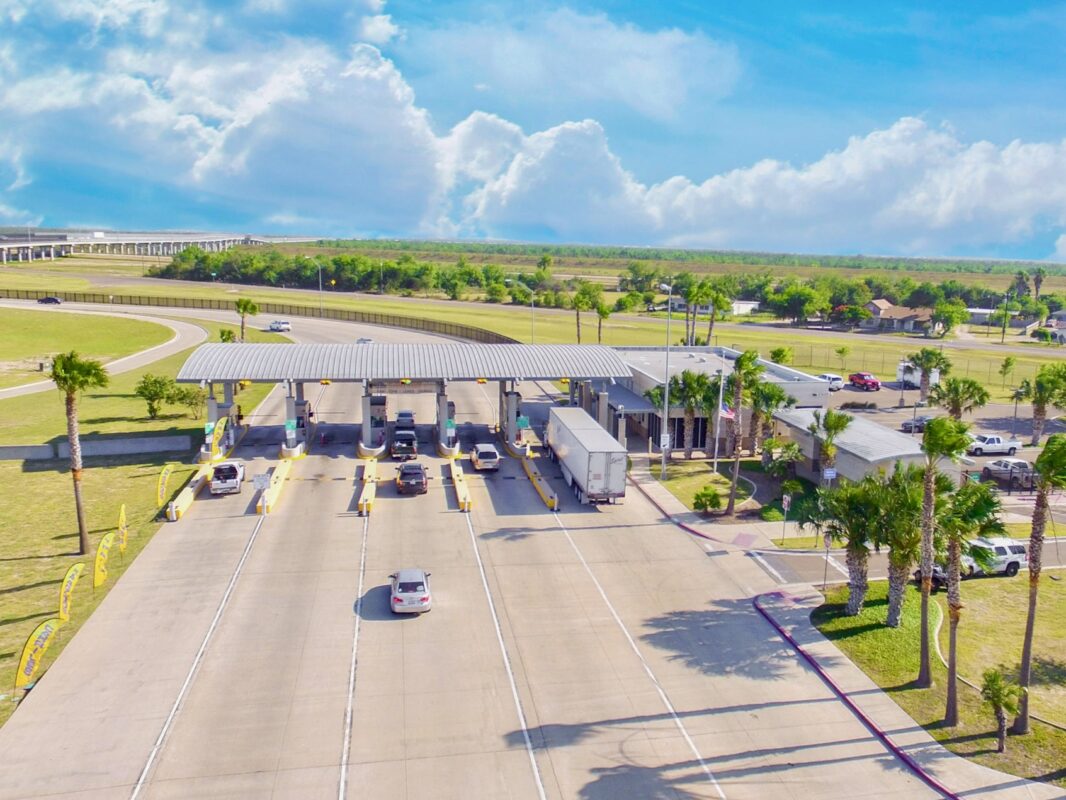
By September, U.S. officials expect to begin processing both southbound and northbound commercial truck traffic at the Anzalduas International Bridge. The port opened in 2009 but has been under construction since 2023 with the addition of new customs and inspection stations that will allow it to process northbound commercial cargo. It currently only allows empty southbound cargo traffic.
The project was initially projected to take about two years to complete, but it’s seen various delays.
One complication has been turnover in the Mexican government at the secretary level, which requires significant coordination to maintain relationships and continuity in conversations.
“We’re at 99% complete,” said Juan Olaguibel, who oversees the McAllen-Hidalgo and Anzalduas international bridges as McAllen assistant city manager and superintendent of bridges. “Now we’re working with the federal government to start operations in September for its unified cargo processing. And what that means is having Mexico on the U.S. side and being able to do their operations on this side until they build their operations on the Mexican side.”
To make the new inspection stations deal happen, the city of McAllen borrowed $63 million from the North American Development Bank and was awarded $22 million in grants from the Texas Department of Transportation through the Metro Planning Organization, plus a $25 million grant from the U.S. Department of Transportation. The city expects to repay the loan with bridge revenue from tolls, as the facility was donated to the federal government.
There are six new commercial inspection lanes, a new cargo processing and administration office, a command center, canopies, inspection booths, commercial inspection bays, road improvements, parking lot expansion, and security technology as part of the Anzalduas International Bridge project.

Photo Credit | Kristen Mosbrucker-Garza
The Mexican government is still working on improvements on its side of the Anzalduas International Bridge to support the flow of commercial traffic, but McAllen officials said they don’t have to wait much longer. The goal is to ensure that the Anzalduas International Bridge becomes the fastest in the nation with the dedicated SENTRI lane for commuters.
“It will take you longer to drive across the bridge than it will for you to go through customs and border protection,” Olaguibel said.
The city of McAllen holds a 66% ownership stake in the Anzalduas International Bridge, while the city of Mission holds a 33% stake. The McAllen-Hidalgo International Bridge is also a partnership between the cities of McAllen and Hidalgo.
Passenger vehicles make up most of the Anzalduas International Bridge’s traffic; more than 105,900 crossed southbound in February, according to the most recent data.
In 2016, McAllen began accepting southbound empty tractor-trailers as one way to break into the commercial traffic market. The city paid about $1.1 million for infrastructure improvements for the Anzalduas bridge in Mexico.
By February 2019, about 1,600 trucks were crossing into Mexico. That has mostly increased with a recent peak of 6,000 trucks in February 2024. This year, about 4,000 empty tractor-trailers crossed the bridge heading into Mexico during February — that’s an 11% increase over the year.
Passenger vehicle traffic on the Anzalduas bridge was up about 1%, while bus traffic was down 40% in February compared to last year.
The bridge appears to be the preferred crossing for people working in the maquila industry.
Of the 1,131 who crossed southbound into Mexico for that line of work, 917 used the Anzalduas International Bridge.
For the McAllen-Hidalgo International Bridge, there was a 9% increase in pedestrian traffic, totaling 112,232; an 8% increase in passenger vehicles, to 206,864; and a 19% decrease in bus traffic to 733 vehicles in February.

Kristen Mosbrucker-Garza
Reporter
Kristen Mosbrucker-Garza is a versatile multimedia news reporter who lives and works along the Texas-Mexico border in Hidalgo County. Mosbrucker-Garza is a news reporter for the Rio Grande Valley Business Journal. During her career she's worked for the McAllen Monitor, San Antonio Business Journal, The Advocate Newspaper in Louisiana, Phoenix New Times, and public media outlets in Baltimore and Philadelphia.
Most Read
- SpaceX’s futuristic city of Starbase finalizes massive 7,100-acre annexation. Here’s what we know.
- SpaceX reschedules Starship’s first flight around the Earth
- How much water does SpaceX need to operate near Brownsville? Nearly 20x its current use
- Could apartment-to-condo conversion help make $100K homeownership in the McAllen metro more affordable? One investor says yes.
- Crunch Fitness is expanding and struggling in the Valley. Here’s why
Get the latest business news delivered to your inbox every morning for free.
Try 30 Days Free!
Get full access to award-winning journalism covering business, real estate, health care, economic trends, and the people shaping the Rio Grande Valley.
30 Days Free!
$9.95/month
Limited time offer
Subscription renews after your 30 day free trial at $9.95/mo.
Included Benefits
- Unlimited access to all articles
- Daily business news and analysis
- Subscriber-only content and features
Stories That Matter
- Starbase leaders approved a 45-year land deal with SpaceX for 166 acres, but what will be built there remains a mystery
- Two Valley businesses turned mangonadas into a school-friendly popsicle. Now they want to take it nationwide
- Pharr doubles bridge capacity as data centers and produce drive new trade demand
- Mission’s first Small Business Expo puts $25K on the line for local entrepreneurs
- Reynosa’s newest technical high school focuses on AI, semiconductors and bionics
- McCoy’s gives $10K, tools to launch Mid-Valley construction academy
- UT Health RGV performs new digestive procedure for first time in the Valley
- Construction begins on Saronic’s $3.2B Brownsville shipyard. Here’s what’s being built first
- TSTC bets on advanced manufacturing to meet RGV’s industrial boom
- Pharr’s cross-border business push earns international recognition