The company planning to build a $1 billion seawater desalination plant on the far north side of South Padre Island expects to file for environmental and state and federal regulatory permits soon.
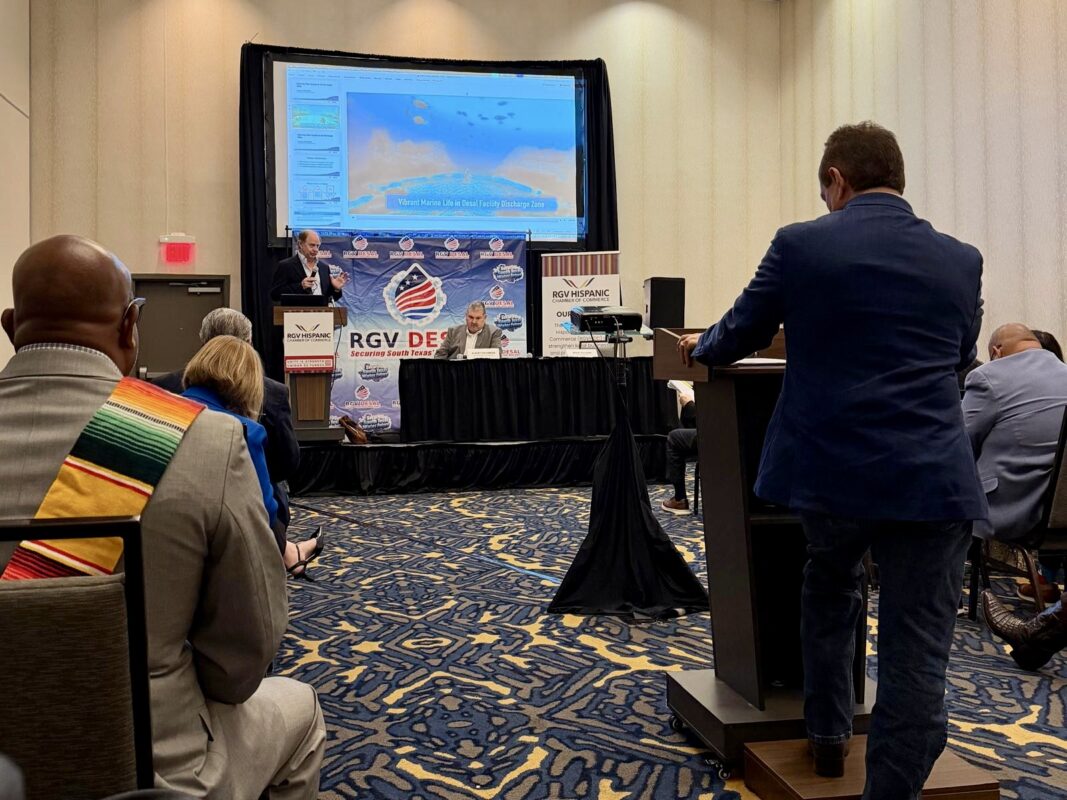
RGV-Desal LLC shared its plans with members of the RGV Hispanic Chamber of Commerce at the Embassy Suites by Hilton in McAllen on Thursday.
“Water has been one of our greatest challenges facing our region. Water is not simply a resource; it is the foundation of our quality of life, our public health, our agriculture, our economic development, and the future growth of our communities,” Cynthia Sakulenzki, CEO of the Rio Grande Valley Hispanic Chamber of Commerce, said. “The proposal of the RGV desalination project represents a bold, forward-thinking investment in the future of South Texas.”
RGV-Desal is a partnership between Houston-based U.S. Desalination and IDE Technologies, an Israeli water desalination and water treatment business. The project has been in the works for the past year and a half, officials said.
The proposed plant — which would produce up to 120 million gallons per day, up from the previously proposed 100 million gallons — would be constructed in a modular manner, and its first phase is likely to process about 50 million gallons of seawater per day.
RGV-Desal has a 117-acre site just south of the proposed second causeway between South Padre Island and Holly Beach in Cameron County’s mainland.
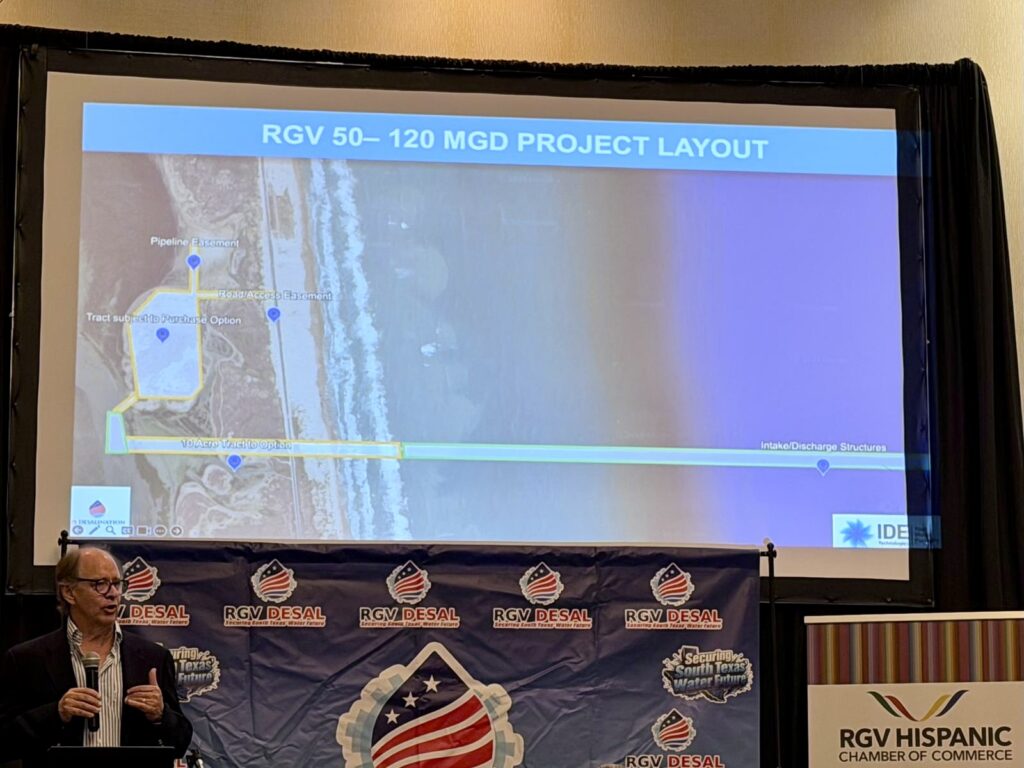
Photo Credit | Kristen Mosbrucker-Garza
The land lies beyond the city limits of South Padre Island and is in Cameron County, so no formal zoning process is required.
The goal is to build a pipeline attached to the new bridge, which would then be routed across the Valley with a grid. The excess brine and salt from the plant would be released back into the ocean.
Since the project is still in the planning phase, it’s possible the pipeline would be buried under the Laguna Madre Bay instead, depending on the construction schedule of the new causeway, officials said.
Doug Allison, a Corpus Christi attorney and partner at RGV Desal, said he’s confident that a seawater desalination project would not be detrimental to the local environment, whether on land or underwater.
“We can deliver the project in a way that’s environmentally sensitive, supporting marine life, the community, and economic development,” Allison said. “By doing large-scale desal, the more pressure we take off your river, your surface water and your groundwater.”
He expects the environmental and state regulatory permitting process for the South Padre Island plant to take about 12 months to complete.
The permits are already drafted, and the company is looking at acquiring more land. Such a project would require intake and discharge permits from the Texas Commission on Environmental Quality, the Texas General Land Office, and likely the U.S. Army Corps of Engineers.
“We have a team that has gotten permitting done and can do that on a much expedited basis. We have the right group doing the design, oversight of construction and making sure that startup operations go smoothly, not just for a day, week or a month, with a long-term commitment,” Allison said.
Allison previously worked with the Port of Corpus Christi to secure permits for a private seawater desalination project, which was permitted but ultimately not built.
On the mainland of Cameron County, the municipal customers of the seawater desalination plant would be responsible for building out the pipeline transmission network as the public part of the public-private partnership model.
“We have met with many of the larger and smaller water districts and municipalities. I think the response overall has been that everyone understands they need to be forward-thinking in securing a water supply, seawater desal is the only long-term, constant, uninterrupted supply as part of their portfolio,” he said.
RGV Desal has the support of a coalition of elected officials seeking a regional approach to water security and has received verbal commitments from customers so far.
Municipal water authorities would be eligible to apply either individually or collectively for grants and low-interest loans from the Texas Water Development Board to fund it.
Allison said there’s potential for right-of-way already owned by municipal customers, such as city water authorities, and by the Texas Department of Transportation, which is willing to offer a slice of its roadway right-of-way along Expressway 83.
The seawater desalination plant could also support industrial customers such as the proposed oil refinery at the Port of Brownsville or water-intensive data centers. It would not likely be used in agriculture. The plant would employ about 50 workers with high-paying jobs.
Desalinated seawater is the most expensive water option, estimated to cost between $3.60 to $5.80 per 1,000 gallons, according to the Texas Water Development Board. And that would not include potential transmission pipeline costs for distribution.
“We have to be able as a community to tell [potential companies] that there’s 20 years, 30 years, 50 years of water. A lot of large developments have 20, 30, 50-year financing commitments, and you’re not going to get those development projects without being able to guarantee a sustainable water supply,” Allison said. “The economic impact of 50 million gallons of water is $55 billion in economic activity.”

Kristen Mosbrucker-Garza
Reporter
Kristen Mosbrucker-Garza is a versatile multimedia news reporter who lives and works along the Texas-Mexico border in Hidalgo County. Mosbrucker-Garza is a news reporter for the Rio Grande Valley Business Journal. During her career she's worked for the McAllen Monitor, San Antonio Business Journal, The Advocate Newspaper in Louisiana, Phoenix New Times, and public media outlets in Baltimore and Philadelphia.
Most Read
- How much water does SpaceX need to operate near Brownsville? Nearly 20x its current use
- Could apartment-to-condo conversion help make $100K homeownership in the McAllen metro more affordable? One investor says yes.
- SpaceX’s futuristic city of Starbase finalizes massive 7,100-acre annexation. Here’s what we know.
- Cameron County is negotiating a $20M Fluidstack data center donation after Harlingen waffles on the same offer
- Fluidstack breaks ground on $4 billion Cameron County AI data center
Get the latest business news delivered to your inbox every morning for free.
Try 30 Days Free!
Get full access to award-winning journalism covering business, real estate, health care, economic trends, and the people shaping the Rio Grande Valley.
30 Days Free!
$9.95/month
Limited time offer
Subscription renews after your 30 day free trial at $9.95/mo.
Included Benefits
- Unlimited access to all articles
- Daily business news and analysis
- Subscriber-only content and features
Stories That Matter
- What we know about Zoho Corporation and what could be built at its 1,000-acre campus
- SpaceX bought some water rights from the Rio Grande River. Here’s what we know.
- Foreign-Trade Zone No. 12 expands into Willacy County
- Mission’s first Small Business Expo puts $25K on the line for local entrepreneurs
- Reynosa’s newest technical high school focuses on AI, semiconductors and bionics
- McCoy’s gives $10K, tools to launch Mid-Valley construction academy
- UT Health RGV performs new digestive procedure for first time in the Valley
- TSTC bets on advanced manufacturing to meet RGV’s industrial boom
- Pharr’s cross-border business push earns international recognition
- Brownsville eases drought restrictions after nearly three years as Rio Grande reservoir levels improve