A key economic development tool that has helped attract housing, industrial and commercial investment across the Rio Grande Valley is up for renewal, and local communities are now waiting to see whether they will make the cut.
The Texas Economic Development & Tourism Office has closed nominations for Opportunity Zone 2.0 after receiving more than 1,200 proposed census tracts from more than 175 economic development organizations and county judges across 114 counties.
The Governor’s Office will now evaluate those nominations and submit Texas’ final recommendations to the U.S. Department of the Treasury by Aug. 17. Based on current eligibility, Texas can nominate up to 605 census tracts for the federal program.
For the Rio Grande Valley, the decision could influence which neighborhoods and industrial corridors are best positioned to compete for new private investment over the next decade, as developers weigh Opportunity Zone tax incentives alongside other factors when deciding where to build.
Opportunity Zones are federally designated areas that give investors a tax incentive to reinvest profits from the sale of assets — such as stocks, businesses or real estate — into new development projects.
If those investments are made through a Qualified Opportunity Fund and held long term, investors can reduce or eliminate certain federal capital gains taxes. Because of those incentives, cities and economic development organizations use the designation to make industrial parks, commercial corridors and redevelopment sites more attractive to developers and other private investors.
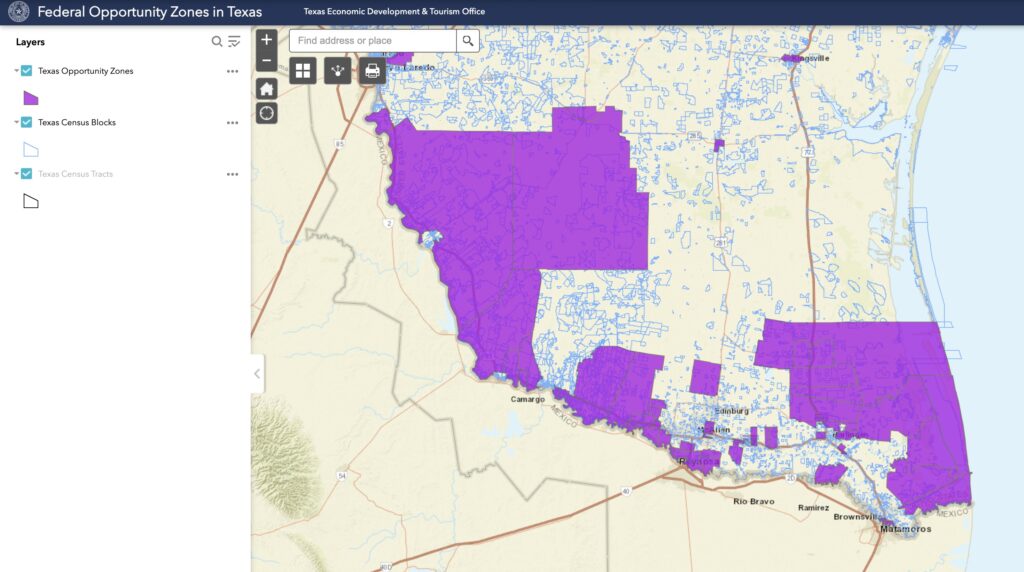
State maps show dozens of census tracts across Hidalgo, Cameron, Starr and Willacy counties are eligible to be considered under the new program. However, eligibility does not guarantee selection.
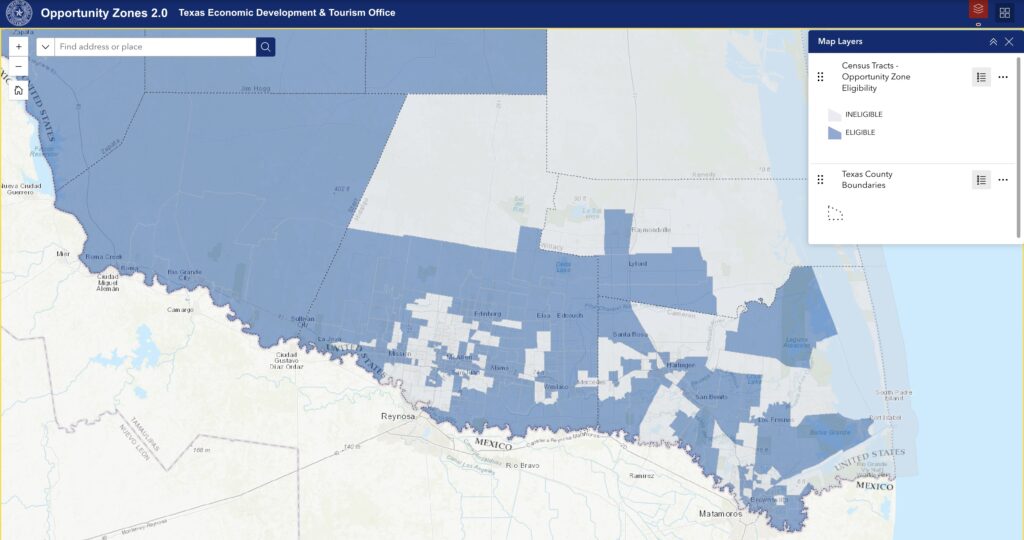
If a Valley census tract is not redesignated under Opportunity Zone 2.0, future projects there generally would no longer qualify for the program’s new federal capital gains tax incentives after the transition period. Existing Opportunity Zone investments, however, continue under the current program’s rules, meaning communities that lose the designation are primarily giving up a tool for attracting future investment rather than affecting projects already underway.
Unlike the original Opportunity Zone program established in 2018, communities that currently hold the designation will not automatically keep it. Some Valley neighborhoods could lose the designation, while others that were previously left out could gain it.
The timing comes as the Rio Grande Valley continues to attract billions of dollars in private investment tied to manufacturing, logistics, aerospace and international trade.
Tougher standards
The updated program, known as Opportunity Zone 2.0, was made permanent through the One Big Beautiful Bill Act approved by Congress in 2025. The new designations will take effect Jan. 1, 2027.
The revised program introduces stricter eligibility requirements than the original version.
To qualify, a census tract generally must have a median family income below 70% of the applicable state or metropolitan median income, or a poverty rate of at least 20% while maintaining a median family income no greater than 125% of the applicable median.
The new law also eliminates the “contiguous tract” rule, which previously allowed states to designate neighboring census tracts that did not independently meet federal income requirements.
At the same time, Opportunity Zone 2.0 increases incentives for investment in rural communities by offering enhanced tax benefits for qualifying rural investment funds.
What happens next
The Texas Economic Development & Tourism Office said it considered several factors during the nomination process, including whether local communities support development through incentives, the likelihood that private investment could occur within the next two to four years, and geographic balance across the state.
The office also gave consideration to communities affected by federally declared disasters during the past three years.
The U.S. Treasury is expected to certify the final designations later this year.
Current Opportunity Zone designations will remain in effect through Dec. 31, 2028, creating a two-year overlap with the new program. However, existing Opportunity Zones must be renominated and approved under the updated criteria if communities want to retain the designation beyond that period.

RGV Business Journal Staff
Staff
Most Read
- SpaceX is giving Brownsville $220M for water projects. In exchange, the city gave up zoning control of 444 acres near Starbase
- SpaceX seeks to take zoning control over nearly 450 acres from city of Brownsville as a ‘regional’ water deal takes shape
- Port of Brownsville could soon host Nodule City, a first-of-its-kind commercial deep-sea mining hub
- Cameron County is negotiating a $20M Fluidstack data center donation after Harlingen waffles on the same offer
- How much water does SpaceX need to operate near Brownsville? Nearly 20x its current use
Get the latest business news delivered to your inbox every morning for free.
Try 30 Days Free!
Get full access to award-winning journalism covering business, real estate, health care, economic trends, and the people shaping the Rio Grande Valley.
30 Days Free!
$9.95/month
Limited time offer
Subscription renews after your 30 day free trial at $9.95/mo.
Included Benefits
- Unlimited access to all articles
- Daily business news and analysis
- Subscriber-only content and features
Stories That Matter
- McAllen’s $204M water investment expects to seek construction bids in 2027
- Saronic lands Navy landing craft contract, first build at Brownsville’s Port Alpha
- The Rio Grande Valley’s tech industry is small but growing — meet some of the next-gen workforce
- Entrepreneurs enter Mission EDC’s ‘Shark Tank’ competition for $25K top prize
- Mission’s first Small Business Expo puts $25K on the line for local entrepreneurs
- Reynosa’s newest technical high school focuses on AI, semiconductors and bionics
- McCoy’s gives $10K, tools to launch Mid-Valley construction academy
- UT Health RGV performs new digestive procedure for first time in the Valley
- TSTC bets on advanced manufacturing to meet RGV’s industrial boom
- SpaceX reschedules Starship’s first flight around the Earth