
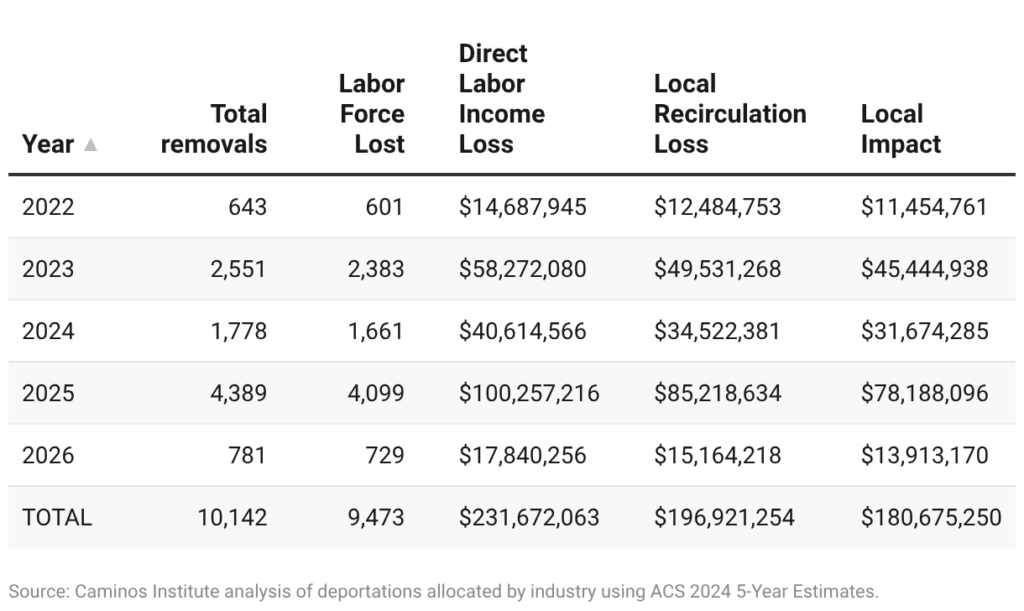
More than 10,000 people are estimated to have been deported from the Rio Grande Valley between October 2022 and March 2026 by U.S. Customs and Immigration Enforcement, according to a new report by a nonprofit research organization in Edinburg, Texas.
And that reality, with fewer residents in a community of several million people, comes with an economic loss estimated at $180.6 million between 2022 and 2026.
About 43% of those economic losses stem from 2025 alone, according to the Caminos Institute’s inaugural report.

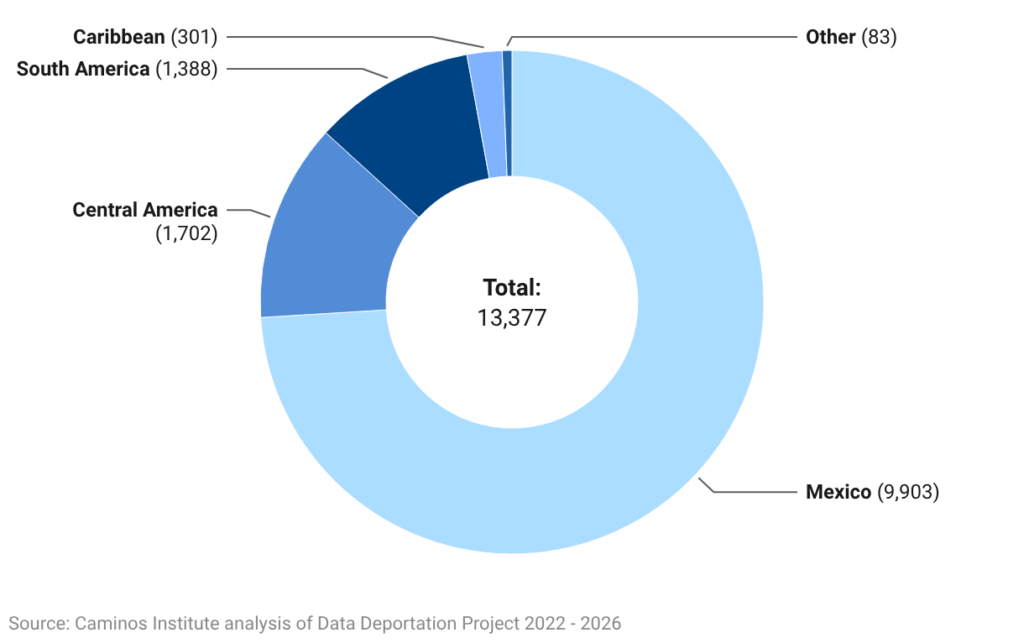
The report, written by the institute’s executive producer, Andrik Gonzalez, analyzed ICE arrest records obtained through Freedom of Information Act requests by the Deportation Data Project. It found that ICE detained 13,377 people in Hidalgo, Cameron, Willacy, and Starr counties from October 2022 through March 2026. Of those, ICE eventually deported 10,142 residents.
There have been sweeping changes in immigration policy under President Donald Trump’s second term in office, including deportation goals by ICE, a mass hiring of new agents, and more funding for law enforcement than ever. There were still apprehensions and deportations under previous President Joe Biden’s administration, but the pace and volume have increased significantly.
In Texas, Gov. Greg Abbott has prioritized limiting the ability of residents who are not U.S. citizens but may have legal status to continue working in the state.
For example, Deferred Action for Childhood Arrivals, or DACA, recipients have seen their visa terms shortened, and the Texas Department of Public Safety has eliminated DACA recipients’ ability to renew their commercial driver’s licenses, or CDLs, which enable individuals to drive tractor-trailers for work. The Rio Grande Valley has somewhere between 7,000 and 14,000 DACA recipients who live and work here out of 100,000 across Texas. There isn’t much publicly available data on how many DACA recipients are no longer in the workforce in Texas or the Valley.
But in general, the ICE strategy has been publicly announced to be focused on individuals with criminal records or gang activity, but individuals and trade groups in the Valley have said work site raids in construction have swept up legal residents, U.S. citizens, and those without legal status in the same buses. During a ropa usada business raid, even customers visiting the Valley were detained by ICE.

“We know what it is anecdotally, but for our policymakers, our stakeholders, and really the general public, what does that look like in numbers?” Gonzalez said in an interview with the Rio Grande Valley Business Journal.
The economic loss is “what these laborers would have been spending on a haircut, on gas, on day-to-day things, going to buy groceries, eating at a local restaurant, paying rent,” Gonzalez said.
The report is expected to be updated in the coming months with new data ICE released on deportations from March 2026 onward.
The average Rio Grande Valley resident who is in the U.S. without legal status is part of the workforce, Gonzalez said, citing U.S. Census estimates showing that 93% of noncitizens are in the local labor force with jobs.
The median age of individuals detained by ICE in the Valley was 36 years old. More than 100 of those detained were under 18. Nearly 69% were men, and the majority hailed from Mexico, while others were from Central and South America.
Gonzalez described the report as a conservative model that accounts for money leaving the region through remittances and taxes; a different formula produced a figure above $200 million.
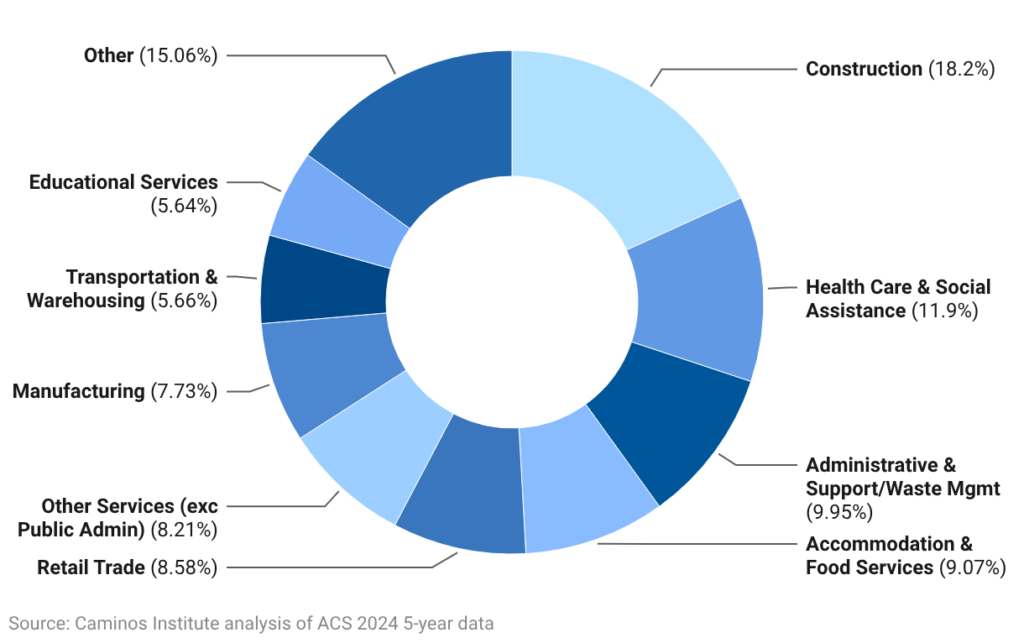
Construction was hit hardest, losing more than $42 million in direct labor income. The report found that 18% of the Valley’s more than 130,000 noncitizen workers are employed in construction, compared with 8.7% of the region’s total workforce.
Health care and social assistance lost more than $27.6 million in direct labor income. That industry is the Valley’s largest employer sector, at 16.1% of the total workforce, and employs 11.9% of the region’s noncitizen workers.
It’s unclear whether that highly regulated industry is mostly home health or not.
Accommodation and food services lost about $21 million. The report cites a 2026 Texas Restaurant Association study that found 36% of restaurant operators lost employees because of enforcement. The same study found that 28% saw fewer job applicants and that customer visits dropped 28%.
“These are not just a young population — they’re your parents, our neighbors, and for industry leaders, they are our workforce. They’re starting to see, with labor shortages, the adverse effect of this population being removed. That’s been my biggest takeaway, which is why we included the economic analysis — specifically for industry leaders,” Gonzalez said.
There is an argument in public discourse, including an economic pitch by ICE officials directly, that deportations improve the economy.
ICE officials recently posted on social media that dropping initial rents in some key markets indicated a smaller country with less competition and, therefore, a lower cost of living.
Gonzalez said he’s heard of the concept that these deportations are simply right-sizing the workforce and nationwide population with the idea that there’s more economic pie left over for U.S. citizens. But he disagrees. Instead, he counters that companies are most interested in workers with the skill set they need to get the job done, and if citizens are trained and willing to work in those industries, that’s a great match, but foreign-born visa workers already fill in the gap, and the economic pie is not bigger with fewer people in the community.
“Industries are coming into the Rio Grande Valley, no doubt about it, but they’re outsourcing rather than sourcing locally. And that has something to do about the skillset of our population here. So it might seem that the pie looks bigger, but in reality the pie is up for grabs and they are grabbing it. If we don’t start competing now, we’ll be outsourcing that pie and none of us will have a piece of it,” he said. “Industry doesn’t care; they’re going to [fill jobs] one way or another. If we’re not up par, they’ll outsource with visas.”

Kristen Mosbrucker-Garza
Reporter
Kristen Mosbrucker-Garza is a versatile multimedia news reporter who lives and works along the Texas-Mexico border in Hidalgo County. Mosbrucker-Garza is a news reporter for the Rio Grande Valley Business Journal. During her career she's worked for the McAllen Monitor, San Antonio Business Journal, The Advocate Newspaper in Louisiana, Phoenix New Times, and public media outlets in Baltimore and Philadelphia.
Most Read
- Edinburg ISD rejects nearly $6M offer for prime land near La Sienna despite $15M budget deficit
- Port of Brownsville approves $2M SpaceX pipeline deal, with millions more on the table
- What Toyota’s $3.6B San Antonio expansion could mean for the Rio Grande Valley
- McAllen’s nonstop Mexico City flight is back
- 5×5 Brewing plots $2.5M comeback with new Edinburg brewpub near UTRGV
Get the latest business news delivered to your inbox every morning for free.
Try 30 Days Free!
Get full access to award-winning journalism covering business, real estate, health care, economic trends, and the people shaping the Rio Grande Valley.
30 Days Free!
$9.95/month
Limited time offer
Subscription renews after your 30 day free trial at $9.95/mo.
Included Benefits
- Unlimited access to all articles
- Daily business news and analysis
- Subscriber-only content and features
Stories That Matter
- Port of Brownsville details SpaceX agreements worth more than $125M in potential revenue
- SpaceX makes history with first Starship catch at Starbase
- Mission’s first Small Business Expo puts $25K on the line for local entrepreneurs
- McCoy’s gives $10K, tools to launch Mid-Valley construction academy
- UT Health RGV performs new digestive procedure for first time in the Valley
- TSTC bets on advanced manufacturing to meet RGV’s industrial boom
- Pharr’s cross-border business push earns international recognition
- Brownsville eases drought restrictions after nearly three years as Rio Grande reservoir levels improve
- Texas A&M’s $53.5M McAllen research center will tackle water, food security and Valley health
- STC puts AI to work across 55 courses — from construction sites to car repair