The Rio Grande Valley economy slowed in 2025, but it’s expected to pick up in 2026, according to a new analysis by researchers at the Federal Reserve Bank of Dallas.
Last year, the Valley only added a small number of jobs. But by comparison, most major metros in Texas lost jobs in 2025.
Valley jobs grew 0.2% in 2025, compared to 1.2% in 2024.
Low job gains was a statewide trend.
Texas saw a 0.1% job growth last year, down from a 1.6% increase in 2024. That means Texas only added about 10,000 jobs last year.
The slowdown wasn’t limited to Texas.
Job growth across the U.S. hasn’t hit 1% in two years.
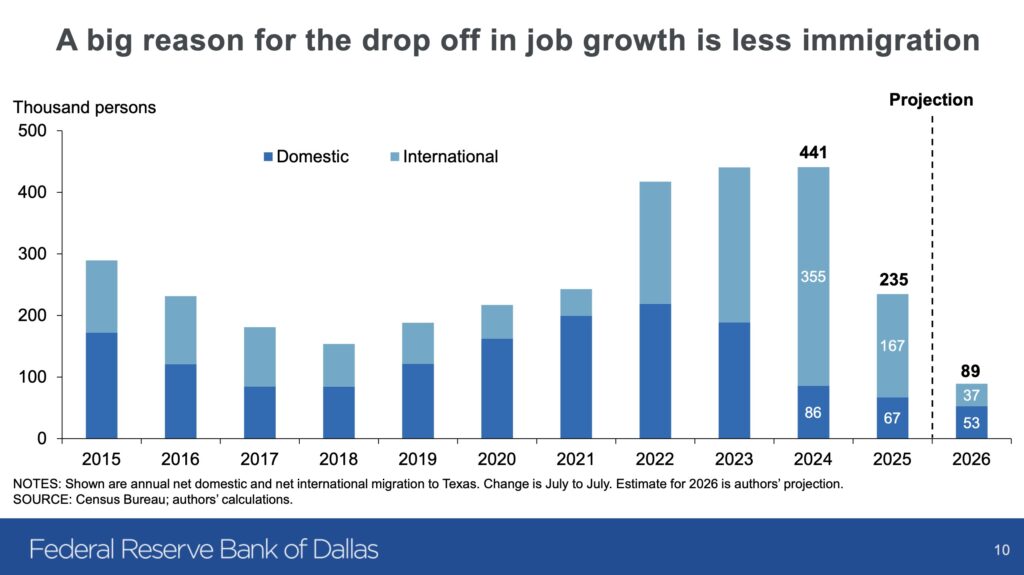
One driver of the market slowdown was the lack of immigration to Texas.
There was a significant drop in international immigration into the state and domestic migration to Texas between 2024 and 2025.
That trend is expected to continue in 2026.
“Given this background, 2025 was not as great as we thought it would be,” Pia Orrenius, senior economist with the Federal Reserve Bank of Dallas said during the 2026 Economic Outlook event hosted Friday by the Rio Grande Valley Business Journal. “But we think that 2026 will really see a pickup in growth. Some of the reasons are certainly the momentum of AI investment, data center construction we expect will carry forward.”
And yet, gross domestic product, or the value of all the economic activity in a region, remained steady, growing by 2.6% in 2025, down slightly from 2024.
That means there was an increase in productivity across the economy, but it wasn’t driven by job growth. Businesses produced more goods and services without adding more employees and avoided widespread layoffs.
That’s known as a “low hire, low fire” situation, Orrenius said.
“Productivity growth is a good thing, unless you’re trying to get your kids who graduated from college into a job and not moving back into your house. Some of us are dealing with that,” she said.
Moving forward, Texas is expected to add 1.1% job growth in 2026.
Where growth is still happening
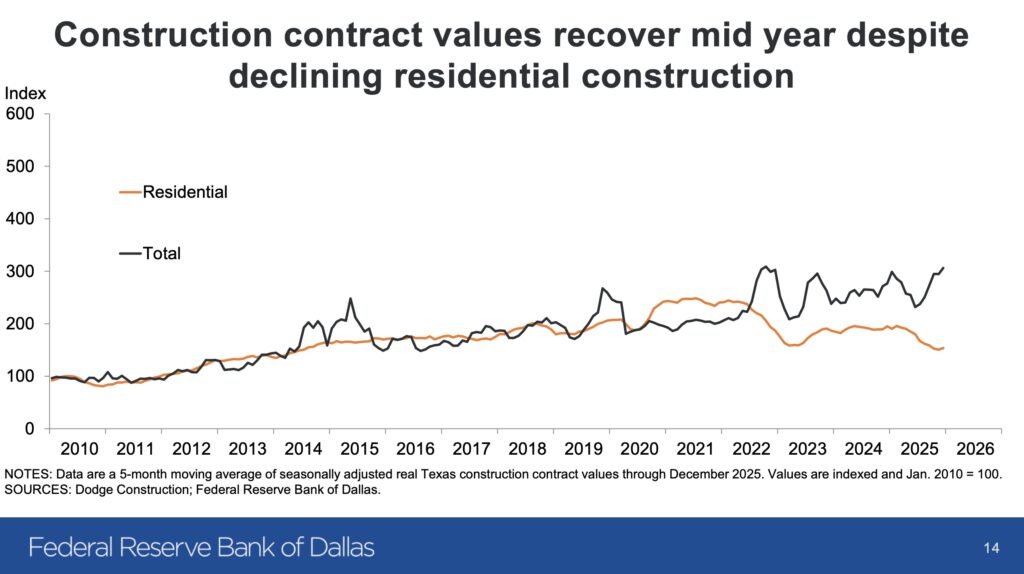
In the Rio Grande Valley, construction increased by 2.1% in 2025, compared to 2.3% statewide.
The uptick in construction in Texas wasn’t driven by residential construction, but instead commercial, industrial, warehouses, and even structures which are not commercial buildings — such as data centers.
International trade slowed overall in the second half of 2025, but the declines were not uniform across U.S. trading partners.
U.S. imports declined by 2.8% between June and November 2025, driven by new tariffs imposed by the Trump administration.
There was a 11.2% contraction in imports from Canada and a 41.5% drop from China, where the highest tariffs were imposed. But there was a 5.1% increase in imports from Mexico, despite a tariff war threat.
The Dallas Fed regularly surveys hundreds of businesses across Texas, and most recently asked about the impact of artificial intelligence on the workforce. About half of the companies statewide now use AI at work, and 8% say they used it to displace workers. About 5% responded that AI meant they hired more employees.
“We’re starting to see there are certain groups of workers where you can identify an impact. Actually, what it looks like is recent college grads are having a harder time finding jobs,” Orrenius said about the effect of AI at work. “And parents who are paying college bills are telling us that, as well, that the work prospects for their kids have worsened.”
Industry leaders weigh in
The Rio Grande Valley Business Journal’s inaugural economic summit also featured a panel of industry leaders to discuss the economy.
In general, local leaders said they’ve noticed strong demand in their respective industries and expect further growth in 2026.
“We rely heavily on the creation of new jobs in this region, whether you’re migrating here from another part of the country or you immigrate here,” said Shant Samtani, executive vice president of sales for Rhodes Enterprises. “There’s been a lot of job growth, and also this is just a really great, affordable place to live.”
Marketing the Rio Grande Valley as RioPlex is starting to pay off, too, said Joaquin Spamer, founder of CIL Group. That’s because there’s a major manufacturer expected to invest in operations to be announced soon, after courting the company for more than a year, he said.
Spamer said he was more optimistic that economic growth would be higher in 2026.
“There is a lot of the economy that is not accounted for. We still have a lot of people paying everything in cash,” he said.
For NextDecade, the company is moving forward with at least $30 billion for liquefaction trains one through five at the Rio Grande LNG export terminal along the Brownsville Shipping Channel.

Photo Credit | RGV Business Journal
A liquefaction train is a processing facility that takes natural gas from a pipeline and both compresses and supercools it. The final product, liquefied natural gas, is a supercooled product often exported overseas as an alternative energy source to nations without domestic energy extraction industries, such as many European and Asian countries.
The export terminal has space for 10 liquefaction trains on a nearly 1,000-acre site, with a capacity of 60 million tonnes of LNG per year.
And while thousands of construction jobs are supported by temporary work, there are also hundreds of permanent jobs expected, with an average salary of $100,000 a year. So far, the average share of local workers is 70%, according to the company.
“The number one source of workers has been Brownsville, then Mission and Edinburg — in that order,” said Andrea Figueroa Benton, head of community relations for NextDecade, the company behind the Rio Grande LNG export terminal.
The company expects that, in the coming years, its investment in deepening the Brownsville Shipping Channel will encourage more companies and industries to operate in the region.

Kristen Mosbrucker-Garza
Reporter
Kristen Mosbrucker-Garza is a versatile multimedia news reporter who lives and works along the Texas-Mexico border in Hidalgo County. Mosbrucker-Garza is a news reporter for the Rio Grande Valley Business Journal. During her career she's worked for the McAllen Monitor, San Antonio Business Journal, The Advocate Newspaper in Louisiana, Phoenix New Times, and public media outlets in Baltimore and Philadelphia.
Most Read
- How much water does SpaceX need to operate near Brownsville? Nearly 20x its current use
- Could apartment-to-condo conversion help make $100K homeownership in the McAllen metro more affordable? One investor says yes.
- SpaceX’s futuristic city of Starbase finalizes massive 7,100-acre annexation. Here’s what we know.
- Cameron County is negotiating a $20M Fluidstack data center donation after Harlingen waffles on the same offer
- Fluidstack breaks ground on $4 billion Cameron County AI data center
Get the latest business news delivered to your inbox every morning for free.
Try 30 Days Free!
Get full access to award-winning journalism covering business, real estate, health care, economic trends, and the people shaping the Rio Grande Valley.
30 Days Free!
$9.95/month
Limited time offer
Subscription renews after your 30 day free trial at $9.95/mo.
Included Benefits
- Unlimited access to all articles
- Daily business news and analysis
- Subscriber-only content and features
Stories That Matter
- These four projects are driving more than $41B in Cameron County investment
- Mission’s first Small Business Expo puts $25K on the line for local entrepreneurs
- Reynosa’s newest technical high school focuses on AI, semiconductors and bionics
- McCoy’s gives $10K, tools to launch Mid-Valley construction academy
- UT Health RGV performs new digestive procedure for first time in the Valley
- TSTC bets on advanced manufacturing to meet RGV’s industrial boom
- Pharr’s cross-border business push earns international recognition
- Brownsville eases drought restrictions after nearly three years as Rio Grande reservoir levels improve
- Texas A&M’s $53.5M McAllen research center will tackle water, food security and Valley health
- STC puts AI to work across 55 courses — from construction sites to car repair