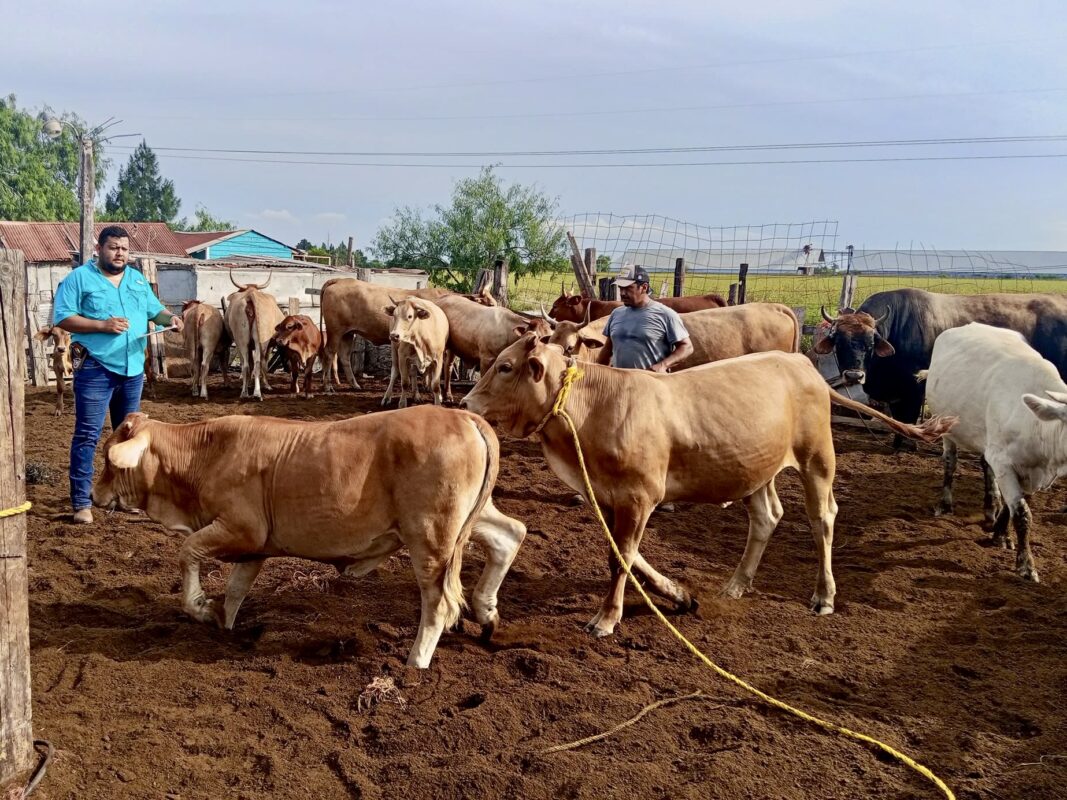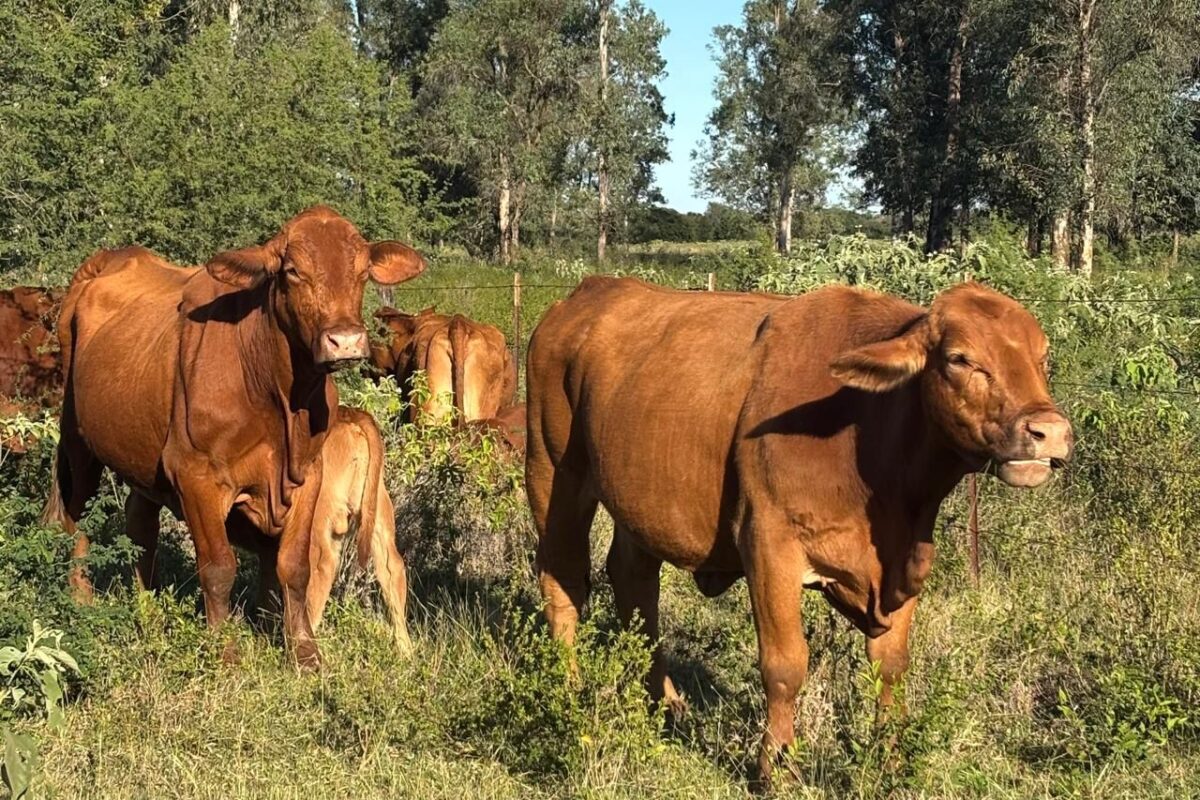
Cattle producers in northern Tamaulipas are tightening herd surveillance as the region faces a convergence of pressures — the presence of the New World screwworm parasite, severe drought conditions, and the continued suspension of cattle exports to the United States.

Industry leaders, veterinary authorities, and municipal officials said the situation remains under control, but requires vigilance from ranchers.
“We are strengthening preventive measures,” José Heriberto Cantú López, president of the Reynosa Cattle Association, said during an assembly last month.
Producers are disinfecting newborn calves’ navels and applying medications to prevent fly infestations, he said.
Exports of cattle to the United States remain suspended since late November 2024, and officials have not announced a reopening date.
Sanitary containment underway
State authorities say they are conducting an intensive monitoring and containment campaign across Tamaulipas to prevent the parasite from spreading north toward the border.
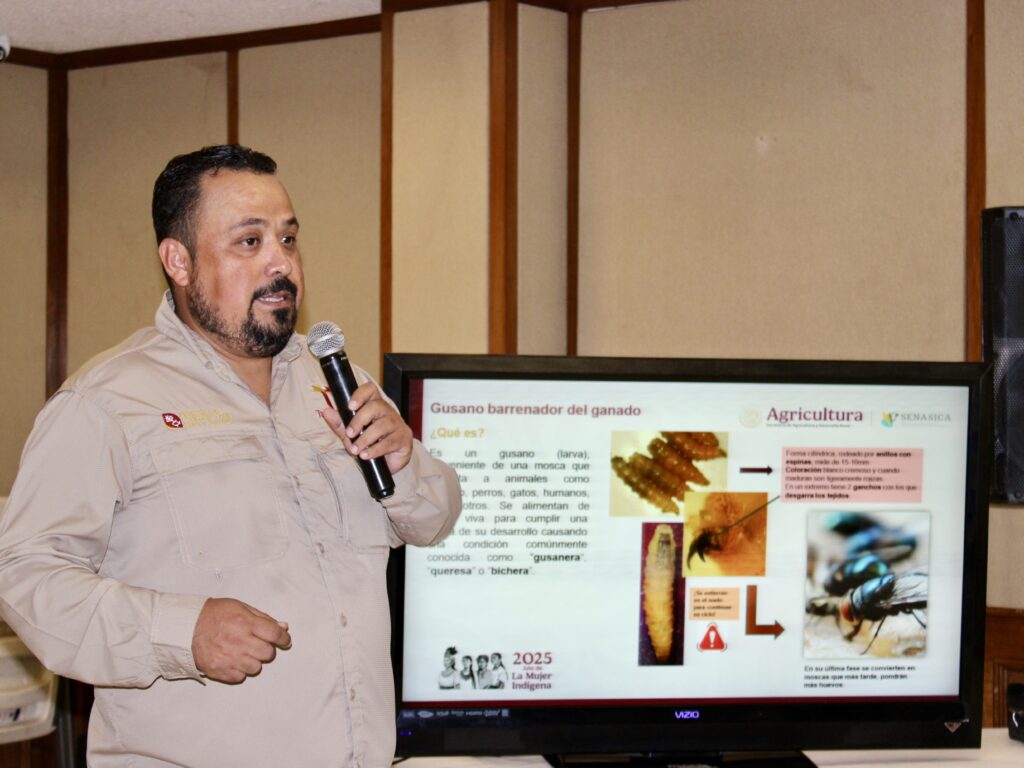
Courtesy of | Tamaulipas state government
Veterinary zootechnician Ricardo De Anda de la Cruz, of the Tamaulipas Secretariat of Rural Development, Aquaculture and Fisheries, said the strategy relies on both rancher reports and active field inspections.
“We are working primarily based on producer reports and, as a second layer, conducting direct sweeps whether there are reports or not,” De Anda said.
Inspections are focused on multiple animals.
“It’s a uniform sweep across all species — not only cattle, but also swine, sheep, goats, and even pets,” he said.
The protocol includes veterinary guidance, ivermectin treatment, wound care and follow-up monitoring.
Each treatment provides roughly 30 days of protection depending on dosage, officials said.
Cases concentrated farther south
Confirmed screwworm cases remain concentrated in central and southern Tamaulipas.
The municipality of González has recorded the highest number, with 11 cases, 10 of which are now inactive, De Anda said.
Other municipalities reporting cases include two in Ciudad Victoria, two in Aldama, one in Nuevo Morelos and one in Ocampo.
Authorities say the goal is to maintain a containment barrier before the parasite reaches the region.
“We are working to build a containment barrier toward the northern zone and the border,” De Anda said.
More than 150 veterinarians from agencies including OIRSA, CPA and Senasica are participating in the campaign.
Climate and wildlife complicate control
Environmental conditions could make the parasite harder to contain, officials said.
“The tropical temperate climate can work against us,” De Anda said. “It can create an ideal environment for faster reproduction.”
The screwworm fly completes its life cycle in about 21 to 23 days and can travel long distances.
“This fly can travel up to 300 kilometers in its biological cycle,” he said. “It could reach Reynosa from Tampico in just 21 days.”
Wildlife populations also make eradication more difficult.
“We cannot say we are free,” De Anda said. “The wildlife factor is always present.”
Sterile fly strategy expands
Officials say aerial dispersal of sterile flies — the main biological control strategy — is already underway along the U.S.–Mexico border.
“Practically the southern Texas border and northern Tamaulipas will have sterile fly dispersal,” De Anda said. “That will significantly reduce the risk.”
The effort operates under binational coordination involving federal Mexican agencies, international animal-health organizations and U.S. partners.
Industry warns of rapid spread
Livestock leaders say the parasite’s advance through Central America illustrates how quickly the threat can move.
“In one year it crossed all of Central America — 1,500 kilometers,” said José Ramón Guerrero Gamboa, president of the Unión Ganadera Regional de Tamaulipas. “It got out of control and reached Mexico.”
Guerrero said sterile flies produced in Panama are already being released over the region.
“All those 100 million flies produced in Panama are being released over Tamaulipas,” he said.
Additional infrastructure is planned, including: a dispersal center in Tampico, a new sterile fly plant in Chiapas, and a complementary facility in Edinburg.
Together, the facilities could produce roughly 500 million sterile flies for the regional eradication campaign.
Cattle movement raises concerns
Producers also warn that cattle movement from southern Mexico could increase sanitary risk.
Guerrero said about 2 million head of cattle from Chiapas and Tabasco move north toward feedlots each year.
“That cattle is coming north,” he said. “Perhaps inspections were not sufficient at the time.”
He also warned the industry faces a growing shortage of experienced ranch workers.
“That traditional cowboy profile no longer exists,” he said. “It is a serious problem.”
He expects cattle prices to remain high.
“Calves will remain expensive for several years,” Guerrero said.
Drought adds pressure
While sanitary surveillance remains critical, ranchers say drought is the most immediate challenge.

“The drought is very severe right now,” said Rigoberto Aguirre, president of the Matamoros Local Cattlemen’s Association. “There is no feed.”
Producers say pasture conditions have deteriorated significantly across northern Tamaulipas.
“We currently have no pasture for the cattle,” Aguirre said. “We are struggling significantly.”
Dry reservoirs and emergency feeding programs are now common across the region.
In Irrigation District 025, about 2,500 acres were not planted this year due to lack of water.

Anayancy Ulloa
Reporter
Anayancy Ulloa Luna is a contributor to the Rio Grande Valley Business Journal who hails from Reynosa in the Mexican state of Tamaulipas. Ulloa has a long history as a U.S.-Mexico region business expert in marketing, formerly the editorial director of Mexico Industry.
Most Read
- Is SpaceX quietly building a data center at Starbase? Job postings offer clues
- 25 Mexican businesses eye McAllen expansion after city pitches U.S. market entry program
- SpaceX’s futuristic city of Starbase finalizes massive 7,100-acre annexation. Here’s what we know.
- McAllen metro keeps selling more homes as Brownsville-Harlingen market sees 17% drop through August
- Rio Grande LNG moves closer to getting even bigger at Port of Brownsville
Get the latest business news delivered to your inbox every morning for free.
Try 30 Days Free!
Get full access to award-winning journalism covering business, real estate, health care, economic trends, and the people shaping the Rio Grande Valley.
30 Days Free!
$9.95/month
Limited time offer
Subscription renews after your 30 day free trial at $9.95/mo.
Included Benefits
- Unlimited access to all articles
- Daily business news and analysis
- Subscriber-only content and features
Stories That Matter
- McAllen’s job market keeps climbing while Brownsville loses ground
- Mission EDC launches search for new CEO with salary up to $190K
- Texas transportation leaders to discuss Rio Grande Valley infrastructure at Mission summit
- Mission’s first Small Business Expo puts $25K on the line for local entrepreneurs
- McCoy’s gives $10K, tools to launch Mid-Valley construction academy
- UT Health RGV performs new digestive procedure for first time in the Valley
- South Texas College plans $4.7M makeover of cosmetology, security facilities in McAllen
- TSTC bets on advanced manufacturing to meet RGV’s industrial boom
- Pharr’s cross-border business push earns international recognition
- Brownsville eases drought restrictions after nearly three years as Rio Grande reservoir levels improve