Editor’s Note: The reporting is based on thousands of U.S. Department of Justice documents, including emails and financial records detailing communications between Jeffrey Epstein and three executives at Landmark Land Co. from 2009 to 2011.
None of the individuals who linked Epstein to the South Padre Island Golf Club’s development appear to have any role in the modern golf club’s operations.
While Jeffrey Epstein served jail time for sex crimes in 2009, he quietly stepped into the finances of the cash-strapped developer behind the South Padre Island Golf Club — advising its CEO and personally paying the salaries of two top executives — according to newly released U.S. Department of Justice documents.
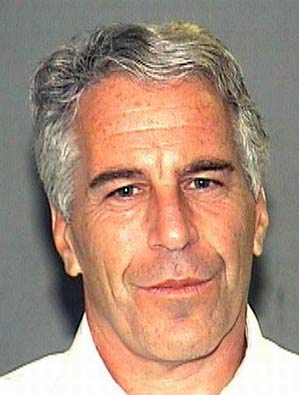
That developer, Landmark Land Co., sought Epstein’s advice during the summer of 2009.
Landmark’s CEO told Epstein he had tried to ride out the Great Recession with its management team intact in hopes of buying up financially struggling properties, but had instead run into a cashflow issue of its own.
Between the summer of 2009 and 2011, Epstein offered to facilitate talks between Landmark and well-known billionaires as the company scrambled for capital to remain solvent.
He also paid more than $43,000 per month in combined compensation to two of the developer’s executives — totaling hundreds of thousands of dollars over two years.
Landmark routinely included Epstein in communication about its operations during that time.
Documents indicate Landmark had business connections to Epstein prior to 2009, but was primarily connected to it through its CEO, Gerald “Jerry” Barton.
Barton and Epstein were friends.
‘Right side of history’
Barton, a noted developer of premium golf course communities, was looking to resuscitate his once thriving real estate empire in the late 1990s after regulatory changes had essentially destroyed it a decade earlier.
The South Padre Island Golf Club was supposed to be the springboard for those ambitions.
The course — which is in Laguna Vista — opened in 1997 on about 2,000 acres of land owned by U.S. Sen. Lloyd Bentsen’s family.
The development, Barton would tell Epstein, was a joint venture between Landmark and the Bentsen family “from a fund run by” noted financier Lewis Ranieri.
According to Barton, Landmark bought Bentsen’s share of the development either in 2004 or sometime after his death in 2006 “at a very attractive price.”
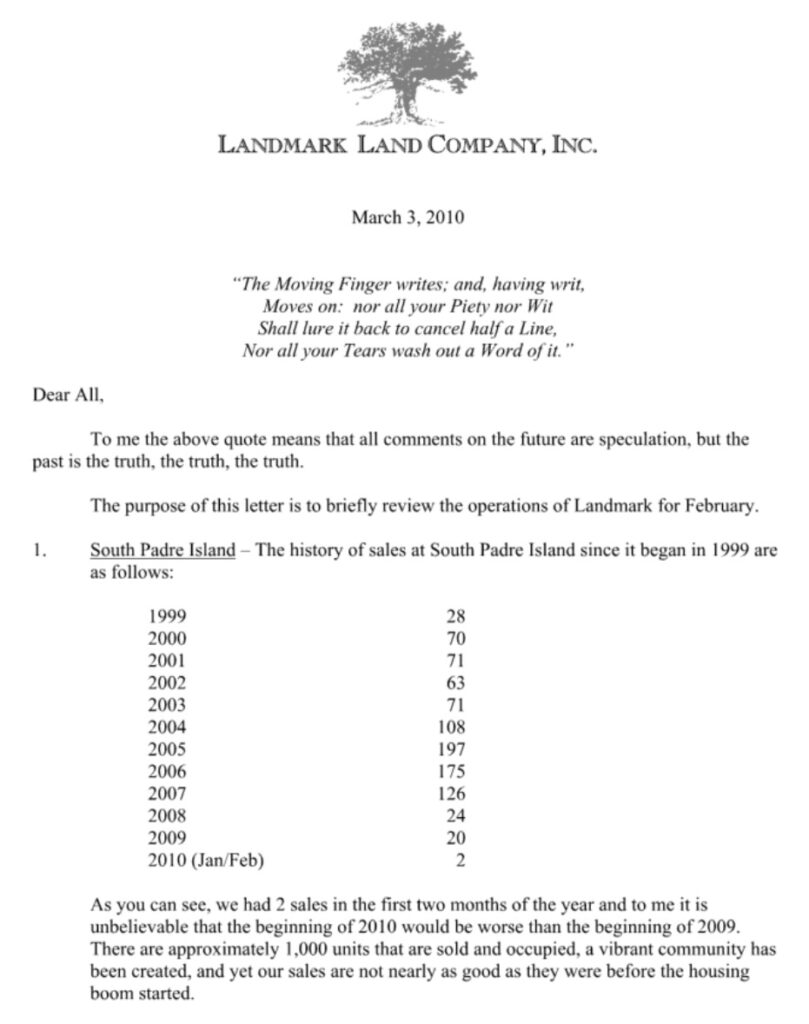
The South Padre Island Golf Club was set up to be a cash cow for Barton’s new golf empire.
Between 1999 and 2008, Barton told his board, Landmark had sold 909 homes at the South Padre Island Golf Club.
Affordable, warm, on the water, Barton thought of the development as a goldmine for selling homes to middle-class buyers looking at retirement.
It was, he said, “on the right side of history,” and there were other hopeful signs.
Barton told his board and Epstein about the prospect of a new causeway at Holly Beach Road.
That causeway — still unbuilt — would help the development in two ways, Barton told Epstein and his board.
“If the four-lane road is built on our northern property line, it will not only create long- term substantial commercial potential, it will also isolate the Ocelot, if in fact there is an Ocelot, and make it easier for us to proceed to get restrictions from Fish and Wildlife lifted from our most valuable property,” he said.
The South Padre Island Golf Club, which sits just off of Ocelot Trail Road, hoped to isolate the ocelot in order to make it easier to develop its habitat.
The Great Recession
Financial turmoil in 2008 interfered with Landmark’s plans, and housing sales plummeted.
Barton hoped to ride out the storm and was even optimistic enough to think that if he kept his team together, he’d be able to pick up some new resorts for cheap and ride an economic upswing.
Barton thought wrong.
By May 2009, he had a serious cashflow issue, so he got in touch with his old friend Epstein via Ghislaine Maxwell, emails show.
Epstein, at the time, was in jail.
In 2008, Epstein pled guilty to one count of soliciting prostitution and one count of soliciting prostitution from someone under the age of 18.
When Barton asked Epstein for advice, Epstein was at the tail end of a cushy 18-month jail sentence that allowed him to leave jail for work most of the day.
“As to Starwood and Barry, I follow my leader and I have but one maven and you see him every morning in the mirror when you shave.”
Gerald “Jerry” Barton, CEO of Landmark Land Co., in a 2009 email to Jeffrey Epstein
After reacquainting themselves, Epstein proffered some off-the-cuff advice and quickly tried to connect Landmark with capital.
Epstein suggested Barton contact Barry Sternlicht, president of Starwood Hotels & Resorts, about one of his properties. Epstein told Barton that once he and Sternlicht had talked, he would help “sell the oil” to Sternlicht.
Barton gushingly said he would take the advice.
“As to Starwood and Barry, I follow my leader and I have but one maven and you see him every morning in the mirror when you shave,” Barton wrote to Epstein.
Representatives for Starwood did not respond to a request for comment.
A few days later, Barton told Epstein he had met with a longtime executive from Apollo Global Management. Epstein said he would call Apollo founder Leon Black to “get the skinny.”
Apollo, which did not respond to a request for comment, previously released a statement about its relationship to Epstein.
Epstein’s initial attempts to help Barton don’t appear to have solved Landmark’s problems. Months later, the company was still scrambling for capital.
Two Salaries
Epstein did, however, find a different way to help Landmark — and for Landmark to help him.
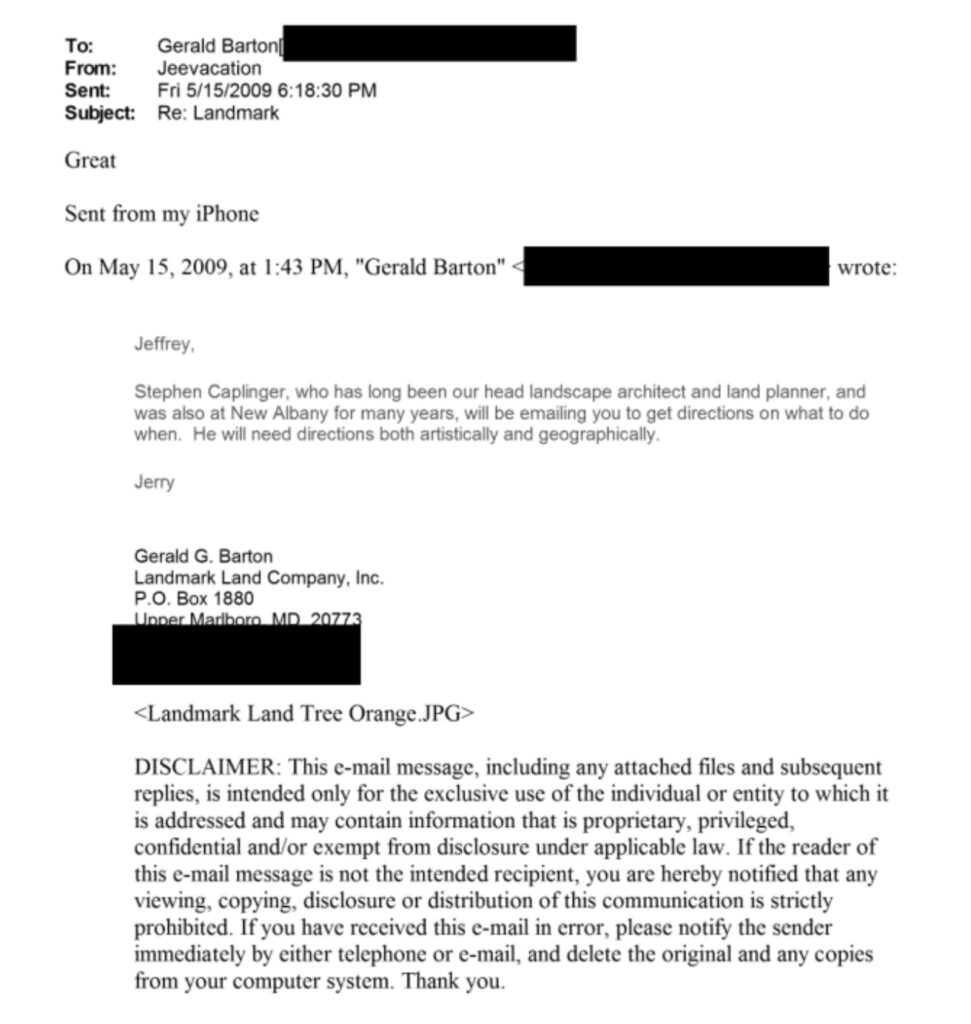
On the same day that he and Barton started discussing Landmark’s finances in May 2009, Epstein told Barton he wanted someone from Landmark to come work on Little St. James, an island Epstein owned on which he allegedly trafficked underage girls.
Epstein said he didn’t mind paying, and pay, he did.
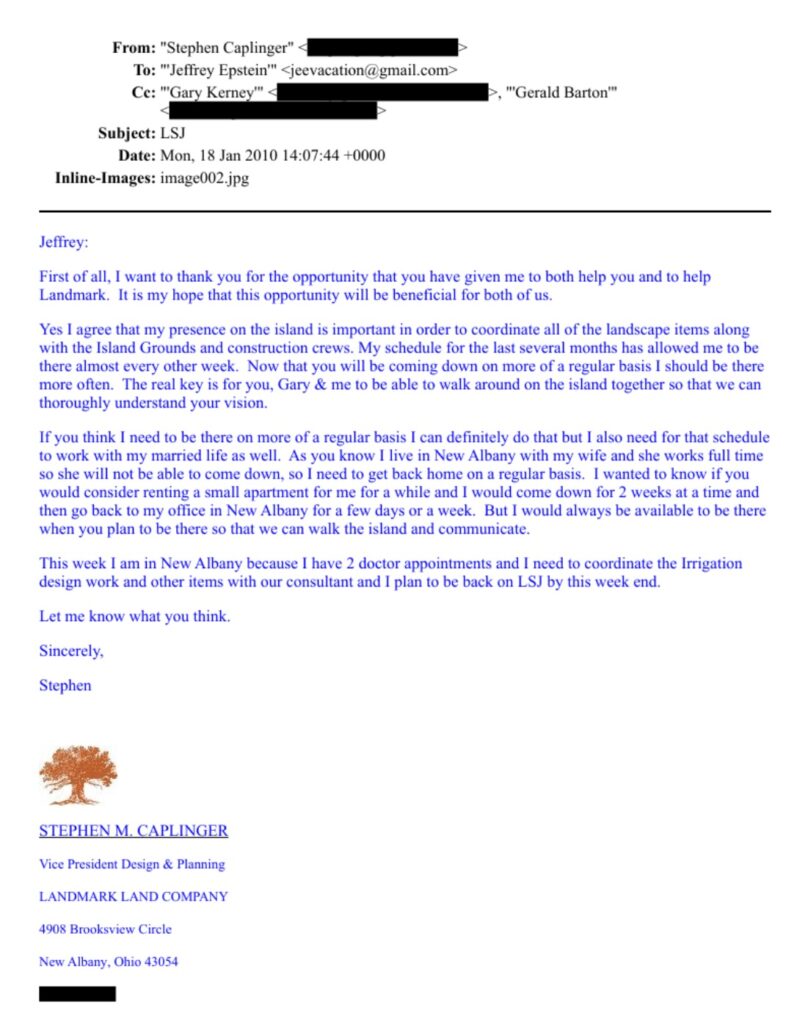
Epstein hired Landmark’s vice president of design & planning, Stephen Caplinger, who co-designed the South Padre Island Golf Club.
He also hired Gary Kerney, Landmark’s senior vice president and director of real estate development, who was described in court documents as the overseer of the Laguna Vista development. Kerney’s son, Mark, co-managed the South Padre Island Golf Club.
Epstein and Kerney also had a prior relationship.
On at least three occasions, Epstein or his company sent packages to Kerney between 1999 and 2001, once to Landmark’s offices in Maryland, once to Epstein’s Zorro Ranch in New Mexico, and once to the golf course in Laguna Vista.
Kerney wrote to Epstein six days after Barton first reached out to him, speaking highly of Caplinger.
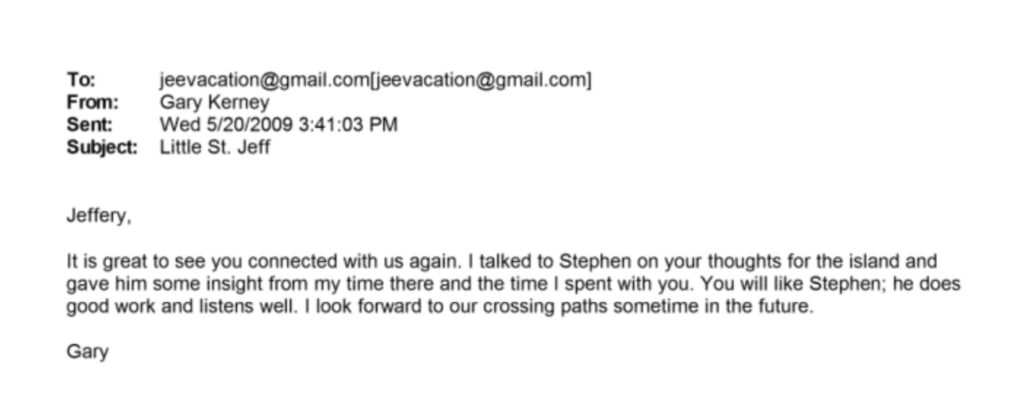
“It is great to see you connected with us again,” Kerney said.
While the developer of the South Padre Island Golf Club teetered on the edge of insolvency, Epstein underwrote the salaries of two of its top executives.
Epstein began making monthly payments — usually through DPMG, Inc., a Landmark subsidiary — to Kerney and Caplinger.
He paid Kerney $25,101.08 and Caplinger $18,301.42 — a combined $43,402.50 per month. That covered their salaries and benefits, though reimbursements and incentives sometimes substantially increased those payments.
Caplinger worked on design elements at Little St. James, while Kerney worked as Epstein’s construction manager primarily at Little St. James and sometimes at other properties, like Zorro Ranch in New Mexico.
‘No good can come from that’
The South Padre Island Golf Club did not respond to requests for comment, and Caplinger could not be reached.
Kerney’s other son, Mike, answered a call, but said his father wasn’t talking to the media.
“No good can come from that,” he said.
Caplinger and Kerney don’t appear to have done any work for Epstein after 2011.
Epstein’s aid doesn’t seem to have saved Barton’s ambitions.
In 2014, he told Epstein he closed down Landmark’s office and transferred all of its assets to pay off its creditors, except for himself.
Barton told Epstein he was broke.
He died in 2018.

Matt Wilson
Reporter
Matt Wilson is a Hidalgo County–based freelance reporter and contributor to the Rio Grande Valley Business Journal. He previously covered education and general assignment for The Monitor, frequently writing about the dramatic ways business changed during the coronavirus pandemic. Before that he worked as a reporter in rural Central Texas where he covered everything from house fires to school board meetings.
Most Read
- SpaceX’s futuristic city of Starbase finalizes massive 7,100-acre annexation. Here’s what we know.
- 25 Mexican businesses eye McAllen expansion after city pitches U.S. market entry program
- Australian company plans to build a $607M lithium refinery at the Port of Brownsville. It’s a big bet on America’s battery future
- Starbase cancels meeting to consider annexing 444 acres relinquished by Brownsville
- SpaceX reschedules Starship’s first flight around the Earth
Get the latest business news delivered to your inbox every morning for free.
Try 30 Days Free!
Get full access to award-winning journalism covering business, real estate, health care, economic trends, and the people shaping the Rio Grande Valley.
30 Days Free!
$9.95/month
Limited time offer
Subscription renews after your 30 day free trial at $9.95/mo.
Included Benefits
- Unlimited access to all articles
- Daily business news and analysis
- Subscriber-only content and features
Stories That Matter
- Dickey’s Barbecue Pit to open new McAllen location inside Cambria Hotel
- NADBank opens $300M financing pipeline for water, energy projects along the border
- Engineering firm Garver opens $5M Harlingen office, plans up to 50 new jobs
- Is SpaceX quietly building a data center at Starbase? Job postings offer clues
- Mission’s first Small Business Expo puts $25K on the line for local entrepreneurs
- McCoy’s gives $10K, tools to launch Mid-Valley construction academy
- UT Health RGV performs new digestive procedure for first time in the Valley
- TSTC bets on advanced manufacturing to meet RGV’s industrial boom
- Pharr’s cross-border business push earns international recognition
- Brownsville eases drought restrictions after nearly three years as Rio Grande reservoir levels improve