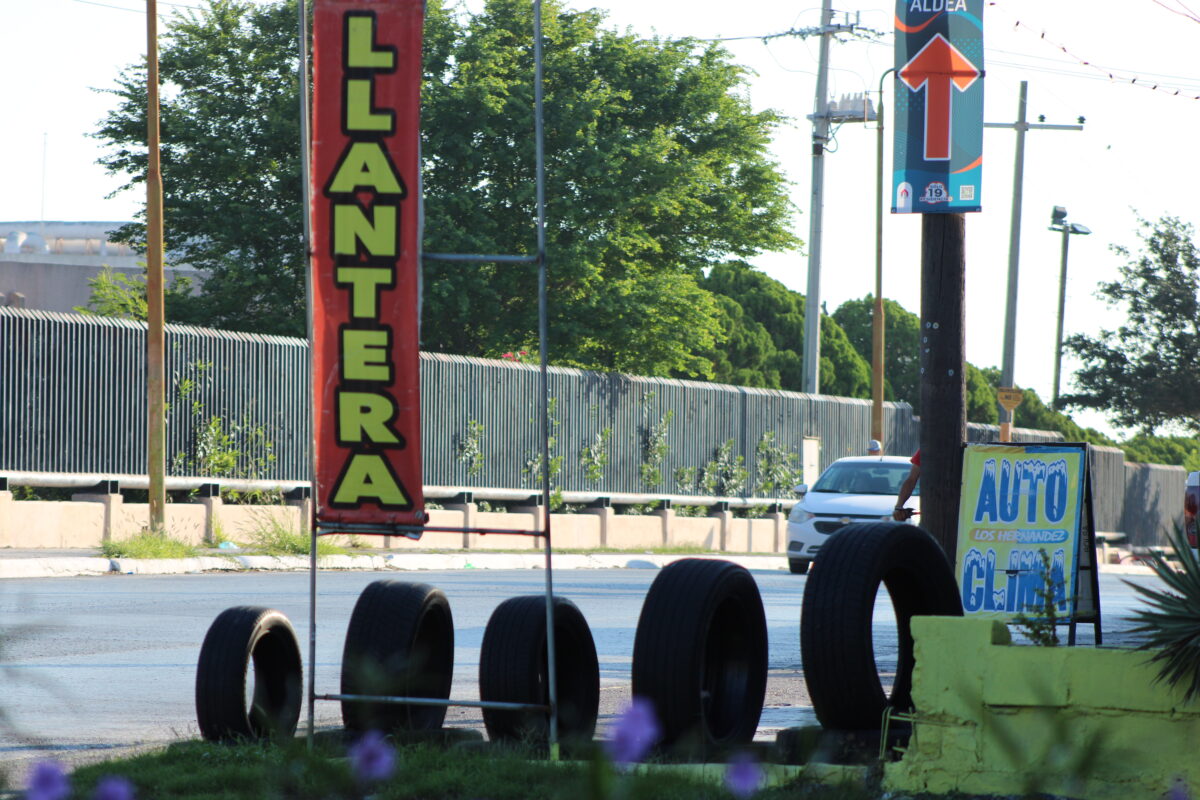
MEXICO CITY — The Mexican government has temporarily banned the import of used tires from the United States, a move that Mexican shop owners say will raise prices for businesses and consumers alike.
For many Mexican tire shops, the ban represents a major operational shift.
Shops that relied on inexpensive used tires from Texas and other U.S. states will now have to focus on selling new tires or offering additional services.
“Now we’ll have to adjust operations and focus on new tires, even though low-income customers will have to pay two to three times more,” said Rolando Juárez, a tire shop owner in Reynosa, Tamaulipas.
More than 1.5 million used tires enter Mexico each year, and about 70% to 80% arrive with little to no remaining life, Karl Heinz Becker Hernández, the undersecretary of environment for Tamaulipas, said.

Photo Credit | Anayancy Ulloa
Only a small fraction of imported tires — roughly 20% to 30% — can be reused, meaning the majority become automotive waste that threatens public safety and environmental health along the border, he said,
The issue has had a particular toll on cities like Nuevo Laredo, Reynosa, and Matamoros. The worn-out tires create fire hazards, mosquito breeding grounds, and increase the risk of accidents, Becker Hernández said.
Mexican officials said the ban is part of a coordinated effort with U.S. authorities to assess accumulated tire stockpiles, develop joint disposal and recycling strategies, and support Mexico’s domestic tire industry, which has been undercut by cheap, discarded imports.
Local officials and environmental groups who have long warned about the risks of unregulated tire imports, say the decree marks a step toward improving road safety, sustainability, and industrial competitiveness along Mexico’s northern border.

Anayancy Ulloa
Reporter
Most Read
- SpaceX is giving Brownsville $220M for water projects. In exchange, the city gave up zoning control of 444 acres near Starbase
- SpaceX seeks to take zoning control over nearly 450 acres from city of Brownsville as a ‘regional’ water deal takes shape
- Port of Brownsville could soon host Nodule City, a first-of-its-kind commercial deep-sea mining hub
- How much water does SpaceX need to operate near Brownsville? Nearly 20x its current use
- Cameron County is negotiating a $20M Fluidstack data center donation after Harlingen waffles on the same offer
Get the latest business news delivered to your inbox every morning for free.
Try 30 Days Free!
Get full access to award-winning journalism covering business, real estate, health care, economic trends, and the people shaping the Rio Grande Valley.
30 Days Free!
$9.95/month
Limited time offer
Subscription renews after your 30 day free trial at $9.95/mo.
Included Benefits
- Unlimited access to all articles
- Daily business news and analysis
- Subscriber-only content and features
Stories That Matter
- 5 things to know about manufacturing along the South Texas-Mexico border
- Mission’s first Small Business Expo puts $25K on the line for local entrepreneurs
- Reynosa’s newest technical high school focuses on AI, semiconductors and bionics
- McCoy’s gives $10K, tools to launch Mid-Valley construction academy
- UT Health RGV performs new digestive procedure for first time in the Valley
- TSTC bets on advanced manufacturing to meet RGV’s industrial boom
- Pharr’s cross-border business push earns international recognition
- Brownsville eases drought restrictions after nearly three years as Rio Grande reservoir levels improve
- Texas A&M’s $53.5M McAllen research center will tackle water, food security and Valley health
- McAllen’s $204M water investment expects to seek construction bids in 2027