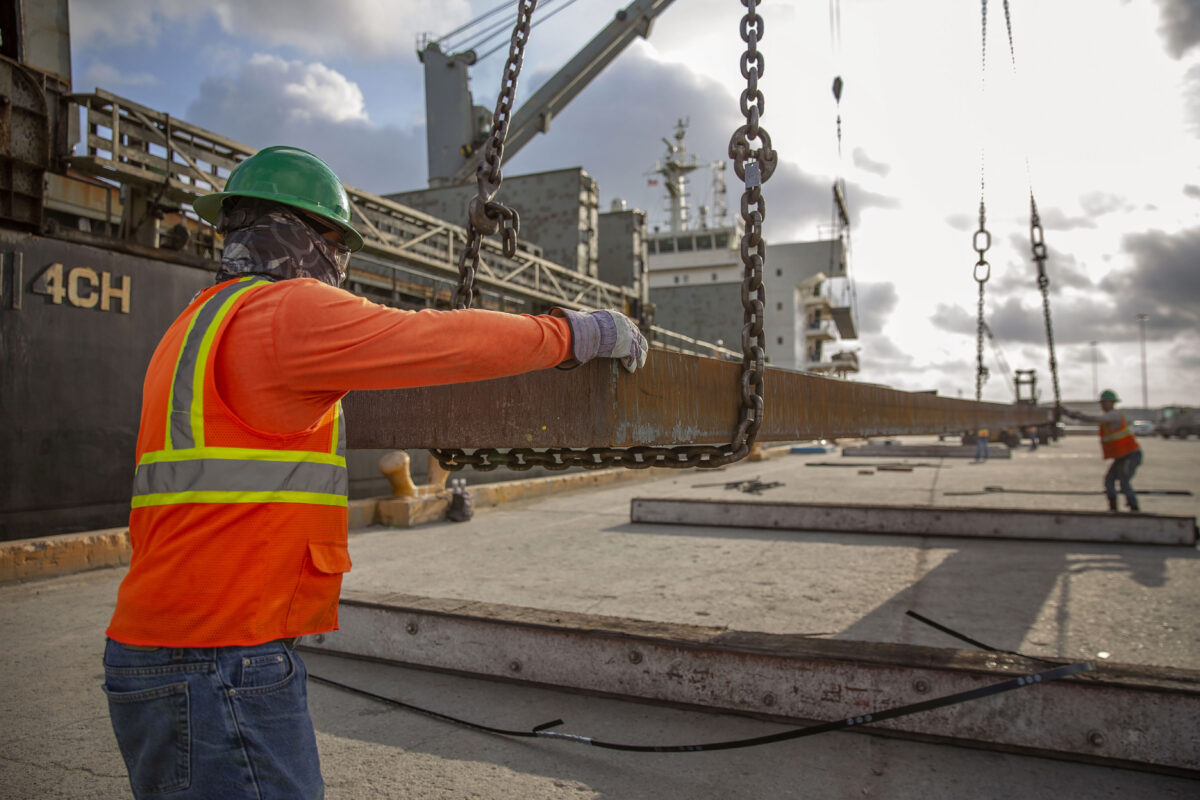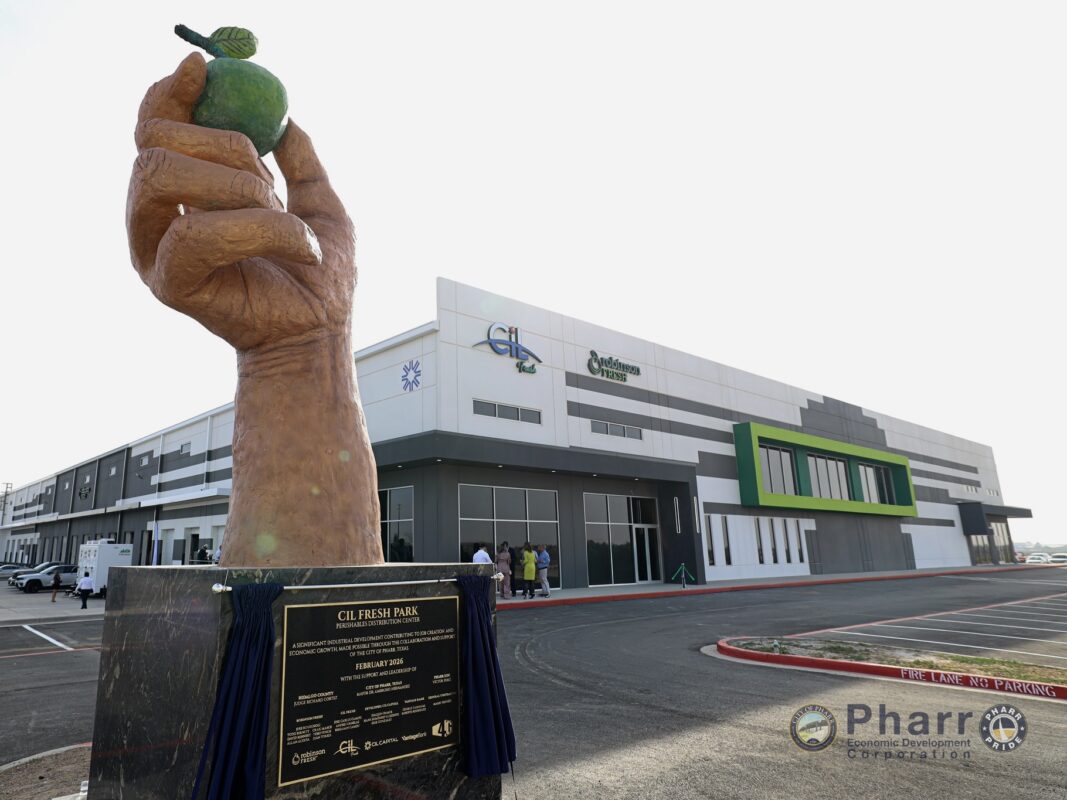
PHARR — The Pharr International Bridge has doubled its capacity with the opening of a second structure, giving one of the Rio Grande Valley’s busiest trade corridors more room to move goods between the United States and Mexico.
Now comes the harder part: making sure the infrastructure surrounding the bridge can keep up.
That was a central message Wednesday during Pharr’s first Gateway Forum, where leaders in manufacturing, logistics, agriculture, customs and transportation discussed what will be needed to capitalize on the bridge expansion.
The new structure adds four lanes and represents a 100% increase in bridge capacity.
Luis Bazán, director of the Pharr International Bridge, described the goal simply: “Faster trade, zero wait.”
But adding lanes alone will not eliminate the bottlenecks that can slow cross-border commerce.
The broader strategy includes improvements inside the port of entry, specialized lanes and infrastructure intended to streamline inspections. The bridge also has FAST lanes for certified cargo and designated facilities and access for empty vehicles and secure cargo.
Bazán said there eventually comes a point when more physical infrastructure cannot be added.
“At the end of the day, once you reach that threshold where you can’t build any more physical infrastructure, you’re going to be talking about innovation,” Bazán said. “It’s going to be about process improvements.”
One of those tools is Unified Cargo Processing, which allows U.S. and Mexican customs authorities to work together on inspections.
Crispin Flores, president of the Mid-Valley Customs Brokers Association, said combining that process with technology and customs reconciliation could help cargo move faster.
“Adding those three together will allow for faster processing of shipments,” Flores said. “It’s not going to be magic. It’s not going to happen overnight, but it’s something that could happen.”
Flores also urged businesses to prepare for trusted-trade programs such as Customs Trade Partnership Against Terrorism, or CTPAT, and Free and Secure Trade, or FAST, as cargo volumes increase.

Data centers could drive more trade
Some of the additional traffic may come from an industry that has been rapidly expanding across Texas: data centers.
Mike Willis, executive director of the South Texas Manufacturers Association, said manufacturers supplying data centers are becoming an increasingly important source of cross-border freight.
Communications cable, consumer electronics and electrical components already generate substantial traffic through Pharr, he said, while automotive and housing-related manufacturing have been weaker.
“The one that has increased and will probably continue to increase significantly is manufacturers supplying data centers,” Willis said.
Manufacturers serving the industry are increasing production and building plants in Mexico and Reynosa, he said.
The growth has implications beyond the bridge. Data centers require electrical equipment, construction, infrastructure, power and specialized workers, creating demand on both sides of the border.
Produce remains a major driver
While emerging industries could generate new traffic, fresh produce remains one of Pharr’s most important commodities.

About 22 million pounds of fresh produce cross the Pharr International Bridge every day, representing more than 200 commodities, according to Dante Galeazzi, president and CEO of the Texas International Produce Association.
Galeazzi said overall fresh produce imports from Mexico have declined this year, but volumes crossing through Pharr have continued to increase.
Texas has a geographic advantage because much of the U.S. population is east of the state, making Texas crossings more efficient for reaching those markets than routes through Arizona or California, he said.
For produce companies, however, increasing bridge capacity is only part of the equation.
“Every 24 hours of delay for fresh produce decreases its value by 10%,” Galeazzi said.
An expansion of refrigerated inspection facilities known as the DAP16 project is expected to add 21,000 square feet of refrigerated space and 13 inspection doors.
“Expanding capacity means expanding efficiency,” Galeazzi said. “It means we can cross faster. It means we can bring more fresh produce across.”
Connecting the Valley’s trade network
Panelists also argued that Pharr’s growth should not be viewed in isolation from the Valley’s other transportation assets.
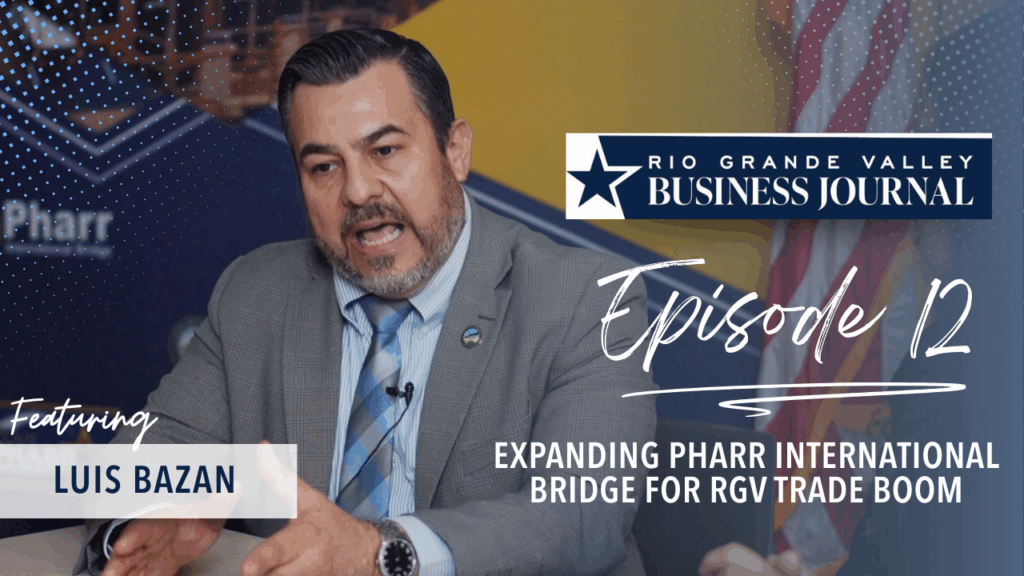
Sergio “Tito” Lopez, chairman of the Brownsville Navigation District, said economic development should not become a competition among the region’s ports and trade corridors.
“It’s not the Port of Brownsville,” Lopez said. “It’s the Port of the Rio Grande Valley.”
Walker Smith, executive director of the Port of Harlingen, said the Valley’s freight corridors need better connections.
“We’re working in silos,” Smith said. “We’re not working together. There is no connectivity.”
The Port of Harlingen handles diesel and other commodities that eventually move through Pharr into Mexico, illustrating how the region’s seaports, highways and international crossings already depend on one another.
The larger challenge, panelists said, is connecting highways, seaports, rail, airports and border crossings into a more coordinated regional logistics network.
‘Right now is the time to invest’
That infrastructure is supporting a U.S.-Mexico trading relationship already measured in hundreds of billions of dollars.
Mexico was the United States’ largest trading partner in August, with $94.3 billion in two-way goods trade, including $33.7 billion in U.S. exports and $60.6 billion in imports, according to U.S. Census Bureau figures.
Duncan Wood, CEO of Hurst International Consulting LLC, said uncertainty surrounding trade policy and the future of the United States-Mexico-Canada Agreement should not stop companies from preparing for greater North American integration.
“Right now is the time to invest,” Wood said. “Right now is the time to think in a more strategic way about what is the future of the United States and North America.”
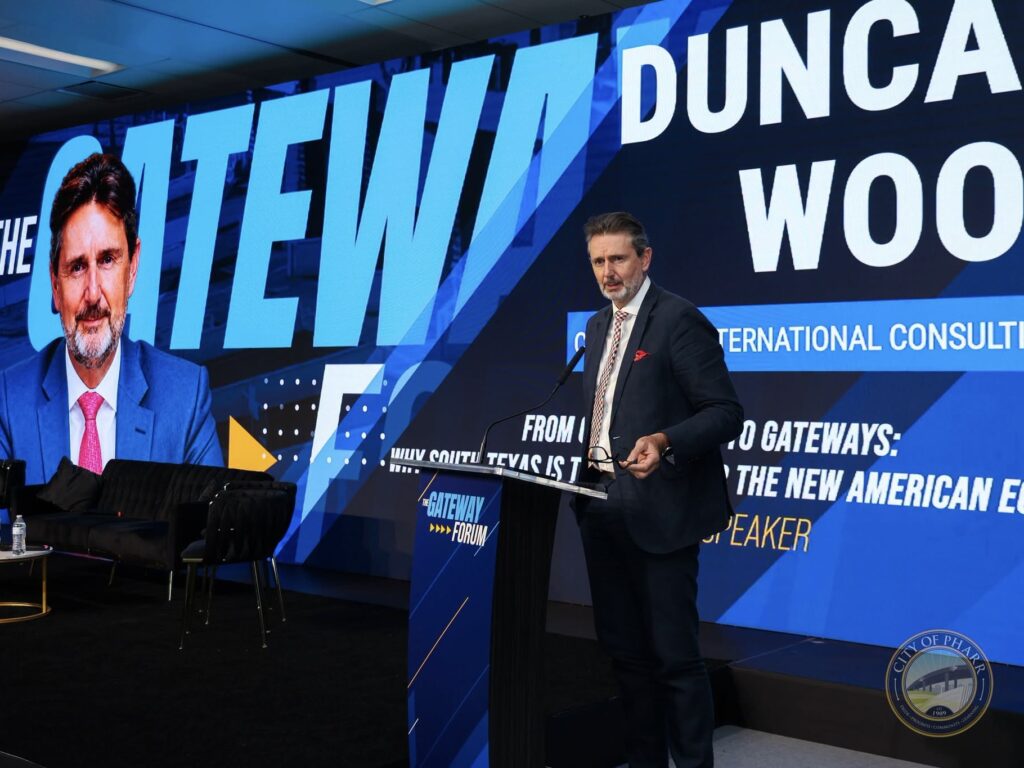
Wood said the United States will have difficulty competing globally without greater collaboration with Mexico.
“The only way in which the United States can compete with China and other international powers is to collaborate more with Mexico,” he said.
That will also require workers.
Wood said the region needs engineers and specialists in artificial intelligence and semiconductors, but its needs are not limited to high-tech occupations.
“It’s not only artificial intelligence or semiconductors,” Wood said. “We also have to think about electricians, plumbers, people who work in construction.”
For Pharr, the opening of the second bridge structure provides substantially more physical capacity. The next test will be whether the region can build the customs processes, workforce and transportation network necessary to fill it.

Anayancy Ulloa
Reporter
Anayancy Ulloa Luna is a contributor to the Rio Grande Valley Business Journal who hails from Reynosa in the Mexican state of Tamaulipas. Ulloa has a long history as a U.S.-Mexico region business expert in marketing, formerly the editorial director of Mexico Industry.
Most Read
- Is SpaceX quietly building a data center at Starbase? Job postings offer clues
- Developers begin $12M master-planned community near Rio Grande City
- Edinburg ISD rejects nearly $6M offer for prime land near La Sienna despite $15M budget deficit
- A little MySpace, a little AOL: Valleyites help grow new social media platform
- Dickey’s Barbecue Pit to open new McAllen location inside Cambria Hotel
Get the latest business news delivered to your inbox every morning for free.
Try 30 Days Free!
Get full access to award-winning journalism covering business, real estate, health care, economic trends, and the people shaping the Rio Grande Valley.
30 Days Free!
$9.95/month
Limited time offer
Subscription renews after your 30 day free trial at $9.95/mo.
Included Benefits
- Unlimited access to all articles
- Daily business news and analysis
- Subscriber-only content and features
Stories That Matter
- $12.3M apartment complex planned for Brownsville
- Mission’s first Small Business Expo puts $25K on the line for local entrepreneurs
- McCoy’s gives $10K, tools to launch Mid-Valley construction academy
- UT Health RGV performs new digestive procedure for first time in the Valley
- TSTC bets on advanced manufacturing to meet RGV’s industrial boom
- Rio Grande Valley hotel occupancy tax receipts show 16% bump through September 2026
- Pharr’s cross-border business push earns international recognition
- How $164M in water conservation funding could help environmental sustainability in the Rio Grande Valley
- Brownsville eases drought restrictions after nearly three years as Rio Grande reservoir levels improve
- Texas A&M’s $53.5M McAllen research center will tackle water, food security and Valley health