After 50 years of working with thousands of families across Hidalgo County to attain and maintain affordable housing, a McAllen-based nonprofit organization is piloting a new path to homeownership — a community land trust model.
For decades, Affordable Homes of South Texas Inc. has purchased lower-cost land across Hidalgo County for low- to moderate-income families to buy and build new single-family homes or to help with repairs.
Most of its subdivisions are in local cities with rural space: Mercedes, Weslaco, Alamo, Edinburg, and Mission.
But now, the focus is on reducing the total cost of homeownership — including the tax and insurance burden — especially for first-time homebuyers and lower-income families across Hidalgo County.

Myra Martinez, CEO of Affordable Homes of South Texas Inc., told the Rio Grande Valley Business Journal in a recent interview that homeownership accessibility is no longer tied to the mortgage payment relative to the purchase price.
“One of the things that we see — and that is the biggest challenge — is the property taxes and insurance. So the construction cost, or the cost of building a home, has risen a little bit. But that’s nominal compared to the increase in property taxes and insurance,” Martinez said.
As a full-service housing nonprofit, the organization purchases land, builds homes, underwrites mortgages, and services the 30-year loans.
It underwrites mortgages for families earning between 80% and 120% of the area median income (AIM) for the McAllen–Edinburg–Mission metropolitan area, as established by the U.S. Department of Housing and Urban Development for fiscal year 2026. For example, the 80% AMI income limit is $46,900 for a one-person household and $66,950 for a four-person household. At the upper end of the program’s eligibility range, 120% AMI is approximately $70,350 for a one-person household and $100,425 for a four-person household. That’s the more typical threshold for HUD-backed programs.
By comparison, another affordable housing development in Hidalgo County, just outside of Mercedes, enables households earning up to 180% of AMI to receive down payment assistance.
But a community land trust is an entirely different model — one that would be a first for the Rio Grande Valley.
“Basically, in a community land trust, the customer purchases the improvements, so that would be the home, and they would lease the land from us [for 99 years]. So they wouldn’t own the land. But even like that, it would be a cheaper way of getting into home ownership. They can still do improvements on the land like put a shed on there like normal and maintain it, it’s just they wouldn’t own it. So they would only pay property taxes on the home and insurance on the home only, which results in a lower affordable [mortgage] payment,” she said. “You can sell it, so it’s a perfect way to start in home ownership but you have to sell it to another low-to-moderate income family to keep it perpetually affordable and that is the restriction.”
The plan is to roll out the program in the fall across three subdivisions in Edinburg, Weslaco and Mission. Three lots in each to start, then it will cascade to a larger scale if successful.
“When you look at a mortgage payment, about 50% of that is just property taxes and insurance — so the PMI [principal, mortgage and interest] is fine, but once you add the property taxes and insurance, it doubles it. And that is what is making home ownership unaffordable right now,” she said. “Tackling property taxes and insurance on a broader scale is a lot more challenging.”
For example, the Jaguar Heights subdivision in Edinburg, which sits near E Chapin Street and Terry Road just west of Alamo Road and Johnny G. Economedes High School, has more than 90 lots and was constructed in 2025.
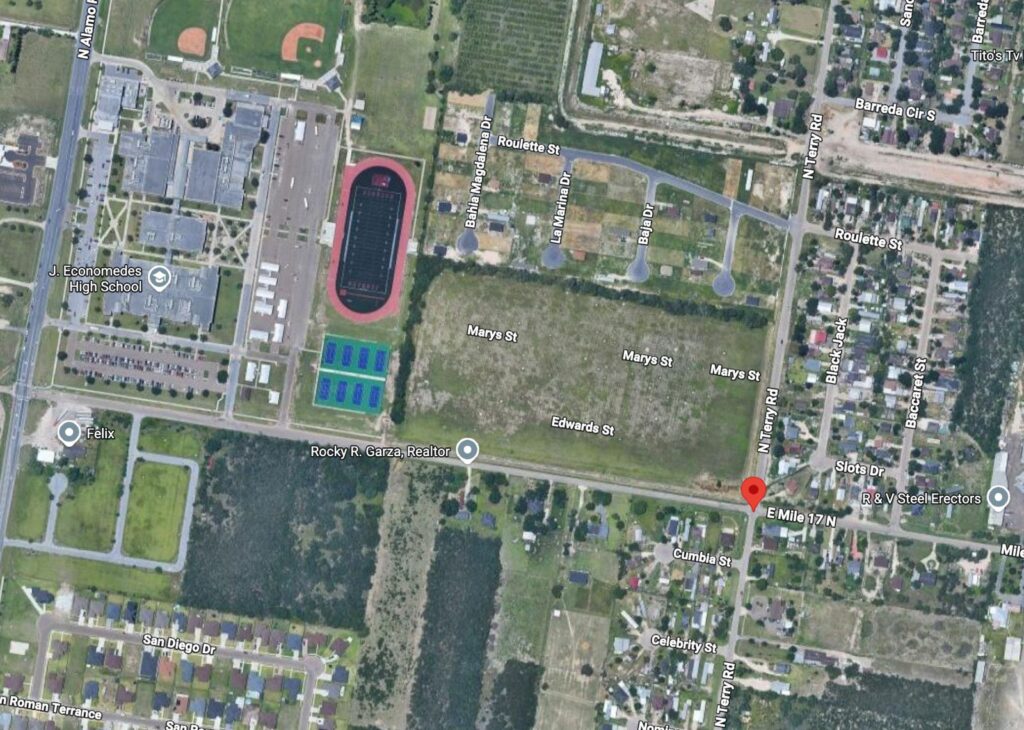
Courtesy of | Google Maps
In the past year, demand for applications to purchase new single-family homes has been much slower among low- to moderate-income families, Martinez said. As such, there are only three purchased lots for the new Edinburg subdivision, according to deed records.
In years past, the organization would see between 150 and 250 people a month apply for homes,
“Our demand dropped off because people were scared of what the future held; there were layoffs, cuts, everything with immigration, so homeownership was put on the back burner. Now we’re seeing demand go up again,” she said.
Decades ago, it was more common for families settling in the Rio Grande Valley to purchase the land first and pay it off with owner financing known as a solar or land mortgage. But land costs have increased significantly.
“The opportunities to buy the land by itself are not that common anymore. And if they are, the cost of the land is huge. Just for one lot, you’re looking at $50,000 to $75,000 in some cases; that’s a huge debt to undertake. And then by the time you pay that off, people, I think, get discouraged.”
It’s not the first pilot project the nonprofit has done in recent years. Its most recent subdivision in McAllen was an affordable multifamily rental project known as Stonebriar at Trinity Oaks, which was sold to developers near North 29th Street and Highway 107. There was a playground and park between the single-family homes and the rental units, too, she said.
“We sold [the rentals] to developers so the proceeds from that sale helped to buy down the cost of the [single-family subdivision] lot [next door] for the homeowners. And that was a great model. We’re not able to do it in every city, but we were able to do it in that one,” Martinez said.
Sometimes new programs aren’t continued, such as an experiment in which the nonprofit sold some lots directly to future homeowners at a discounted rate, but the market was too saturated with investors looking for flips.
“We’ve tried selling the lots on their own but what we were finding was that a lot of investors [wanted] to come in and then turn around and sell them for double, triple what the cost is and that’s not what the mission of our organization is, so we don’t do that anymore,” she said.

Kristen Mosbrucker-Garza
Reporter
Kristen Mosbrucker-Garza is a versatile multimedia news reporter who lives and works along the Texas-Mexico border in Hidalgo County. Mosbrucker-Garza is a news reporter for the Rio Grande Valley Business Journal. During her career she's worked for the McAllen Monitor, San Antonio Business Journal, The Advocate Newspaper in Louisiana, Phoenix New Times, and public media outlets in Baltimore and Philadelphia.
Most Read
- SpaceX’s futuristic city of Starbase finalizes massive 7,100-acre annexation. Here’s what we know.
- 25 Mexican businesses eye McAllen expansion after city pitches U.S. market entry program
- Australian company plans to build a $607M lithium refinery at the Port of Brownsville. It’s a big bet on America’s battery future
- Starbase cancels meeting to consider annexing 444 acres relinquished by Brownsville
- SpaceX reschedules Starship’s first flight around the Earth
Get the latest business news delivered to your inbox every morning for free.
Try 30 Days Free!
Get full access to award-winning journalism covering business, real estate, health care, economic trends, and the people shaping the Rio Grande Valley.
30 Days Free!
$9.95/month
Limited time offer
Subscription renews after your 30 day free trial at $9.95/mo.
Included Benefits
- Unlimited access to all articles
- Daily business news and analysis
- Subscriber-only content and features
Stories That Matter
- Edinburg looks to attract new franchise businesses with matchmaking event
- $10M apartment complex planned in Hidalgo
- A Brownsville startup wants to deliver water in space. First, it needs $7M
- Mission’s first Small Business Expo puts $25K on the line for local entrepreneurs
- McCoy’s gives $10K, tools to launch Mid-Valley construction academy
- UT Health RGV performs new digestive procedure for first time in the Valley
- TSTC bets on advanced manufacturing to meet RGV’s industrial boom
- Pharr’s cross-border business push earns international recognition
- New Harlingen airport CEO eyes Mexico flights, cargo expansion and more development
- T-Mobile plans fiber-optic internet expansion in Mercedes