Mexican trucking companies moving freight through the Rio Grande Valley are ramping up English-language training for drivers as U.S. inspectors continue strict enforcement of communication requirements that can sideline trucks, disrupt schedules, and slow cross-border supply chains.
The English-language requirement has existed for years, but industry leaders say intensified enforcement at ports of entry is creating new delays during an already difficult year for logistics.
Companies operating along one of the region’s busiest trade corridors — handling thousands of daily truck crossings — are responding with internal schools, updated inspection training, and new hiring strategies, while bridge operators report real-time operational impacts when drivers and their cargo are stopped from continuing their routes.
Industry representatives warn the burden falls most heavily on small carriers and independent drivers, as freight volumes soften amid security concerns, tariff shifts, administrative bottlenecks, and broader uncertainty reshaping cross-border trade.
According to the National Chamber of Freight Transport, or Canacar, the Pharr–Reynosa International Bridge alone handles an average of about 4,200 truck crossings per day, a benchmark that illustrates the volume of freight moving through the Rio Grande Valley’s broader cross-border trade network even as logistics activity slows.

“We are fully in favor of safety and compliance with U.S. regulations,” said Edgar Zamorano, Canacar’s president representing the northern border region. “What we ask for is clear rules… without improvisation and without unfairly affecting Mexican drivers.”
Driver delays at ports
Enforcement actions at international crossings across the Valley are forcing operational pauses and daily adjustments.
At the Starr-Camargo international crossing between Rio Grande City, Texas, and Camargo, Tamaulipas, drivers are sometimes out of service, halting trucks and delaying supply chains.

“The regulation remains in effect, it has not changed, and it continues to be applied the same way,” Beatriz Castro, international legal officer at Starr-Camargo Bridge Company, said. “Drivers are not sent back, but they can be placed out of service until another driver who complies with the English requirement arrives to move the truck.”
When a driver is placed out of service, the truck must remain stopped until a qualified operator takes over — a delay that can ripple through tightly scheduled supply chains.
“It definitely impacts operations… because the supply chain is delayed,” Castro said. “It’s not like officers say: ‘since you don’t speak English, just cross and come back.’ They must apply the regulations regardless.”
Companies invest in training and preparation
Larger carriers with binational operations say compliance now requires more formalized preparation.
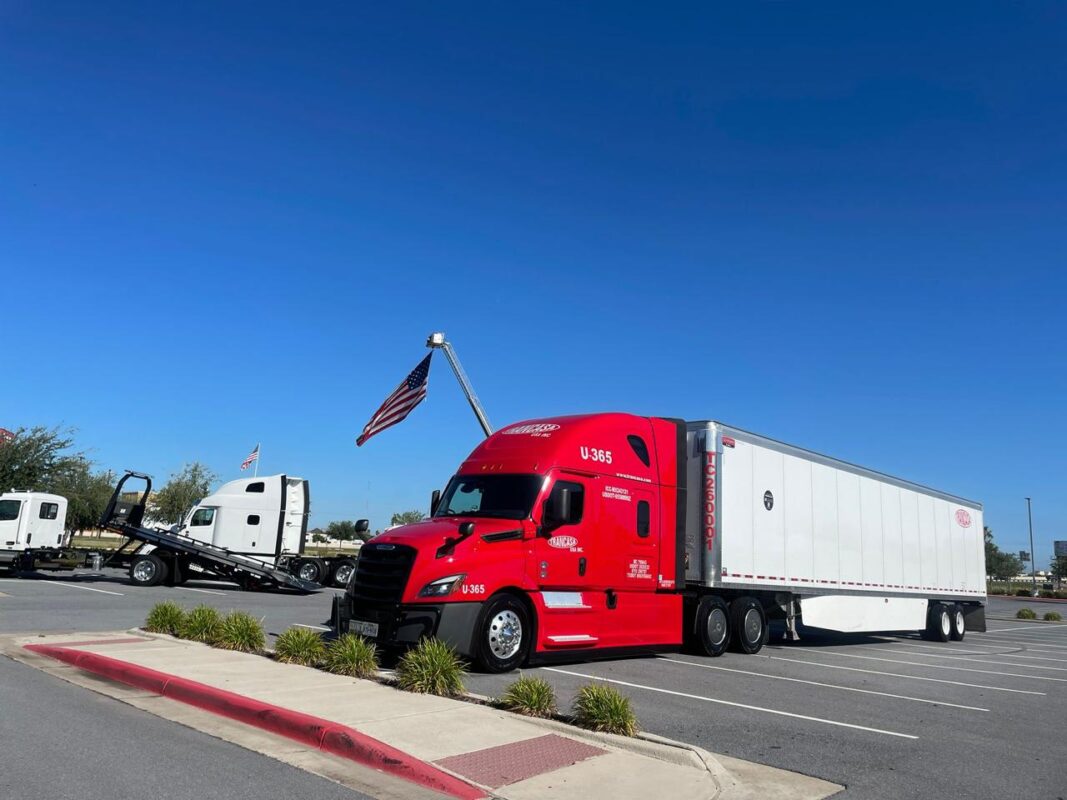
Transportes Canales, or Trancasa, has institutionalized English courses by combining them with in-house programs and roping in other educational institutions. The company also operates a dedicated training department focused on preparing drivers for inspections.

Courtesy of | Trancasa
“We have a school — a company that is part of our group — that provides English classes to our operators,” said Julia María Martínez, customer service and marketing manager at Trancasa.
Martínez said U.S. authorities have been clear about expectations during inspections.
“CBP was very transparent… they said: we do not expect your driver to fully master the language. What matters is that the operator can respond to questions if an officer requires it,” she said. “It doesn’t matter if they answer in Spanish, but they must at least understand what they are being asked.”
Those questions typically cover destination, origin, type of cargo, and insurance.
Trancasa has incorporated those scenarios into its road-safety and signage courses, supported by an English instructor and a sister company that specializes in operator development. The updated course aligned with the regulation is scheduled to launch in January.
Driver shortages add pressure
Training efforts are unfolding alongside a long-standing shortage of qualified drivers.
“Hiring has been difficult for a long time,” Martínez said. “We have built partnerships with schools in Mexico and the U.S., and we are running strong campaigns on Facebook and TikTok to attract new drivers.”
Despite the challenge, Martínez said the border region offers a practical advantage.
“It hasn’t been a major obstacle… on the border it’s very easy to mix both languages,” she said. “If the operator doesn’t have English, we provide the tools — if they are willing to learn, we will train them.”
Small carriers feel the strain most
While large and mid-sized companies often operate with bilingual manuals, simulators, and structured training programs, Zamorano said smaller carriers and independent truckers face greater vulnerability.
“Where we see more vulnerability is among small companies… they are feeling this change much more,” he said. “This requires extensive training, workshops, simulations, and higher safety standards.”
Zamorano said language enforcement is only one factor in a year marked by compounding challenges, including roadway blockades, security concerns, tariff changes, slow bureaucratic processes, and shortages of license plates and required medical examinations.
In the Reynosa–Pharr corridor, he estimated freight movement has declined between 20% and 30% from previous levels as companies downsize and restructure operations.
“These are very difficult times… a complete restructuring of the landscape,” Zamorano said. “Before, we only looked at wait times and bridge lines. Today, we must consider wars, tariffs, exchange rates, blockades, protests, and highway insecurity.”

Anayancy Ulloa
Reporter
Anayancy Ulloa Luna is a contributor to the Rio Grande Valley Business Journal who hails from Reynosa in the Mexican state of Tamaulipas. Ulloa has a long history as a U.S.-Mexico region business expert in marketing, formerly the editorial director of Mexico Industry.
Most Read
- Is SpaceX quietly building a data center at Starbase? Job postings offer clues
- 25 Mexican businesses eye McAllen expansion after city pitches U.S. market entry program
- SpaceX’s futuristic city of Starbase finalizes massive 7,100-acre annexation. Here’s what we know.
- McAllen metro keeps selling more homes as Brownsville-Harlingen market sees 17% drop through August
- Rio Grande LNG moves closer to getting even bigger at Port of Brownsville
Get the latest business news delivered to your inbox every morning for free.
Try 30 Days Free!
Get full access to award-winning journalism covering business, real estate, health care, economic trends, and the people shaping the Rio Grande Valley.
30 Days Free!
$9.95/month
Limited time offer
Subscription renews after your 30 day free trial at $9.95/mo.
Included Benefits
- Unlimited access to all articles
- Daily business news and analysis
- Subscriber-only content and features
Stories That Matter
- Texas A&M seeks contractors for new health education and research building in McAllen
- Beach Water Park files plans for $750K go-kart track project on South Padre Island
- Hundreds are vying for jobs in Brownsville. Here’s what jobseekers are seeing in the market
- Mission’s first Small Business Expo puts $25K on the line for local entrepreneurs
- McCoy’s gives $10K, tools to launch Mid-Valley construction academy
- UT Health RGV performs new digestive procedure for first time in the Valley
- TSTC bets on advanced manufacturing to meet RGV’s industrial boom
- Pharr’s cross-border business push earns international recognition
- Brownsville eases drought restrictions after nearly three years as Rio Grande reservoir levels improve
- Texas A&M’s $53.5M McAllen research center will tackle water, food security and Valley health