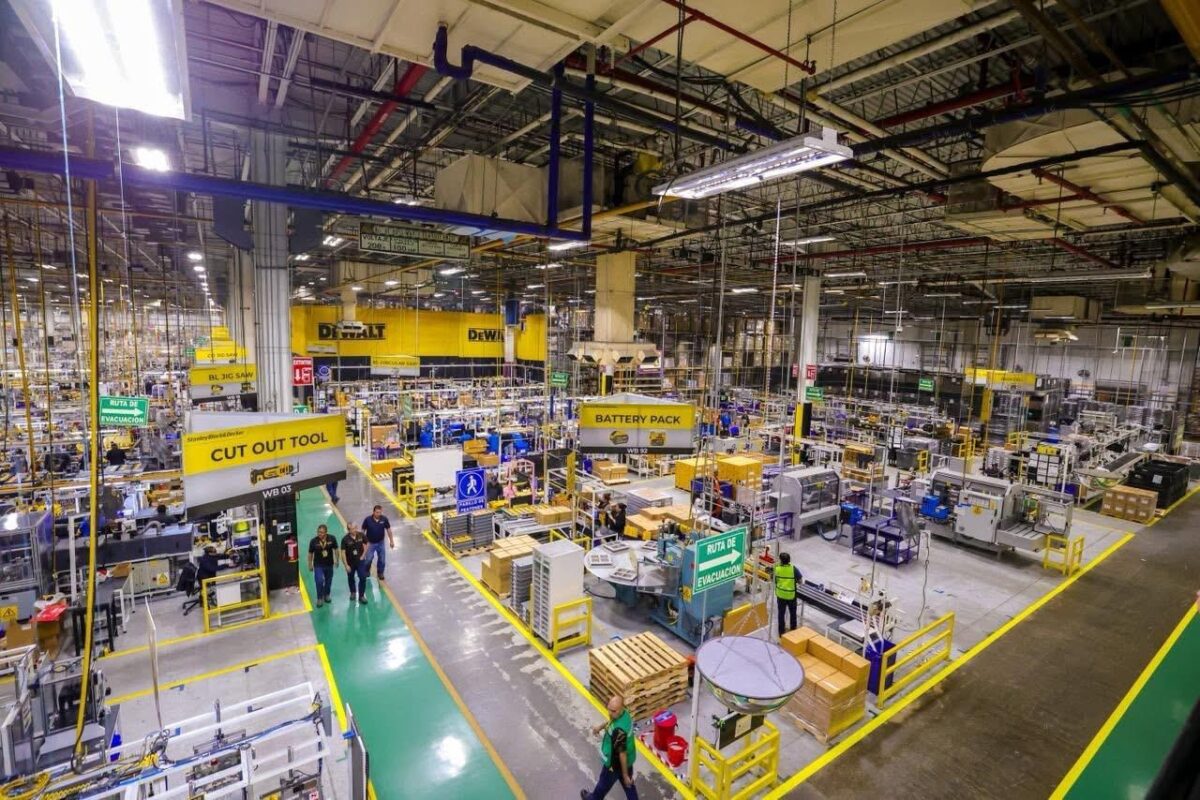
Reynosa, Mexico, has formally launched a new electronics manufacturing cluster that brings manufacturers, universities, and Tamaulipas state agencies together to better organize a sector that already plays a central role in the region’s economy.
Industrial clusters in Mexico are essential partnerships used to coordinate established industries, such as automotive, aerospace, and energy manufacturing.
The cluster provides a shared framework for companies, educators, and government agencies to align production needs, workforce training, and long-term planning as demand for electronics manufacturing and specialized skills continues to grow.
In Tamaulipas, state officials said this cluster is intended to give structure to an electronics manufacturing base that already exists. During the launch, Tamaulipas Gov. Américo Villarreal Anaya said the initiative reflects the state’s push toward higher-value and technology-driven industry.

“They are planting a seed in fertile soil. Tamaulipas is a good place to promote an initiative of this nature, both for what it is today and for the medium- and long-term future it offers,” Villarreal said.
The governor said the goal is to generate sustainable economic benefits while strengthening the competitiveness of companies operating in the state.
“I have full confidence and certainty that Tamaulipas is moving steadily toward a promising future,” he said.
The cluster includes about 15 major electronics manufacturers, universities, and state officials.
Ninfa Cantú Deándar, the Tamaulipas secretary of economy, said the signing of the charter formalizes a triple-helix model that connects industry, academia, and government.
“Tamaulipas is advancing with a modern industrial policy, a long-term vision, and strong alignment with the 2025–2030 National Development Plan and Plan Mexico,” Cantú Deándar said.
How the cluster works
For manufacturers, the cluster is designed as a practical coordination tool, not a trade association, said Abraham Walter Rico Murrieta, senior manager of foreign trade and legal representative of LG Electronics Reynosa.

Photo Credit: Tamaulipas state government
“The cluster is a methodology, a structure for creating synergies among all stakeholders,” Rico said.
He noted that many electronics manufacturers in Reynosa adjusted their supply chains and production strategies years before nearshoring became a widely used term.
“The famous nearshoring… we have been implementing it since 2011. So we already had that concern,” he said.
Rico said the organization is intentionally focused on technical collaboration, allowing companies to address shared challenges related to production, logistics, and workforce needs.
Who is involved
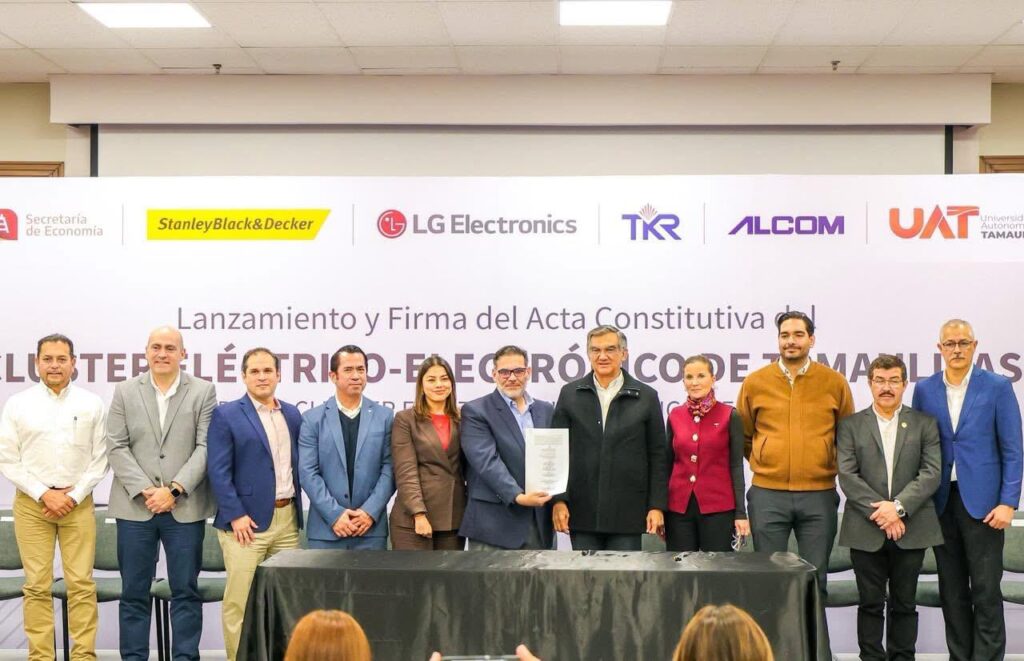
Photo Credit: Tamaulipas state government
The cluster’s founding group reflects a cross-sector approach.
It includes executives from LG Electronics Reynosa, TKR de México, and Alcom Electrónicos de México, as well as leaders from the Universidad Autónoma de Tamaulipas, the state’s public university system, and the Universidad Tecnológica de Tamaulipas Norte, a public technical university in Reynosa focused on engineering and applied sciences.
Organizers said that mix is intended to ensure decisions reflect both factory-floor realities and long-term workforce development needs.
Training workers for today’s factories
Universities play a central role in the cluster’s workforce strategy, particularly in aligning education with the skills manufacturers need.

“The university, as one of the helices, helps strengthen ties with the productive sector and translate the educational policies instructed by Governor Américo Villarreal Anaya,” said Edgar Garza Hernández, president of the Universidad Tecnológica de Tamaulipas Norte, known in English as the Technological University of Northern Tamaulipas.
Garza Hernández said the cluster will expand internships for students and faculty, allowing training to take place directly inside manufacturing plants.
“Training will not take place only in classrooms; it will also be reinforced through internships for both faculty and students, so competencies can be developed once graduates enter the workforce,” he said.
Building technical capacity in Reynosa
The cluster is also expected to strengthen continuing education and technical services for engineers and skilled workers already employed in the industry.
“The next training courses will be directly aligned with the needs of the electrical and electronics industry,” Garza Hernández said.
He pointed to Reynosa’s established manufacturing footprint, noting that the city has a number of surface-mount technology production lines, commonly known as SMT lines, comparable to major industrial states.
“Reynosa has the same number of SMT production lines as Nuevo León and Chihuahua,” he said. “This places us at the forefront and puts us in direct competition with those states.”
The Technological University of Northern Tamaulipas is the only public technical university in the state offering a degree in microelectronics and semiconductors. It is also one of five institutions nationwide that offer the Fuji Diploma, a specialized surface-mount technology training program that uses industrial-grade manufacturing equipment.
“We have a complete surface-mount technology line and a machine valued at approximately $200,000,” Garza Hernández said.

Anayancy Ulloa
Reporter
Most Read
- SpaceX is giving Brownsville $220M for water projects. In exchange, the city gave up zoning control of 444 acres near Starbase
- SpaceX seeks to take zoning control over nearly 450 acres from city of Brownsville as a ‘regional’ water deal takes shape
- Port of Brownsville could soon host Nodule City, a first-of-its-kind commercial deep-sea mining hub
- Cameron County is negotiating a $20M Fluidstack data center donation after Harlingen waffles on the same offer
- How much water does SpaceX need to operate near Brownsville? Nearly 20x its current use
Get the latest business news delivered to your inbox every morning for free.
Try 30 Days Free!
Get full access to award-winning journalism covering business, real estate, health care, economic trends, and the people shaping the Rio Grande Valley.
30 Days Free!
$9.95/month
Limited time offer
Subscription renews after your 30 day free trial at $9.95/mo.
Included Benefits
- Unlimited access to all articles
- Daily business news and analysis
- Subscriber-only content and features
Stories That Matter
- McAllen’s $204M water investment expects to seek construction bids in 2027
- Saronic lands Navy landing craft contract, first build at Brownsville’s Port Alpha
- The Rio Grande Valley’s tech industry is small but growing — meet some of the next-gen workforce
- Entrepreneurs enter Mission EDC’s ‘Shark Tank’ competition for $25K top prize
- Mission’s first Small Business Expo puts $25K on the line for local entrepreneurs
- Reynosa’s newest technical high school focuses on AI, semiconductors and bionics
- McCoy’s gives $10K, tools to launch Mid-Valley construction academy
- UT Health RGV performs new digestive procedure for first time in the Valley
- TSTC bets on advanced manufacturing to meet RGV’s industrial boom
- SpaceX reschedules Starship’s first flight around the Earth