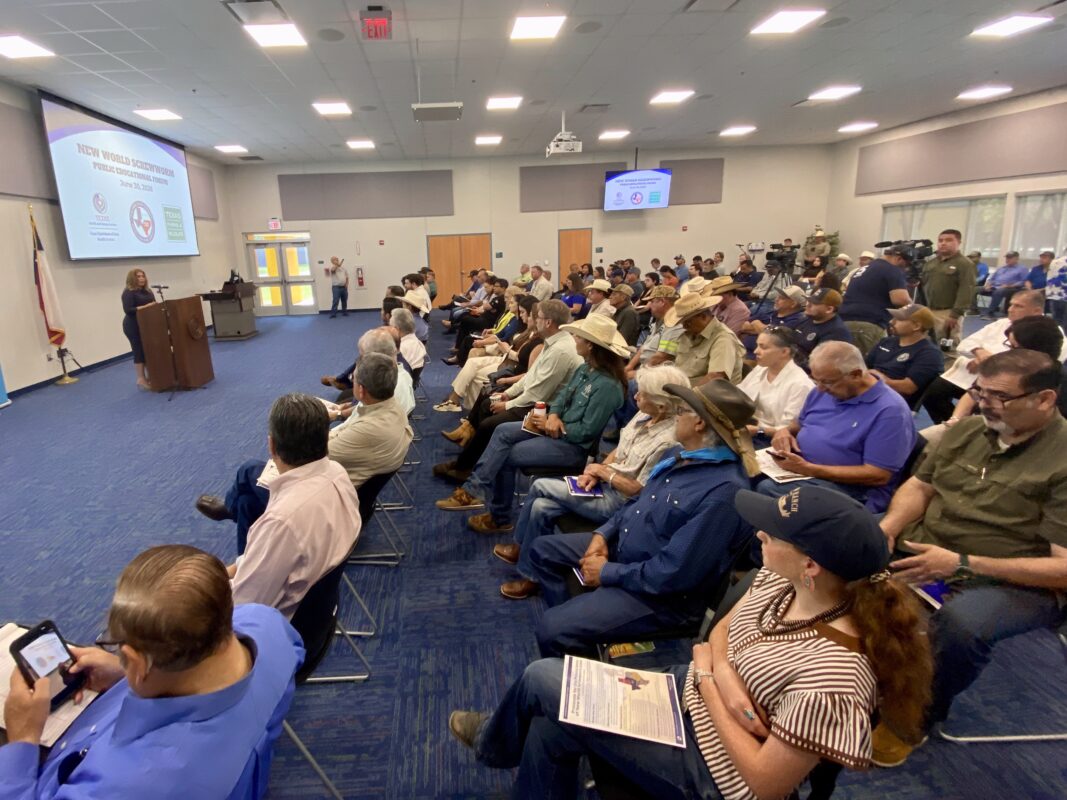
RIO GRANDE CITY — Texas animal health officials urged South Texas livestock producers Tuesday to serve as the first line of defense against the New World screwworm, telling ranchers that early detection and rapid reporting will be critical to preventing outbreaks that could disrupt livestock production and cross-border agricultural trade.
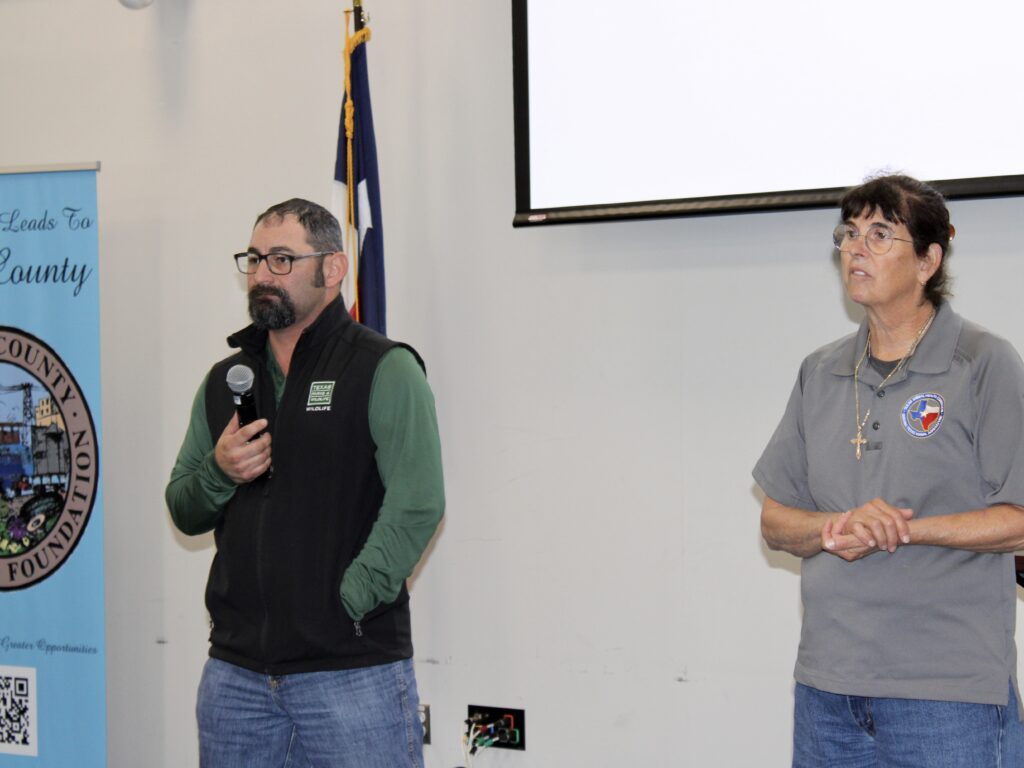
Photo credit | Anayancy Ulloa
“We need your eyes, your ears and even your sense of smell to help us,” Dr. Sandra Leyendecker of the Texas Animal Health Commission told ranchers and rural landowners attending the New World Screwworm Public Educational Forum. “That’s the only way we’ve been able to keep cases contained in specific areas.”
The forum, hosted in Starr County by the Starr County Industrial Foundation in partnership with Starr Camargo Bridge Co., South Texas College and several Texas agencies, brought together livestock producers, wildlife experts and state officials to discuss surveillance efforts, reporting requirements and response plans as Texas works to prevent the pest from spreading north.
Texas’ outreach comes as officials monitor the pest’s spread in Mexico, where authorities had reported 461 confirmed cases and two deaths as of June 26. The state has established 10 surveillance zones, plus one in New Mexico, to help detect and contain the parasite before it reaches Texas livestock.
While state officials emphasized vigilance, local ranchers wanted to know what would happen if they were the ones to identify a case.

Their questions centered on how they would obtain medication, whether the state would help cover treatment costs and how livestock movement restrictions could affect their operations if infestations are confirmed.
“Our goal is to give producers the opportunity to speak directly with the experts and understand what actions the state and federal governments will take — not only to help prevent the disease, but also to respond if cases are eventually detected,” said Rose Benavidez, president of the Starr County Industrial Foundation.
Benavidez said one of the livestock industry’s biggest concerns is understanding how producers would gain access to medication and treatment should an infestation occur.
“We hope the state will be able to support us. If we do find a case, we want to know how we’ll be able to access medication and the assistance needed to treat it, because we expect those costs could be very high,” she said.
She said Starr County’s active livestock industry and weekly cattle market make it especially important for producers to understand movement restrictions and response protocols before an emergency develops.
State outlines surveillance strategy
Leyendecker said the New World screwworm poses a unique threat because its larvae feed exclusively on the living tissue of warm-blooded animals, including livestock, wildlife, birds and, in some cases, humans.
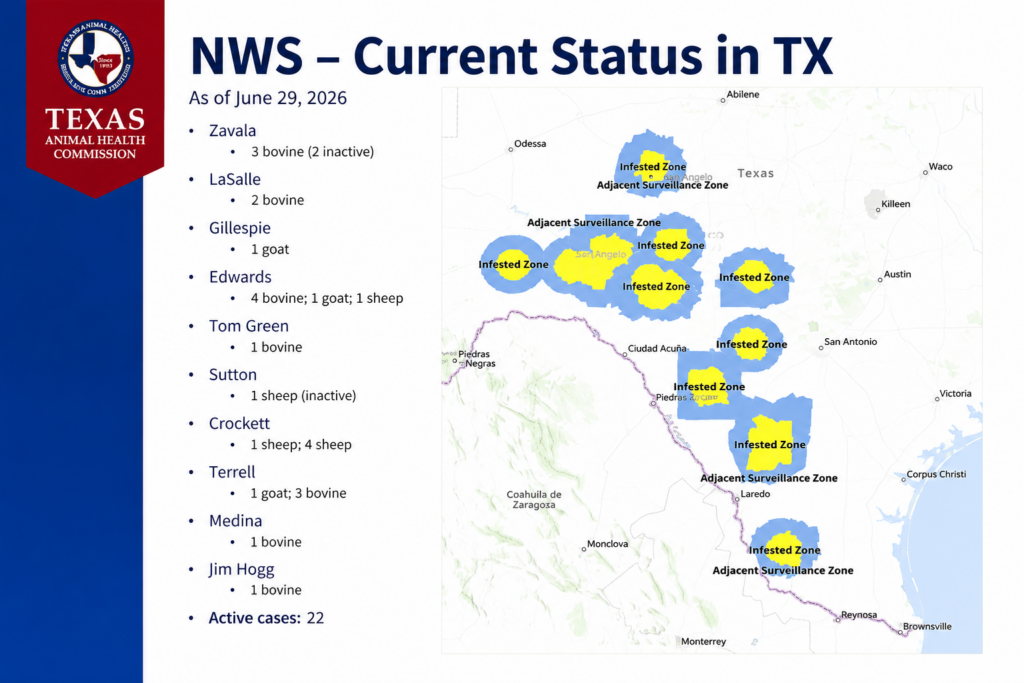
Although the United States eradicated the pest during the 1970s through the release of sterile male flies, that technique remains the foundation of today’s response. Officials said Texas now combines aerial surveillance, ground monitoring and artificial intelligence tools to identify infestations before they spread.
Eric Garza, a certified wildlife biologist with the Texas Parks and Wildlife Department, said the agency has contacted more than 6,100 rural landowners and secured access to monitor more than 300,000 acres.
The surveillance effort includes 73 trap sites, 22 ground-based sterile fly release stations and monitoring of more than 3,000 wild animals.
“We’ve had eyes on more than 3,000 wild animals,” Garza said. “We have not confirmed a single positive case in monitored wildlife.”
Garza said laboratory testing of 43 suspected wildlife cases has returned negative results. Texas laboratories are producing results within 24 to 48 hours, allowing sterile fly releases to begin almost immediately if a case is confirmed.
Once a positive case is identified, the surrounding surveillance zone remains in place for 90 days without additional detections before restrictions can be lifted.
Northern Tamaulipas remains free of cases

José Ramón Guerrero Gamboa, president of the Regional Livestock Union of Tamaulipas, said northern Tamaulipas remains free of confirmed New World screwworm cases because of coordination between livestock producers and Mexican animal health authorities.
“Fortunately, we have not detected a single case in the northern part of the state,” Guerrero said.
He said producers have worked alongside the state government, the federal government and Mexico’s National Service for Agrifood Health, Safety and Quality since the first case was identified in Tamaulipas in December 2025.
According to Guerrero, the closest confirmed case to the Texas border was detected in the municipality of Burgos, while another suspected case in San Fernando was contained before it could spread farther north.
Stakes extend beyond animal health
Officials said the New World screwworm poses not only an animal health threat but also an economic threat for South Texas and northern Tamaulipas, where ranching remains a major industry and cross-border cattle movement supports regional commerce.
A significant outbreak could trigger additional livestock inspections, movement restrictions and higher operating costs for producers.
Leyendecker reminded attendees that state agencies do not have the personnel to inspect every ranch or rural property, making producers’ participation essential.
“We need you to monitor your animals,” she said. “If you believe you have a case and don’t report it, we can’t deploy the sterile flies needed to contain the infestation.”
With surveillance zones in place, thousands of landowners participating in monitoring efforts and laboratories capable of confirming suspected cases within 24 to 48 hours, officials said Texas is relying on producers to help prevent the New World screwworm from threatening livestock production, wildlife and cross-border commerce.

Anayancy Ulloa
Reporter
Most Read
- SpaceX’s futuristic city of Starbase finalizes massive 7,100-acre annexation. Here’s what we know.
- SpaceX reschedules Starship’s first flight around the Earth
- How much water does SpaceX need to operate near Brownsville? Nearly 20x its current use
- Could apartment-to-condo conversion help make $100K homeownership in the McAllen metro more affordable? One investor says yes.
- Crunch Fitness is expanding and struggling in the Valley. Here’s why
Get the latest business news delivered to your inbox every morning for free.
Try 30 Days Free!
Get full access to award-winning journalism covering business, real estate, health care, economic trends, and the people shaping the Rio Grande Valley.
30 Days Free!
$9.95/month
Limited time offer
Subscription renews after your 30 day free trial at $9.95/mo.
Included Benefits
- Unlimited access to all articles
- Daily business news and analysis
- Subscriber-only content and features
Stories That Matter
- Tamaulipas is rethinking how it sells its cattle. A $44.5M project would keep more of the business at home
- Brownsville is changing its drainage fee. Businesses could pay more as the city looks to raise $6.2M a year
- Mission’s first Small Business Expo puts $25K on the line for local entrepreneurs
- Reynosa’s newest technical high school focuses on AI, semiconductors and bionics
- McCoy’s gives $10K, tools to launch Mid-Valley construction academy
- UT Health RGV performs new digestive procedure for first time in the Valley
- TSTC bets on advanced manufacturing to meet RGV’s industrial boom
- Pharr’s cross-border business push earns international recognition
- Brownsville eases drought restrictions after nearly three years as Rio Grande reservoir levels improve
- Texas A&M’s $53.5M McAllen research center will tackle water, food security and Valley health