Editor’s note: This is a developing story. Check back later for updates.
Austin-based technology startup Saronic Technologies, a company promising 10,000 shipyard jobs at the Port of Brownsville and $3.2 billion of investment for the Rio Grande Valley, made a final investment decision on Thursday, officials announced.
“We searched the entire country for a year,” Dino Mavrooka, Co-Founder and Chief Executive Officer at Saronic Technologies, said Thursday during a news conference alongside Texas Gov. Greg Abbott. “We found exceptional sites from coast to coast, but Brownsville and Texas won on every dimension — deepwater access, land availability, workforce, and state government committed to moving at Saronic speed. We’re proud to call Texas home.”
If the company does create 10,000 jobs, it would become the largest single private-sector employer in the Rio Grande Valley. For example, even the largest hospital system employs fewer than 4,000 workers. It’s possible that someday SpaceX could outpace Saronic in the number of jobs, but it was not immediately clear when that might happen.
The Saronic Technologies economic incentive deal includes tax breaks from Cameron County for nearly two decades, the Point Isabel Independent School District for at least a decade, and $10 million from the Greater Brownsville EDC.
The total value of the economic incentive deal is $211 million over four phases, starting in 2029; the deal is tied to job creation.
The company’s economic incentives application indicated that it was considering sites in Texas, California, and Virginia. The company had initially also considered Louisiana, but it was not a finalist for Port Alpha, the application indicated.
Saronic, founded in 2022 and backed by $845 million in investor capital, aims to build a next-generation shipyard to manufacture autonomous vessels for the U.S. Navy in wartime operations and for commercial customers.
“We’ve raised a lot of capital where we have the ability to mobilize that capital in a way that impacts communities like Brownsville, but more importantly, we’re not SpaceX. We don’t have an unlimited budget,” Doug Lambert, co-founder and chief operating officer of Saronic, previously said during a public meeting.
Saronic previously outlined the types of jobs it would create, from welders to administrators, with a minimum wage of $25 an hour and an average closer to $36 an hour. The average annual wage for the Brownsville project is expected to be about $75,500, according to the company’s application.
Saronic touted that its employees are eligible for company stock and that it has plans to expand into the commercial market to reduce reliance on defense industry contracts.
The median household income in Cameron County is about $24 an hour, according to the Workforce Solutions office. That could account for two adults working $12-an-hour jobs each, or one earning a minimum wage of $7.25 and the other working closer to $17 an hour.
Saronic promised that 35% of its workforce would be Cameron County residents, and it would participate in job fairs and educational training.
Greater Brownsville EDC estimates that the Saronic Technologies shipyard could generate an economic impact of $4.9 billion, 20,000 jobs when indirect jobs are included, and $1.4 billion in annual wages for 10,000 workers, thereby increasing the community’s total gross domestic product.
The Donald Trump administration’s Big Beautiful Bill included billions for autonomous naval defense technology — including $2.1 billion for medium-sized unmanned surface vessels, $1.7 billion for workforce development for shipbuilding, and $1.3 billion for the expansion of unmanned vehicle production.
Last year, the U.S. Navy awarded the company a $394 million contract to produce autonomous surface vessels — or drone boats that can maneuver through the ocean on a mission without human intervention — by 2031.
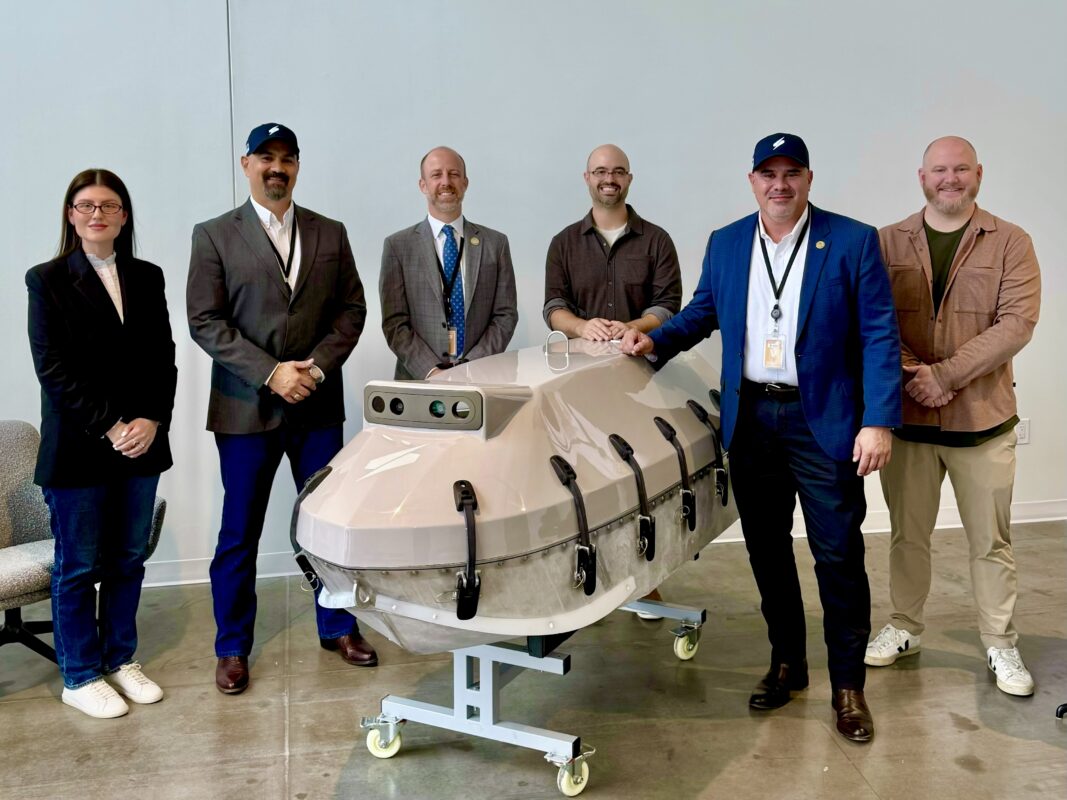
The Navy contract is for its Corsair drone boat, which is 24 feet long and can carry 1,000 pounds for more than 1,000 nautical miles. The U.S. Navy secretary boasted that the Corsair was developed from prototype to production in less than a year, which is a significantly faster cycle than the defense industry standard.
Saronic blends technology with manufacturing vessels, which have historically relied on ship captains. Instead, the vessels rely on cameras, radar, and computer programming models.
Building autonomous vessels that navigate open-ocean waters is especially challenging, as there are no cell phone towers and even satellite internet access is limited. The saltwater interrupts antenna signals, company officials said.

Kristen Mosbrucker-Garza
Reporter
Kristen Mosbrucker-Garza is a versatile multimedia news reporter who lives and works along the Texas-Mexico border in Hidalgo County. Mosbrucker-Garza is a news reporter for the Rio Grande Valley Business Journal. During her career she's worked for the McAllen Monitor, San Antonio Business Journal, The Advocate Newspaper in Louisiana, Phoenix New Times, and public media outlets in Baltimore and Philadelphia.
Most Read
- Is SpaceX quietly building a data center at Starbase? Job postings offer clues
- 25 Mexican businesses eye McAllen expansion after city pitches U.S. market entry program
- SpaceX’s futuristic city of Starbase finalizes massive 7,100-acre annexation. Here’s what we know.
- McAllen metro keeps selling more homes as Brownsville-Harlingen market sees 17% drop through August
- Rio Grande LNG moves closer to getting even bigger at Port of Brownsville
Get the latest business news delivered to your inbox every morning for free.
Try 30 Days Free!
Get full access to award-winning journalism covering business, real estate, health care, economic trends, and the people shaping the Rio Grande Valley.
30 Days Free!
$9.95/month
Limited time offer
Subscription renews after your 30 day free trial at $9.95/mo.
Included Benefits
- Unlimited access to all articles
- Daily business news and analysis
- Subscriber-only content and features
Stories That Matter
- New filings detail nearly $11M in UTRGV tennis, football stadium improvements
- Tamaulipas battles rising screwworm cases as cattle exports remain on hold
- Mission’s first Small Business Expo puts $25K on the line for local entrepreneurs
- McCoy’s gives $10K, tools to launch Mid-Valley construction academy
- UT Health RGV performs new digestive procedure for first time in the Valley
- TSTC bets on advanced manufacturing to meet RGV’s industrial boom
- Pharr’s cross-border business push earns international recognition
- Mission EDC launches search for new CEO with salary up to $190K
- Brownsville eases drought restrictions after nearly three years as Rio Grande reservoir levels improve
- Texas transportation leaders to discuss Rio Grande Valley infrastructure at Mission summit