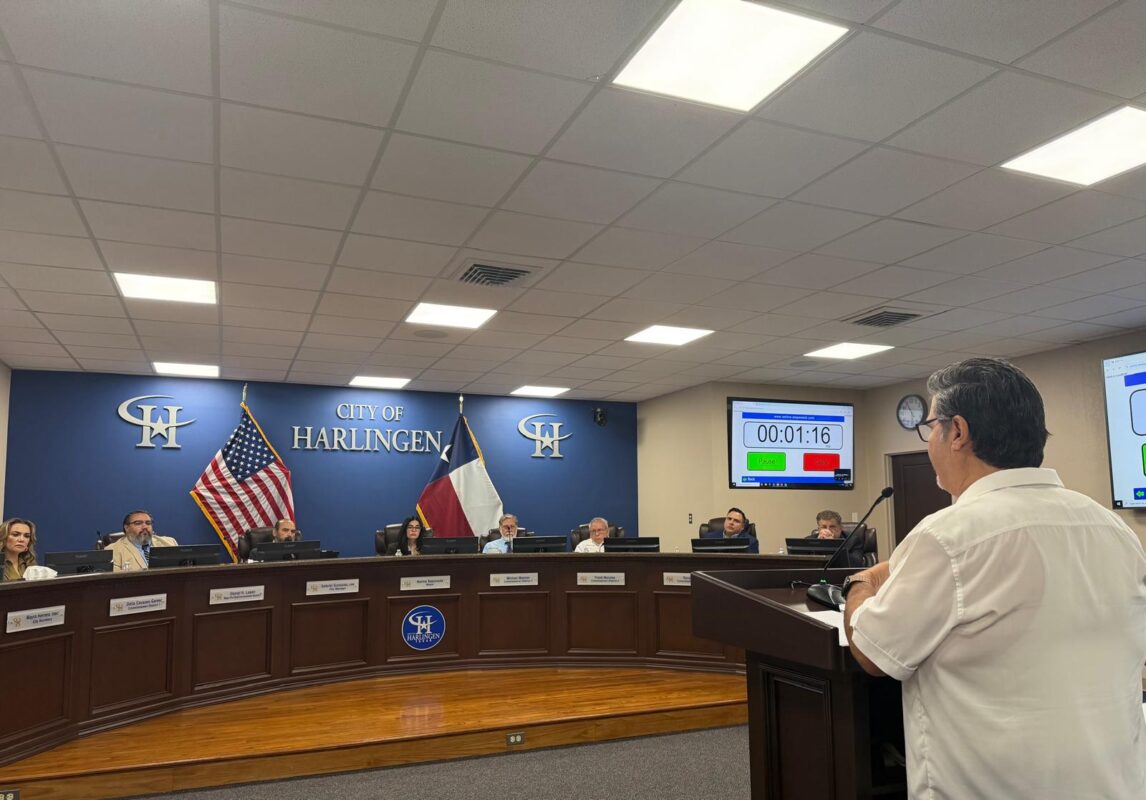
New York City-based technology startup Fluidstack offered Harlingen city commissioners a $20 million donation and $7 million in infrastructure improvements on Wednesday night in exchange for drainage approvals for its 1,000-acre data center planned near the Port of Harlingen.
But instead of accepting the donation, city commissioners asked the company to host an open house in Harlingen to share its plans with the community before the city decides on the company’s drainage approval request — instead of after — which the data center business planned to do.
“That could do a lot in our community. I know it would help with the streets, with the drainage projects, and that would do a lot of benefit. But saying yes, for me, that’s kind of selling our soul, and I will not do that,” Harlingen District 5 Commissioner Rene Perez said.
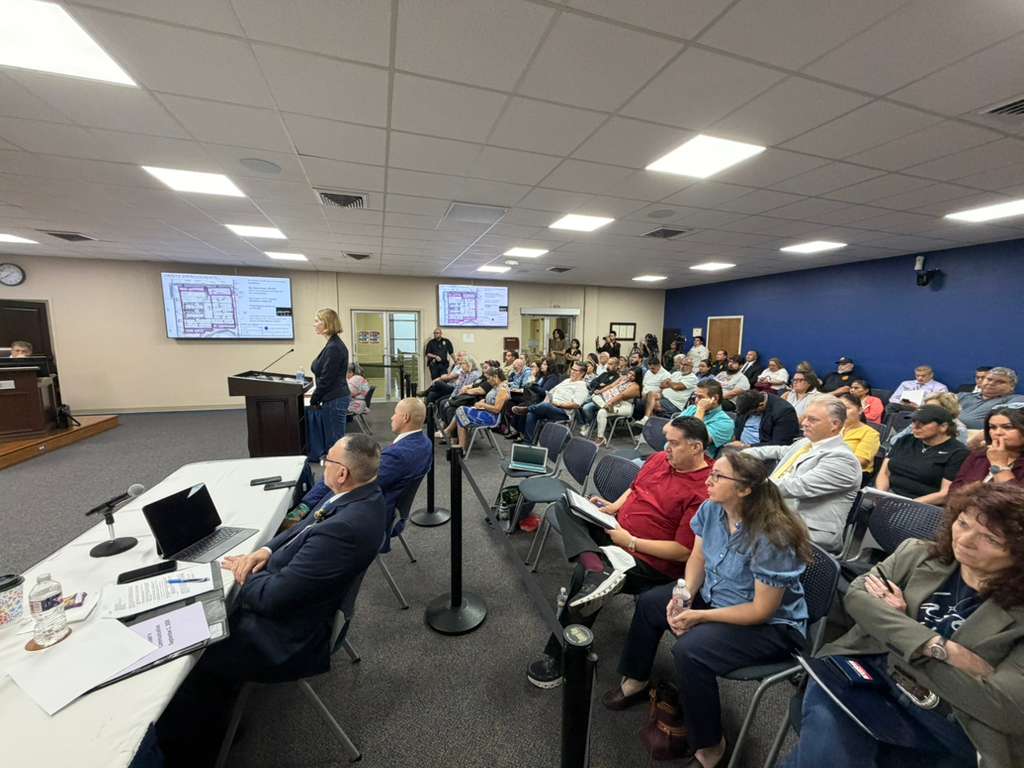
Harlingen commissioners already passed a data center moratorium, but because the project is outside city limits, they cannot control the two data centers proposed next to the airport. Several concerned residents spoke out against the data center project, questioning whether the city was being transparent in its process and saying they felt left out of major decisions.
Harlingen real estate agent Albert Garcia said he was initially worried that the city’s water company would also supply water to the data center.
“The drainage into the Harlingen airport, it’s going to be even more and more compromises that the city has to make. What concerns me, [as a realtor], is that it’s become even more like Brownsville. SpaceX did a lot of great stuff, but unfortunately their taxes have gone up outrageously; the utilities [cost] are outrageous too. People who couldn’t afford the house then certainly can’t do it now,” Garcia said. “And now, that’s about to happen here. I’m concerned about the transparency: not voting on important things until the last minute and explaining it, and letting the people know, because you represent us.”

Harlingen Mayor Norma Sepulveda said the commission passed a new ordinance on Wednesday night requiring stormwater changes to come before the city, rather than through an administrative process, in order to bring the data center into public discussion. Sepulveda pushed for the open house before a vote.
“Here, in Harlingen, the community likes the town halls before we make a decision — not after,” she said. “We were given some [of this] information last-minute. We, as commissioners, are trying to evaluate the pros and cons.”
Harlingen District 2 Commissioner Daniel Nemecio Lopez said he’s learned that each data center proposal is unique and needs to be fully evaluated, but he’s not convinced this is the best way forward for the community.
“What I’ve learned is that no two data centers are the same,” Lopez said. “I understand that $20 million is a lot of money. And people have to realize the consequences of saying no, and of saying yes, right? If we have another, god forbid, flood in 2026 like we had back in 2018 and 2019, back-to-back, people have to realize, if we’re in a flood, and people’s homes are flooding, inundated with water, I want them to know that hey, there was an opportunity to potentially change that outcome.”
But Lopez said he’s unlikely to vote in favor of the drainage approval right now.
“We have to make sure that the economic development that we bring to the city is reflective of the residents’ visions and goals for the city of Harlingen and the future,” he said.
Fluidstack is a technology company building data centers to power artificial intelligence models. It was funded in part by a former OpenAI researcher who helped create ChatGPT, raised $830 million in Series A to build data centers nationwide, and was valued at $7.5 billion. The company also has corporate offices in Austin and is hiring hundreds of workers.
Anthropic, the company behind Claude, has also tapped Fluidstack to build data centers in Texas.
Fluidstack executive Kate Franko, who has been attending community meetings for the company’s data center ambitions in rural areas, offered Harlingen city commissioners $20 million and an additional $7 million for improvements to drainage infrastructure because the business plans to transform cotton fields into impervious surfaces.
To manage the landscape change, the company expects to build retention ponds on the property that could hold roughly three times as much water during heavy rainfall.
Franko declined a news interview with the Rio Grande Valley Business Journal but presented the plans directly to the city commission during its regular meeting.
“The detention ponds will have controlled release, so when a storm comes in, like in March of 2025, the ponds here can hold that capacity for whatever comes to this area. Then we can control the release into the ditch so that it doesn’t overrun the walls of the ditch,” Franko said. “When a new company comes into a new area, we are of the very firm belief that we want to work with our partners. That means showing up and asking about what needs exist, and then asking ourselves how we can help. The way we can help is this drainage issue.”
The company estimated that $20 million for a city of Harlingen’s size and scope would help with about a decade’s worth of drainage infrastructure, adding that it would not add restrictions on how the city spent the money.
Beyond that, Fluidstack’s executive explained that the company has not sought economic incentives or property tax breaks from Cameron County, nor does it intend to seek any incentives from Harlingen.
“Which means we will be paying a full tax bill,” Franko said. “Which means tens of millions of dollars every year for Cameron County and associated partners.”
Cameron County deeds show that three private landowners sold about 1,000 acres of land to the company over the summer. That includes about 336 acres from Mark and Molly Abbott and their affiliated real estate company, 3M LLC. The Abbott’s are cotton farmers who operate the Harlingen Gin and once ran what appears to be a defunct palm tree farm. Co-trustees Dwain Estes and Rebecca Estes sold another 418 acres, and the Geistman farm heirs, Tiffini Adamson and David Grabbs Jr., sold 309 acres, deed records show.
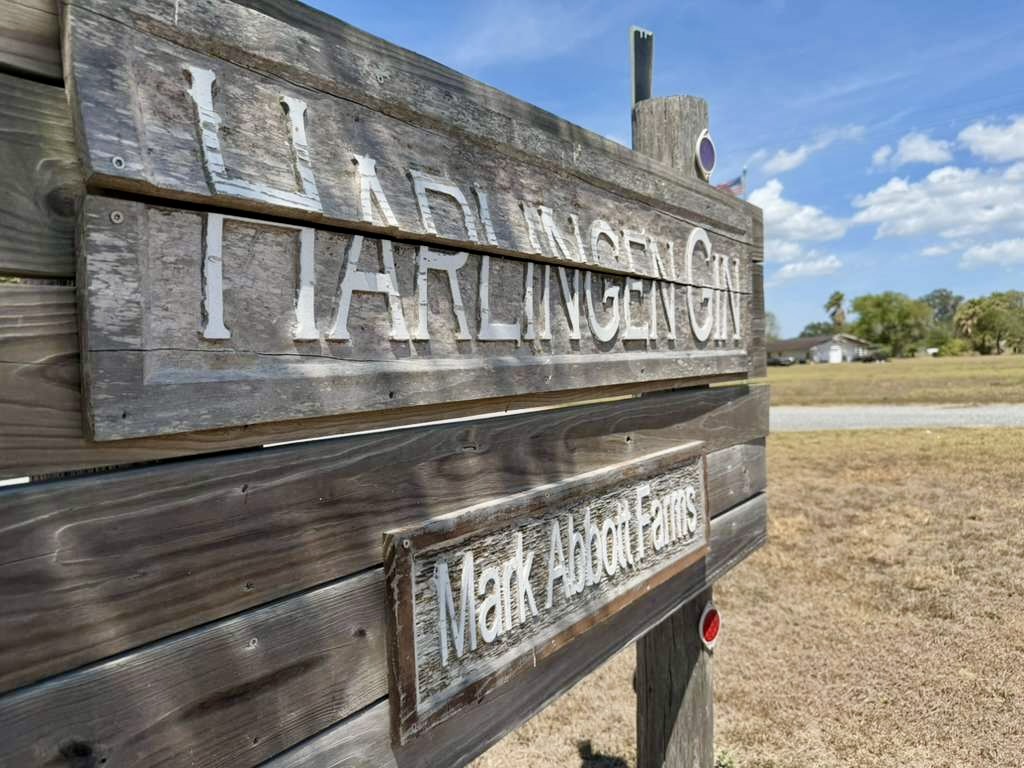
Farmer and Harlingen Gin operator Mark Abbott declined to comment on the issue. Maps show the Abbott land has its own private reservoir, but it was not immediately clear how many acre-feet of water the company controls as a result of the land deal.
The purchase price for the land sales was not publicly disclosed — as is often the case in Texas — but the state’s agricultural exemptions significantly reduced their taxable value for decades.
For example, the 418-acre lot once owned by the Estes — which is now controlled by Fluidstack affiliate Confluence Compute and slated to pay property taxes to the Port of Harlingen, Rio Hondo Independent School District, the Emergency Service District No. 1, Cameron County, and South Texas Independent School District — was appraised at $1.1 million in 2026, but its net appraisal was reduced to $203,000 because of farmland exemptions.
The proposed data center along Farm-to-Market Road 106 sits across the highway from the Port of Harlingen and bends towards the city of Rio Hondo.
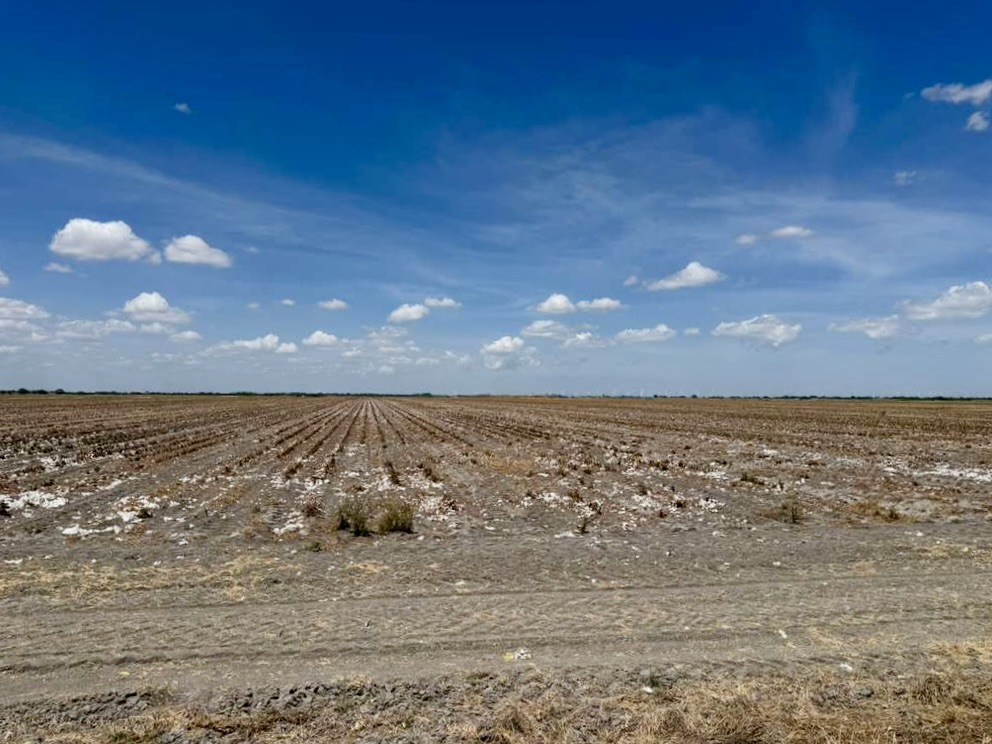
The road where the data center will be built leads to an industrial bridge that lifts up to allow vessels and barge traffic to travel along the Arroyo Colorado River to and from the Port of Harlingen, an inland port.
“Everyone is concerned with data centers and water usage, and that’s a very fair concern. There are evaporative-cooling data centers that draw millions of gallons a day. That’s the data center you all heard about first, [Eneus Energy], that is not us,” Franko said. “Fluidstack exclusively builds closed-loop cooling, which means each building has a tank. We fill it one time and one-time only. The only top-offs are for maintenance and repairs. There is no daily draw on water. That tank is about 400,000 gallons.”
It was not immediately clear where the company would initially get 400,000 gallons, but it expects to pay East Rio Hondo Water Supply Corporation, a nonprofit organization, for 50,000 gallons of water each day. The company described that amount as what it needs during its construction phase, in part, to keep the dust down. But, on a daily basis, the company would only require about 7,000 gallons per day for employee restrooms.
“That’s less than what a cotton field uses — by a lot,” Franko said. “The only daily drawdown we will have, ultimately, is for domestic purposes — kitchens and bathrooms for employees.”
It was not immediately clear how much power the facility would need, but Fluidstack expects to purchase electricity from AEP Texas, its transmission provider, and a private third-party company.
“We have already paid for new transmission lines. We will pay for our own substation, and we will pay for upgrades to the local substation that are needed, and we will buy all our own energy,” Franko said.
As for noise, the company claims it can contain the sound to 60 decibels for the surrounding community at the property line.
Data centers need not just land, electricity, and internet but also water — that’s where the East Rio Hondo Water Supply Corporation comes in.
The Eneus Data Center has a deal with the Harlingen Water Works even though it’s in the county as well.
As for whether the East Rio Hondo Water Supply Corporation has sufficient capacity for its customers today, and whether the data center request would push the organization beyond its limits, Brian Macmanus, general manager, told the Journal that he’s not concerned.
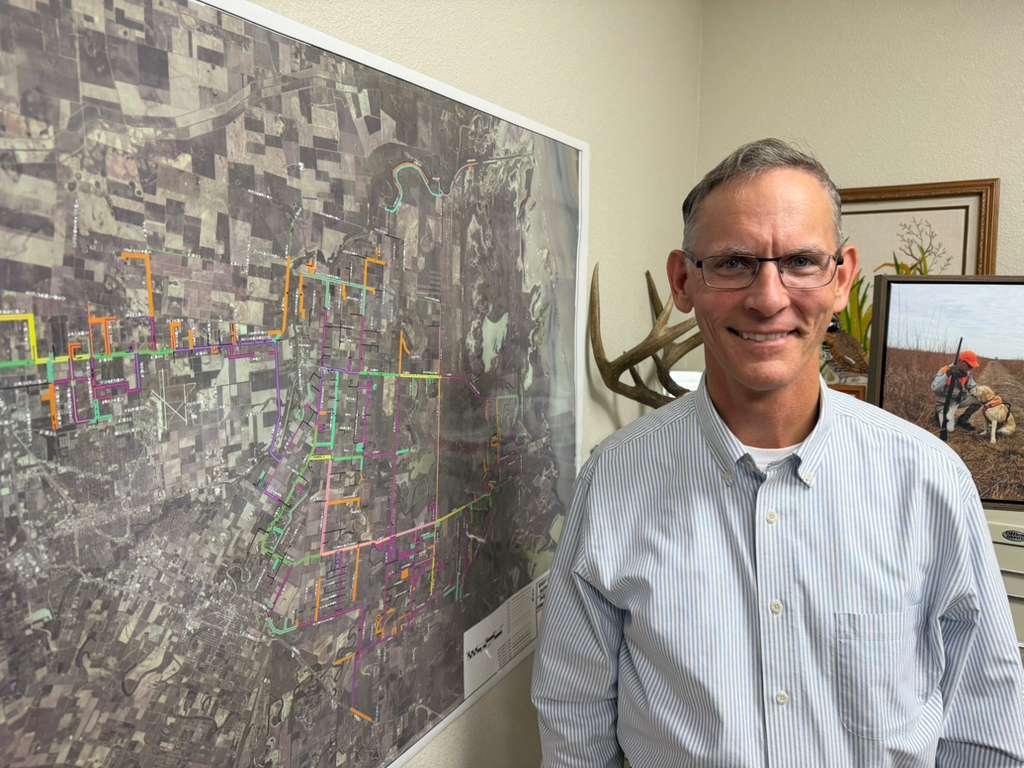
He said a new industrial customer would instead help stabilize against future water rate hikes. For example, Fluidstack paid for its own feasibility study and is expected to pay $700,000 to the East Rio Hondo Water Supply Corporation for the interconnection fee, membership dues, and other initial startup costs.
Fluidstack initially asked for 350,000 gallons of water from the nonprofit, but that was recently reduced to 50,000 gallons, he said.
“This isn’t going to be an issue for us to handle from a capacity perspective,” Macmanus said, likening it to the equivalent of 58 lots in a residential subdivision.
But unlike the Eneus Energy deal with Harlingen Water Works, which relies on effluent water, this deal would rely on potable drinking water.
On a peak day, existing customers use about 6.9 million gallons of water across the district. With the new brackish desalination plant, capacity would increase to 21.4 million gallons of water each day. And demand isn’t slowing down; the furthest southern edge of the water supply district’s boundaries now includes the city of Brownsville as the communities grow into each other.
East Rio Hondo Water Supply Corporation recently raised its water rates by 50% to help cover the cost of drilling a new water source for brackish groundwater and to build a new plant to avoid relying solely on the Rio Grande River.
When a water utility borrows money, the cost of the upgrades is repaid by the ratepayers with higher rates as opposed to grants, which do not contribute to rate hikes. Most of the brackish plant was paid for with grants, Macmanus said. The goal is to be prepared for the day when the river water availability dries up.
“We want to hold our brackish desal for our members, in somewhat reserve, for that emergency day, which we foresee the future drought coming and the river not being able to carry the day,” he said.
Beyond that, if the water is available, the water supply organization is not allowed to deny potential customers access to water because of the state-level certificate of convenience and necessity it holds.
But the water supply organization has gotten inquiries from future heavy-water users.
One unnamed business asked for 16 million gallons of water each day — but only from a source not reliant upon the Rio Grande River, which would have been possible but very expensive, he said.
“Even the folks who are coming in here and looking at our community from the outside for jobs are concerned about the reliability of the river,” he said.
Instead of using brackish groundwater or the Rio Grande River to supply the water needed by the growing data center cluster in the Rio Grande Valley, a proposed seawater desalination plant proposed for South Padre Island might be a better fit, he said. It would be easier for an industrial customer to absorb the higher cost of desalting water, which is the most expensive source.
It would cost water supply companies anywhere between $10 and $15 per gallon for desalinated water, which is higher than any water supplier in the Valley charges customers for water retail.
“When you have a data center or an industrial customer at the port, which is going to put a big burden on the local water source, it makes sense for them to pick up that higher-cost water and take care of that and leave the local populace at the lower rate,” he said.

Kristen Mosbrucker-Garza
Reporter
Kristen Mosbrucker-Garza is a versatile multimedia news reporter who lives and works along the Texas-Mexico border in Hidalgo County. Mosbrucker-Garza is a news reporter for the Rio Grande Valley Business Journal. During her career she's worked for the McAllen Monitor, San Antonio Business Journal, The Advocate Newspaper in Louisiana, Phoenix New Times, and public media outlets in Baltimore and Philadelphia.
Most Read
- Is SpaceX quietly building a data center at Starbase? Job postings offer clues
- 25 Mexican businesses eye McAllen expansion after city pitches U.S. market entry program
- SpaceX’s futuristic city of Starbase finalizes massive 7,100-acre annexation. Here’s what we know.
- McAllen metro keeps selling more homes as Brownsville-Harlingen market sees 17% drop through August
- Rio Grande LNG moves closer to getting even bigger at Port of Brownsville
Get the latest business news delivered to your inbox every morning for free.
Try 30 Days Free!
Get full access to award-winning journalism covering business, real estate, health care, economic trends, and the people shaping the Rio Grande Valley.
30 Days Free!
$9.95/month
Limited time offer
Subscription renews after your 30 day free trial at $9.95/mo.
Included Benefits
- Unlimited access to all articles
- Daily business news and analysis
- Subscriber-only content and features
Stories That Matter
- Texas transportation leaders to discuss Rio Grande Valley infrastructure at Mission summit
- South Texas College plans $4.7M makeover of cosmetology, security facilities in McAllen
- Mission’s first Small Business Expo puts $25K on the line for local entrepreneurs
- McCoy’s gives $10K, tools to launch Mid-Valley construction academy
- UT Health RGV performs new digestive procedure for first time in the Valley
- TSTC bets on advanced manufacturing to meet RGV’s industrial boom
- Pharr’s cross-border business push earns international recognition
- Brownsville eases drought restrictions after nearly three years as Rio Grande reservoir levels improve
- Texas A&M’s $53.5M McAllen research center will tackle water, food security and Valley health
- STC puts AI to work across 55 courses — from construction sites to car repair