
Photo Credit | Kristen Mosbrucker-Garza
After three decades of building homes in the Rio Grande Valley, Emiliano Zapata is increasingly helping finance new construction himself, as banks pull back on lending and builders look to private investors to keep projects moving.
Zapata, the CEO of Capital Insiders, shared an economic outlook for 2026 at the South Texas Builders Association offices in McAllen on Thursday.
“Banks are getting stricter,” Zapata said.
Tighter financing
Most banks finance only up to 80% of commercial loans, while private lenders offer more flexible terms. With that flexibility comes a higher overall cost. Private lenders may charge a 13% interest rate rather than an 8% interest rate at a bank, and instead of a lump sum, the money is drawn out over time as the project is completed.
“We are asset-based lenders. We can give you 100% of the construction,” Zapata told the crowd of builders. “We understand that you have a customer waiting for the house, you need to get the house in the ground as quickly as possible or otherwise the family is going to move on with another builder or they start making changes to the plans.”
But he still recommends homebuilders use banks if the project is a long-term investment rather than a short-term 12-month loan — that’s because banks charge lower interest rates than private lenders.
In general, there’s been more demand for alternative financing among homebuilders because lenders are pulling back on new loans and tightening loan requirements — a trend that’s happening nationwide, according to the National Association of Home Builders survey in late 2025.
The most common way lenders are pulling back is by lowering the maximum allowable loan-to-cost ratio, which refers to the cost of building a home compared to how much it can be sold for later. This means projects with slimmer margins are considered higher risk to lenders, according to the survey.
Homebuilders also saw lenders offering smaller loans for proposed projects, which meant higher up-front costs for the builder.

“One of the trends we’re keeping a close eye on for 2026 is geography,” Robert Dietz, the chief economist for the National Association of Home Builders, said. “We’ve seen new-home markets slow down in previously hot markets, like Texas and Florida, in part because of some limited cyclical overbuilding, and the fact that mortgage rates remained above 6% in 2025.”
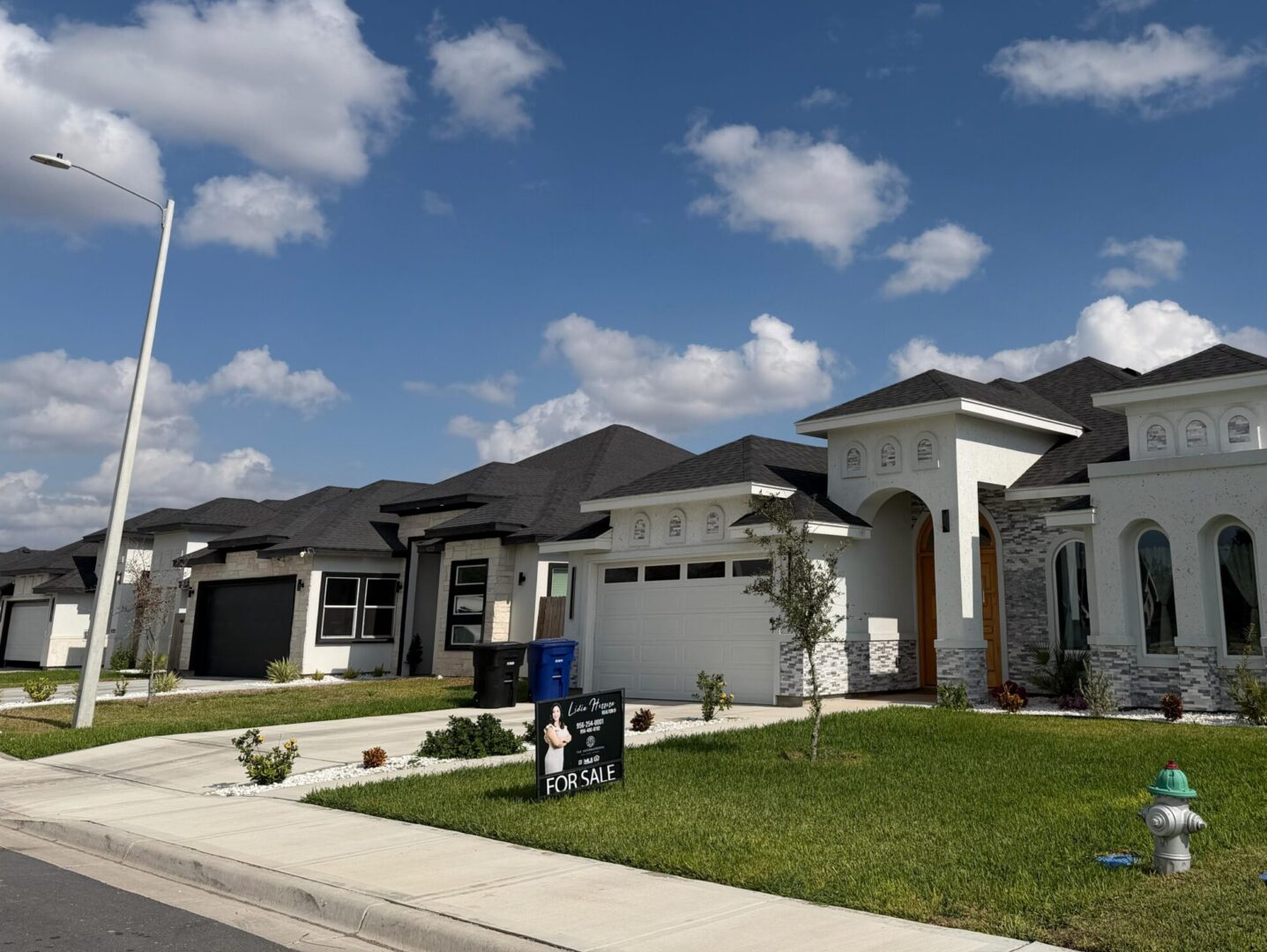
In the Rio Grande Valley, there’s a similar trend, especially because there’s already a glut of single-family homes on the market. As a result, some builders are renting homes that haven’t sold yet — or in some cases building entire subdivisions of single-family houses designed as rentals.
In November, the McAllen-Mission-Edinburg metro area had more than 9.3 months of inventory, indicating that thousands of homes were already for sale. In the Brownsville-Harlingen metro area, there were 7.4 months of homes for sale.
Rising land prices and in-demand locations
The price of land is a key factor in home prices. It typically sets the minimum price for a single-family home.
In 2026, there are few lots below $60,000 in the Rio Grande Valley, especially in the highest-demand cities of McAllen, Mission, and Edinburg.
“It is hard to do affordable housing in the Valley; land prices have gone up. Every single developer is facing challenges to get the price of land in a proper way, so that we can do lots. The days of $30,000 or $40,000 lots are far behind,” Zapata said. “And when you have $50K, $60K, $70K lots, it’s nearly impossible to do a $200,000 house anymore.”
Zapata said he knows a developer who is building a subdivision who purchased a site with 18 lots on it near the intersection of Owassa and Sugar Road in Pharr. The developer paid $180,000 per lot, so homes were being priced at $750,000 each to recoup the cost of the land.
As a result, developers are building in lower-cost cities, like San Juan, Pharr, Alamo, and further into the mid-Valley. There was a flurry of subdivisions built in Weslaco because the lots were cheaper, but there aren’t enough buyers right now.
“There are so many empty subdivisions in Weslaco. Ghost towns, completely empty,” Zapata said.
One of his clients who built homes in Weslaco is now redesigning their subdivision.
“They might need to do townhouses or rental communities,” Zapata said.

Kristen Mosbrucker-Garza
Reporter
Kristen Mosbrucker-Garza is a versatile multimedia news reporter who lives and works along the Texas-Mexico border in Hidalgo County. Mosbrucker-Garza is a news reporter for the Rio Grande Valley Business Journal. During her career she's worked for the McAllen Monitor, San Antonio Business Journal, The Advocate Newspaper in Louisiana, Phoenix New Times, and public media outlets in Baltimore and Philadelphia.
Most Read
- Edinburg ISD rejects nearly $6M offer for prime land near La Sienna despite $15M budget deficit
- What Toyota’s $3.6B San Antonio expansion could mean for the Rio Grande Valley
- Port of Brownsville approves $2M SpaceX pipeline deal, with millions more on the table
- New Texas Workforce Commission grant to help upskill 78 employees in the RGV’s manufacturing sector
- Texas LNG seeks 5 more years but remains bullish on Port of Brownsville export project
Get the latest business news delivered to your inbox every morning for free.
Try 30 Days Free!
Get full access to award-winning journalism covering business, real estate, health care, economic trends, and the people shaping the Rio Grande Valley.
30 Days Free!
$9.95/month
Limited time offer
Subscription renews after your 30 day free trial at $9.95/mo.
Included Benefits
- Unlimited access to all articles
- Daily business news and analysis
- Subscriber-only content and features
Stories That Matter
- UTRGV files $25.3M renovation plans for McAllen optometry school
- Saronic wins Marine Corps contract for autonomous military supply vessel
- Social Fest: Long lines, big names and unexpected lessons
- DHR Health helps Valley veterans access specialty care close to home
- Greater Brownsville EDC CEO Gilberto Salinas earns international economic development award
- Longtime nurse at South Texas Health System named Veteran of the Year
- Mission’s first Small Business Expo puts $25K on the line for local entrepreneurs
- McCoy’s gives $10K, tools to launch Mid-Valley construction academy
- UT Health RGV performs new digestive procedure for first time in the Valley
- TSTC bets on advanced manufacturing to meet RGV’s industrial boom