Despite heightened trade uncertainty, geopolitical tensions, and the upcoming review of the United States–Mexico–Canada Agreement, the industrial real estate market along Tamaulipas’ border is entering 2026 with more stability than many industry players had anticipated, supported by expansion activity, logistics demand, and more disciplined growth.
Sergio Reséndez, managing director of Colliers Monterrey, the regional office of the global commercial real estate services firm, said the risks that dominated headlines over the past year had limited operational impact on border markets.

“There has been more noise than real effect,” Reséndez said. “Although there was significant uncertainty related to tariffs, migration, and blockades, in practice, the impact on Mexico has been very limited.”
He said concerns that companies would begin leaving the border region did not materialize.
“What we clearly saw did not happen was companies beginning to leave. We did not observe that phenomenon, particularly along the border,” he said.
Instead, Reséndez said, many companies adopted a cautious stance — pausing decisions while maintaining operations and, in some cases, preparing future expansion plans.
“Probably the worst thing most companies did was stay on standby, while continuing to operate as they had been,” Reséndez said.
Expansions signal confidence
Reséndez pointed to LG’s expansion in Reynosa as one of the most notable investments in 2025, which he said closed at an unusually fast pace.

Courtesy of | State of Tamaulipas
LG invested $100 million to expand and modernize production lines at its Reynosa television manufacturing plant, creating about 500 direct jobs and 800 indirect jobs.
“From zero to fully leased took 30 days,” Reséndez said about the global firm’s expansion project. “It has been one of the fastest deals I’ve closed in my career.”
The speed of the deal, he said, reflects companies’ efforts to anticipate inflation, interest-rate trends, and consumption patterns, while also diversifying their footprint within the same metropolitan area.
“Companies no longer necessarily want to concentrate their entire operation in a single location,” Reséndez said. “They are looking for strategic sites based on labor availability, logistics, and proximity to different border crossings.”
More orderly growth than other markets
Reséndez said Tamaulipas’ border cities avoided several of the constraints that slowed industrial growth in other parts of Mexico, particularly energy-related limitations.
“Electric power became a major inhibitor in cities like Monterrey, but that did not happen in the same way along the border,” he said, citing investments in transmission lines and dedicated substations within industrial parks.
He also noted that growth across the region remained balanced, avoiding oversupply.
“Investments did not spiral out of control and flood the market with square footage as happened in other cities,” Reséndez said. “Reynosa, Matamoros, and Nuevo Laredo have remained stable.”
Market conditions by city
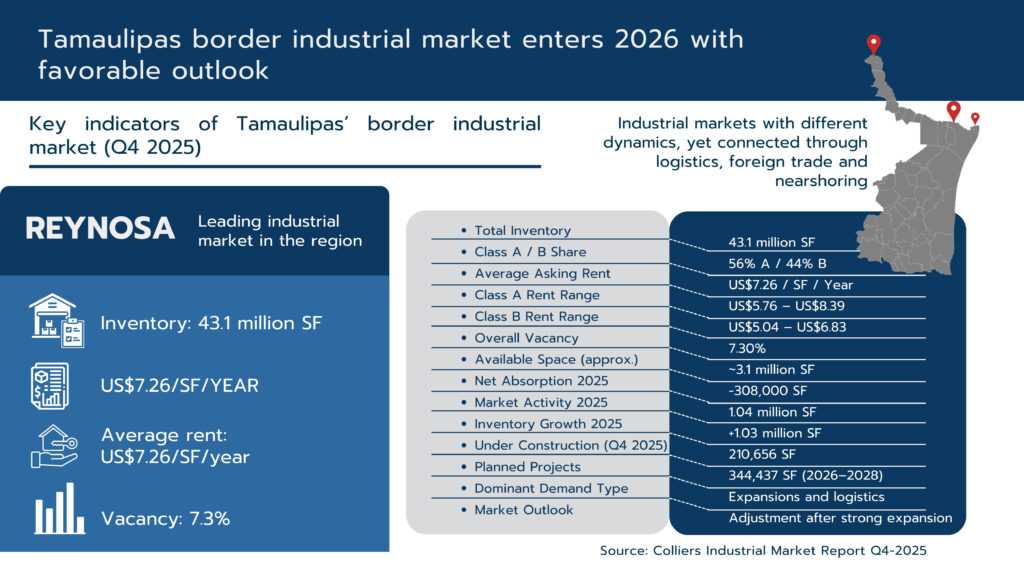
According to Colliers’ fourth-quarter 2025 reports, Reynosa remains the region’s largest industrial market, with approximately 43 million square feet of inventory. Average asking rents stand at $7.26 per square foot per year, with a vacancy rate of 7.3%, reflecting an adjustment after several years of strong expansion.
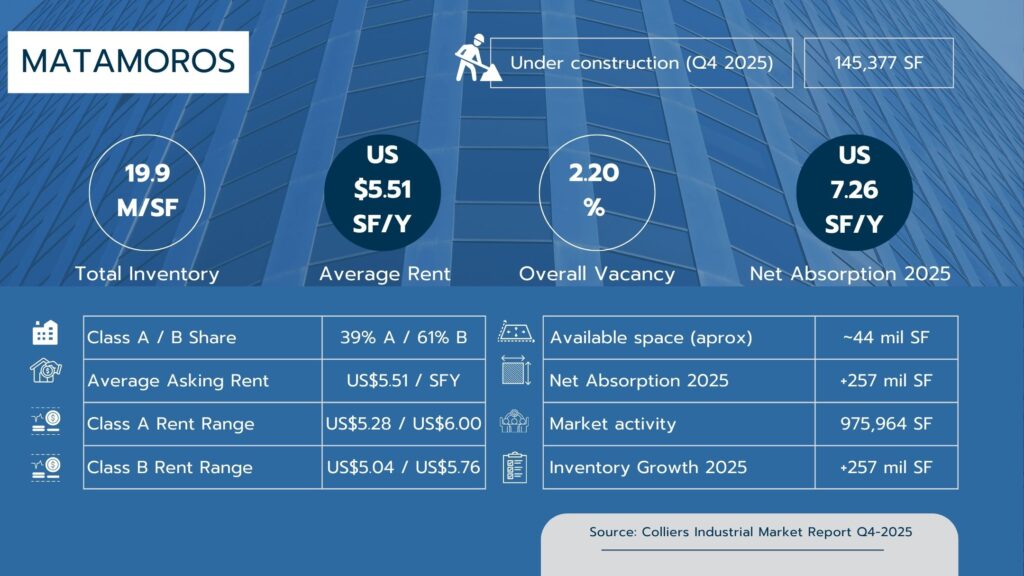
Matamoros, by contrast, has 19.9 million square feet of inventory, average asking rents of $5.51 per square foot, and a vacancy rate of just 2.2%.
“In Matamoros, there has been a lack of new industrial development, particularly speculative projects, to the point where availability was virtually nonexistent at one stage,” Reséndez said.
Nuevo Laredo has about 12.5 million square feet of inventory, with average rents of $6.97 per square foot and a vacancy rate of 7.3%. While its role as a logistics hub remains critical, Reséndez said additional inventory will be needed to support continued growth there.
Logistics and cold storage drive demand
Beyond manufacturing, Reséndez said demand continues to rise in logistics-related sectors, including electronics, specialized warehousing, and cold storage infrastructure.
“We don’t produce food in these cities,” he said about the border region. “It has to be brought in from increasingly distant locations. That requires facilities to refrigerate, inspect, and store products, especially at the border.”
As urban populations grow and supply chains become more complex, he said, this type of infrastructure is becoming increasingly essential.
USMCA review seen as potential catalyst
While the USMCA review remains a central issue for 2026, Reséndez said it could ultimately incentivize further supply-chain localization rather than deter investment.
“The most likely outcome is an increase in regional content, probably to between 82% and 85%,” he said. “That would force more companies to bring their supply chains closer to the region to remain within the agreement.”
Uncertainty — not stricter rules themselves — remains the primary challenge, Reséndez said.
“The common denominator is the need for a clear rule — whatever it may be — to eliminate the uncertainty effect,” he said.
Outlook for 2026
Reséndez expects the first half of 2026 to remain cautious, with stronger activity emerging later in the year as trade policy and interest-rate conditions become clearer.
“The critical months will be June and July, when there is greater clarity regarding the USMCA,” he said. “After the summer, toward late August and into year-end, we do expect a rebound.”
Gradual interest-rate declines could support new construction, though he expects developers to remain disciplined.
“We will see some additional construction, but nothing excessive,” Reséndez said. “The industrial sector has learned to grow in line with demand.”

Anayancy Ulloa
Reporter
Most Read
- SpaceX is giving Brownsville $220M for water projects. In exchange, the city gave up zoning control of 444 acres near Starbase
- SpaceX seeks to take zoning control over nearly 450 acres from city of Brownsville as a ‘regional’ water deal takes shape
- Port of Brownsville could soon host Nodule City, a first-of-its-kind commercial deep-sea mining hub
- Cameron County is negotiating a $20M Fluidstack data center donation after Harlingen waffles on the same offer
- How much water does SpaceX need to operate near Brownsville? Nearly 20x its current use
Get the latest business news delivered to your inbox every morning for free.
Try 30 Days Free!
Get full access to award-winning journalism covering business, real estate, health care, economic trends, and the people shaping the Rio Grande Valley.
30 Days Free!
$9.95/month
Limited time offer
Subscription renews after your 30 day free trial at $9.95/mo.
Included Benefits
- Unlimited access to all articles
- Daily business news and analysis
- Subscriber-only content and features
Stories That Matter
- McAllen’s $204M water investment expects to seek construction bids in 2027
- Saronic lands Navy landing craft contract, first build at Brownsville’s Port Alpha
- The Rio Grande Valley’s tech industry is small but growing — meet some of the next-gen workforce
- Entrepreneurs enter Mission EDC’s ‘Shark Tank’ competition for $25K top prize
- Mission’s first Small Business Expo puts $25K on the line for local entrepreneurs
- Reynosa’s newest technical high school focuses on AI, semiconductors and bionics
- McCoy’s gives $10K, tools to launch Mid-Valley construction academy
- UT Health RGV performs new digestive procedure for first time in the Valley
- TSTC bets on advanced manufacturing to meet RGV’s industrial boom
- SpaceX reschedules Starship’s first flight around the Earth