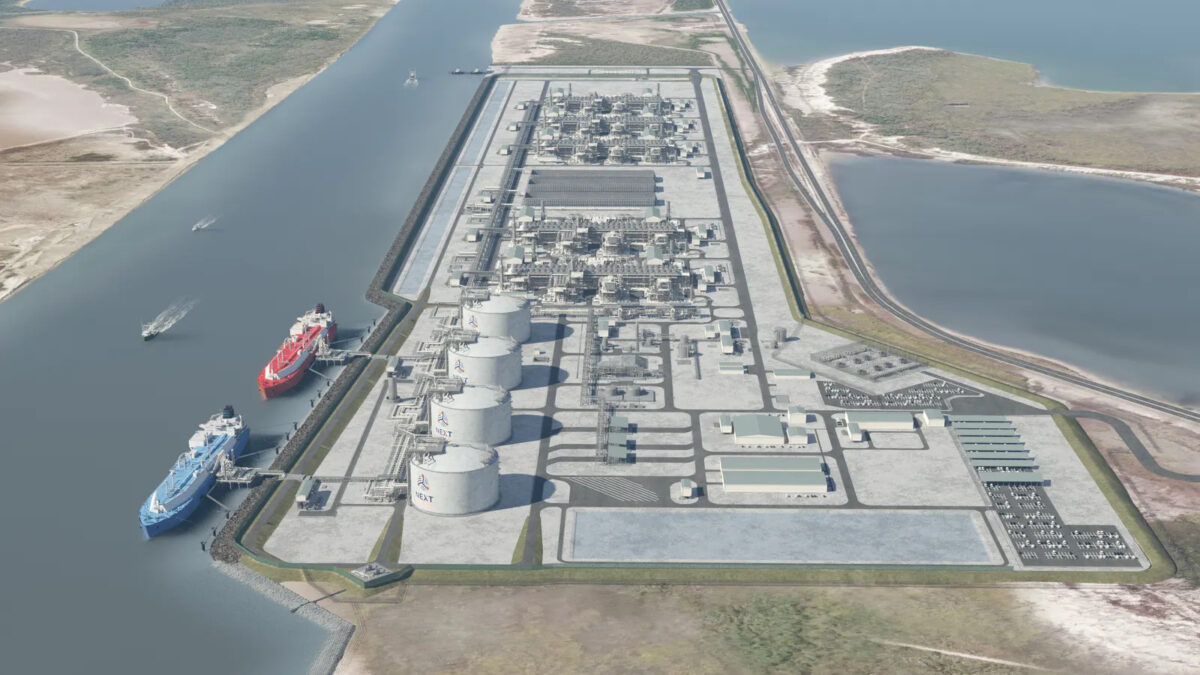
Houston-based energy company NextDecade Corp. reached a final investment decision on Thursday to expand its Brownsville LNG export terminal, currently under construction, adding a fifth liquefaction train for $6.7 billion alone.
Betchel Energy will be the construction company leading the project. Thousands of construction workers in various trades are expected to be hired as temporary workers on the project.
NextDecade already has a 20-year contract with customers like ConocoPhillips, JERA, and ETQ Corporation for 4.5 million tonnes per annum out of 6 million tonnes to be built as part of the fifth train to be delivered by 2031. NextDecade is financing the deal with a $3.5 billion loan, with the rest as equity stakes from investors like a BlackRock subsidiary.
Liquefied natural gas is a supercooled product often exported overseas as an alternative energy source to nations without domestic energy extraction industries, such as many European and Asian countries.
Rio Grande LNG’s export terminal has capacity for 10 liquefaction trains on the sprawling 1,000-acre site, which would be 60 million tonnes per annum of capacity.
The U.S. is the largest exporter of LNG in the world, with more than 11.9 billion cubic feet of LNG each day in 2024, according to the U.S. Energy Information Administration.
That’s because the price of natural gas in America has been low for decades, as opposed to oil, which fetches higher prices on the market and is used in the production of gasoline.
In January, President Donald Trump removed a moratorium on new export permits for LNG and has issued a flurry of permits for new projects since then, including in Louisiana, a big export hub for LNG.

Kristen Mosbrucker-Garza
Reporter
Kristen Mosbrucker-Garza is a versatile multimedia news reporter who lives and works along the Texas-Mexico border in Hidalgo County. Mosbrucker-Garza is a news reporter for the Rio Grande Valley Business Journal. During her career she's worked for the McAllen Monitor, San Antonio Business Journal, The Advocate Newspaper in Louisiana, Phoenix New Times, and public media outlets in Baltimore and Philadelphia.
Most Read
- SpaceX is giving Brownsville $220M for water projects. In exchange, the city gave up zoning control of 444 acres near Starbase
- SpaceX seeks to take zoning control over nearly 450 acres from city of Brownsville as a ‘regional’ water deal takes shape
- Port of Brownsville could soon host Nodule City, a first-of-its-kind commercial deep-sea mining hub
- Cameron County is negotiating a $20M Fluidstack data center donation after Harlingen waffles on the same offer
- How much water does SpaceX need to operate near Brownsville? Nearly 20x its current use
Get the latest business news delivered to your inbox every morning for free.
Try 30 Days Free!
Get full access to award-winning journalism covering business, real estate, health care, economic trends, and the people shaping the Rio Grande Valley.
30 Days Free!
$9.95/month
Limited time offer
Subscription renews after your 30 day free trial at $9.95/mo.
Included Benefits
- Unlimited access to all articles
- Daily business news and analysis
- Subscriber-only content and features
Stories That Matter
- McAllen’s $204M water investment expects to seek construction bids in 2027
- Saronic lands Navy landing craft contract, first build at Brownsville’s Port Alpha
- The Rio Grande Valley’s tech industry is small but growing — meet some of the next-gen workforce
- Entrepreneurs enter Mission EDC’s ‘Shark Tank’ competition for $25K top prize
- Mission’s first Small Business Expo puts $25K on the line for local entrepreneurs
- Reynosa’s newest technical high school focuses on AI, semiconductors and bionics
- McCoy’s gives $10K, tools to launch Mid-Valley construction academy
- UT Health RGV performs new digestive procedure for first time in the Valley
- TSTC bets on advanced manufacturing to meet RGV’s industrial boom
- SpaceX reschedules Starship’s first flight around the Earth