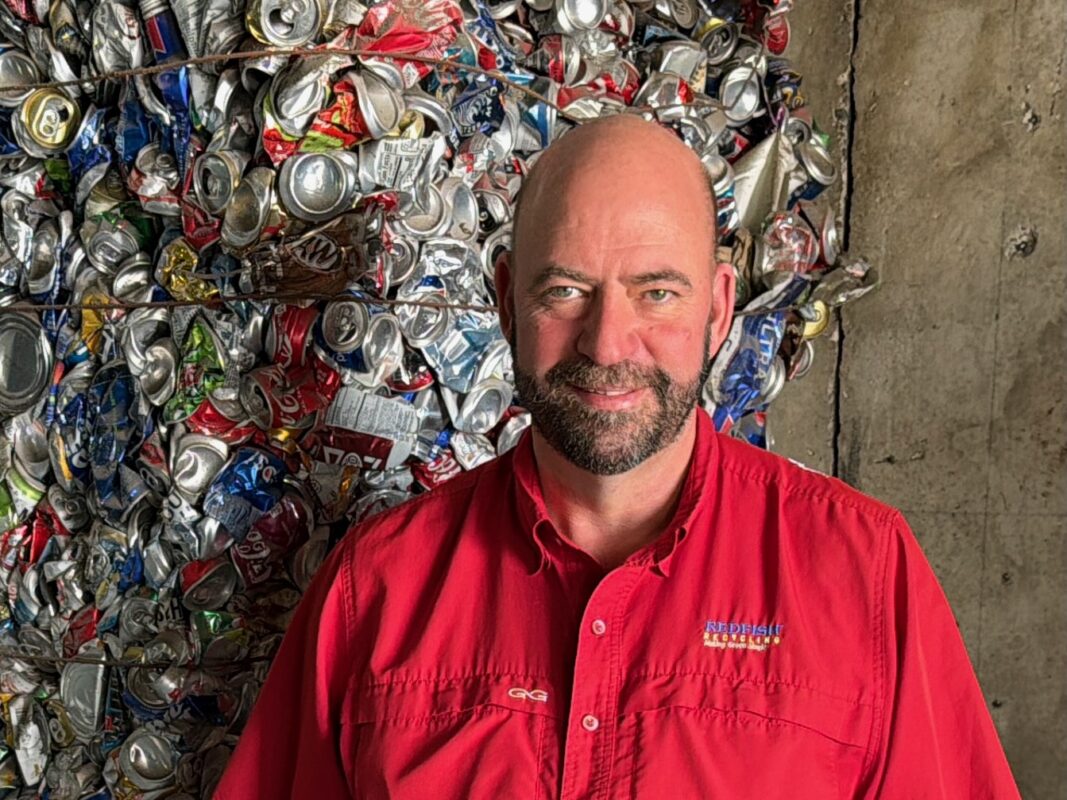
Redfish Recycling founder Dean Putegnat envisions a future in which his company’s signature red bins will be at the ends of driveways across the Rio Grande Valley.
But first, Putegnat must navigate a massive increase in new customers. On Jan. 1, he became the city of Brownsville’s curbside residential recycling contractor.
“We’re thinking that when other cities see Brownsville implementing a city-wide curbside program and what the effect it has on conserving natural resources, that other cities are going to want to do this,” Putegnat told the Rio Grande Valley Business Journal.
McAllen, Harlingen, and Edinburg already operate municipal curbside recycling programs; most other cities offer residents centralized recycling drop-off locations.
But Putegnat is determined and patient.
To achieve his goal in Brownsville, he waited more than a decade. In 2014, he was selected to participate in the city’s pilot program, but the deal failed to pass a city commission vote. Since then, the slate of elected officials has changed.
Last year, Redfish Recycling was awarded a $4 million, 7-year contract with renewal options.
From pilot project to citywide contract
Putegnat kept the company alive for years through commercial recycling contracts, which are often cheaper than throwing everything away in a trash dumpster.
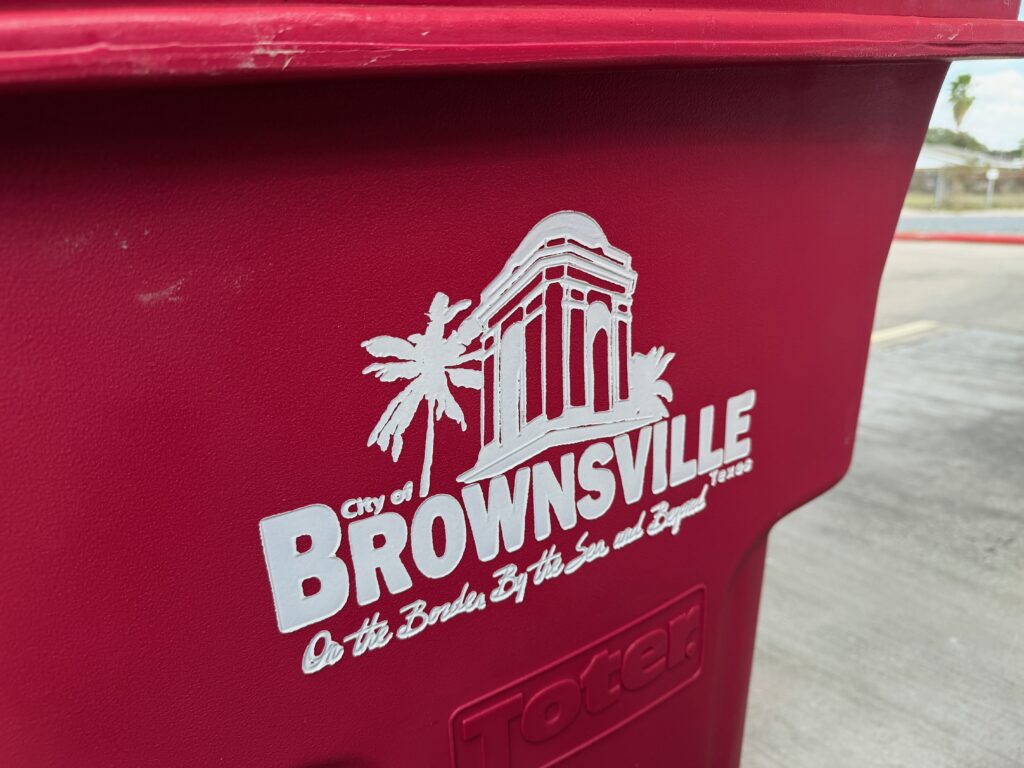
Photo Credit | Kristen Mosbrucker-Garza
“We came into this market with recycling to save businesses money and do good for the planet,” he said. “The concept of that was not here [in Brownsville]. It started slow, and we grew over 11 years.”
Then, about four years ago, he expanded into residential recycling as a subscription service for households in Brownsville, Palm Valley, Los Fresnos, and Rancho Viejo. Most recently, he even picked up residential customers in the new city of Starbase and SpaceX as a commercial recycling customer.
Before landing the contract in Brownsville, the residential subscription service there, alone, accounted for 1,500 households; now, 48,500 households are signed up for recycling.
Scaling up operations
To accommodate the increase in demand, the company purchased five new recycling trucks, hired six more delivery drivers, and hired three more office workers, bringing the total to about 30 employees.
Plus, it’s adding more automation to its sorting machine process to handle the new volume of recycling — about 7 tons per hour with extra capacity to hit 20 tons each hour.
As a result, the city is closing down its centralized recycling drop-off center and moving it to Redfish’s headquarters on Coffee Road and U.S. Highway 48. Residential recycling is picked up every two weeks.
“It really takes the whole community to make recycling make [financial] sense,” he said. “The participation rate is probably around 80%, so the environmental impact of what people are recycling, conserving natural resources, saving landfill space, and protecting the planet is night and day different.”
So far, the community has been onboard.
“We were pleasantly surprised when the first trucks came in, how clean the material is,” Putegnat said. “We were expecting the worst.”
The net increase for curbside recycling for a household with one trash can is about 86 cents a month — or about $10 a year.
Where the material goes
All the recycling is sorted by material: plastic, aluminum, tin, and paper, then wrapped into bales for easy shipping. The paper and cardboard are shipped to paper mills in the Mexican cities of Monterrey and Durango, and they are then used to make either more cardboard boxes or craft paper.
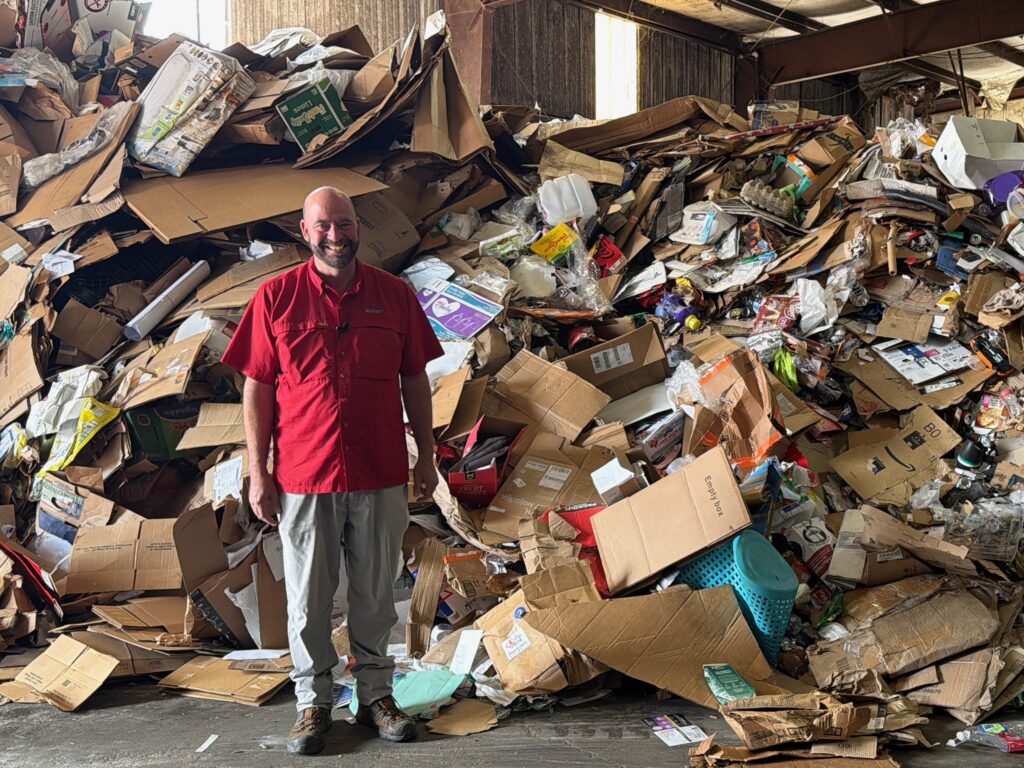
Photo Credit | Kristen Mosbrucker-Garza
Plastic bottles made of polyethylene terephthalate (PET) are sent to a recycler in Dallas, where they’re washed, shredded, and re-pelletized, then resold to plastic manufacturers.
High-Density Polyethylene (HDPE) bottles and jugs are sent to Alabama for recycling into plastic gallons used for paint.
Tin cans and any ferrous metals are sold to a scrapyard in the Port of Brownsville, then shipped to a steel mill for reuse. Aluminum cans are sold to a smelter company.
None of the recycling products are shipped overseas to China, unlike many recycling companies did for years before the nation stopped accepting such vessels due to too much nonrecyclable material.
“There are just better domestic markets,” Putegnat said.
A family business, across generations
Recycling was not Putegnat’s first career.
For years, he helped his father, Barry, run an 11,000-acre hunting ranch and resort in Mexico known as Rancho Caracol — or the Snail Ranch.
The family hunted in the region for 50 years but purchased the land in the late 1990s in the Mexican state of Tamaulipas, just north of Ciudad Victoria — or about 150 miles south of Brownsville.
In 2010, the hunting ranch closed due to cartel violence.
So Dean Putegnat, the owner of Redfish, pivoted to recycling after meeting Kent Longley, the founder of Missouri-based Marck Industries. Redfish is a standalone company, not a subsidiary of Marck, but the pair worked closely together to launch the business, of which Kent owns a stake.
The Putegnat family is no stranger to Brownsville.
In the 1890’s, the family patriarch, William Henry Putegnat II, founded Model Laundry and Dry Cleaning, which contracted with the federal government for commercial laundry services at Fort Brown — the namesake of Brownsville.
More than a century later, the Putegnat family is now tied to another core service in Brownsville — collecting and processing the city’s recycling.

Kristen Mosbrucker-Garza
Reporter
Kristen Mosbrucker-Garza is a versatile multimedia news reporter who lives and works along the Texas-Mexico border in Hidalgo County. Mosbrucker-Garza is a news reporter for the Rio Grande Valley Business Journal. During her career she's worked for the McAllen Monitor, San Antonio Business Journal, The Advocate Newspaper in Louisiana, Phoenix New Times, and public media outlets in Baltimore and Philadelphia.
Most Read
- SpaceX’s futuristic city of Starbase finalizes massive 7,100-acre annexation. Here’s what we know.
- 25 Mexican businesses eye McAllen expansion after city pitches U.S. market entry program
- Australian company plans to build a $607M lithium refinery at the Port of Brownsville. It’s a big bet on America’s battery future
- Starbase cancels meeting to consider annexing 444 acres relinquished by Brownsville
- SpaceX reschedules Starship’s first flight around the Earth
Get the latest business news delivered to your inbox every morning for free.
Try 30 Days Free!
Get full access to award-winning journalism covering business, real estate, health care, economic trends, and the people shaping the Rio Grande Valley.
30 Days Free!
$9.95/month
Limited time offer
Subscription renews after your 30 day free trial at $9.95/mo.
Included Benefits
- Unlimited access to all articles
- Daily business news and analysis
- Subscriber-only content and features
Stories That Matter
- Edinburg looks to attract new franchise businesses with matchmaking event
- $10M apartment complex planned in Hidalgo
- A Brownsville startup wants to deliver water in space. First, it needs $7M
- Mission’s first Small Business Expo puts $25K on the line for local entrepreneurs
- McCoy’s gives $10K, tools to launch Mid-Valley construction academy
- UT Health RGV performs new digestive procedure for first time in the Valley
- TSTC bets on advanced manufacturing to meet RGV’s industrial boom
- Pharr’s cross-border business push earns international recognition
- New Harlingen airport CEO eyes Mexico flights, cargo expansion and more development
- T-Mobile plans fiber-optic internet expansion in Mercedes