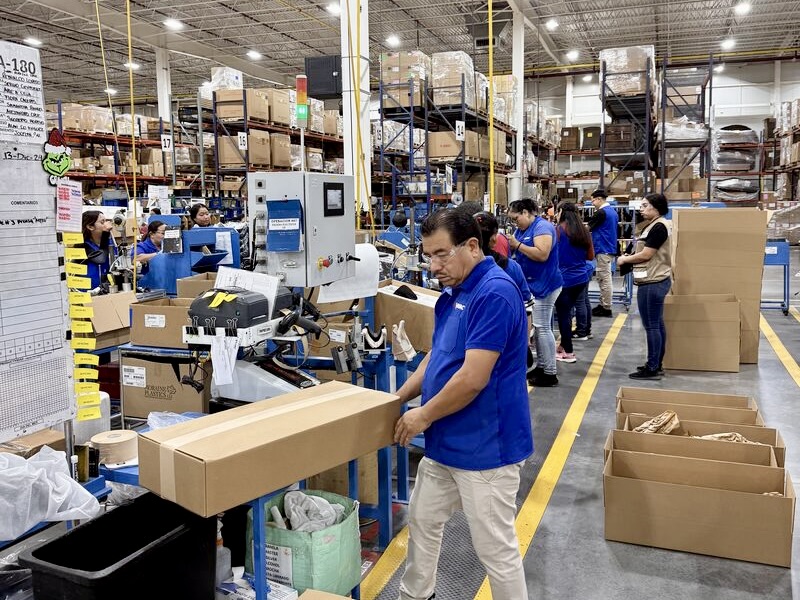
About a decade ago, the Reynosa-based manufacturer Velvac imported about 95% of its plastic components used in trucks and recreational vehicles from Asian countries.
“Now it’s the other way around, we’ve got 95% domestic from North America,” Dan McGrew, CEO of Velvac, said during the McAllen Trade Talks discussion on Thursday. “Some things make sense to be sourced in Asia. In this case, plastics were better served closer to the plant.”
Velvac designs and manufactures proprietary vision systems for medium- and heavy-duty trucks, buses, and motorhomes, including side mirrors equipped with embedded safety technology.
The company’s strategy to bring its supply chain closer to its manufacturing operation is known as nearshoring. That means its supply chain is also closer to customers — U.S. vehicle makers — which enables the business to respond more quickly to customer needs or changes.
About one-third of the plastic components are now manufactured in Reynosa by Velvac itself, a big change.
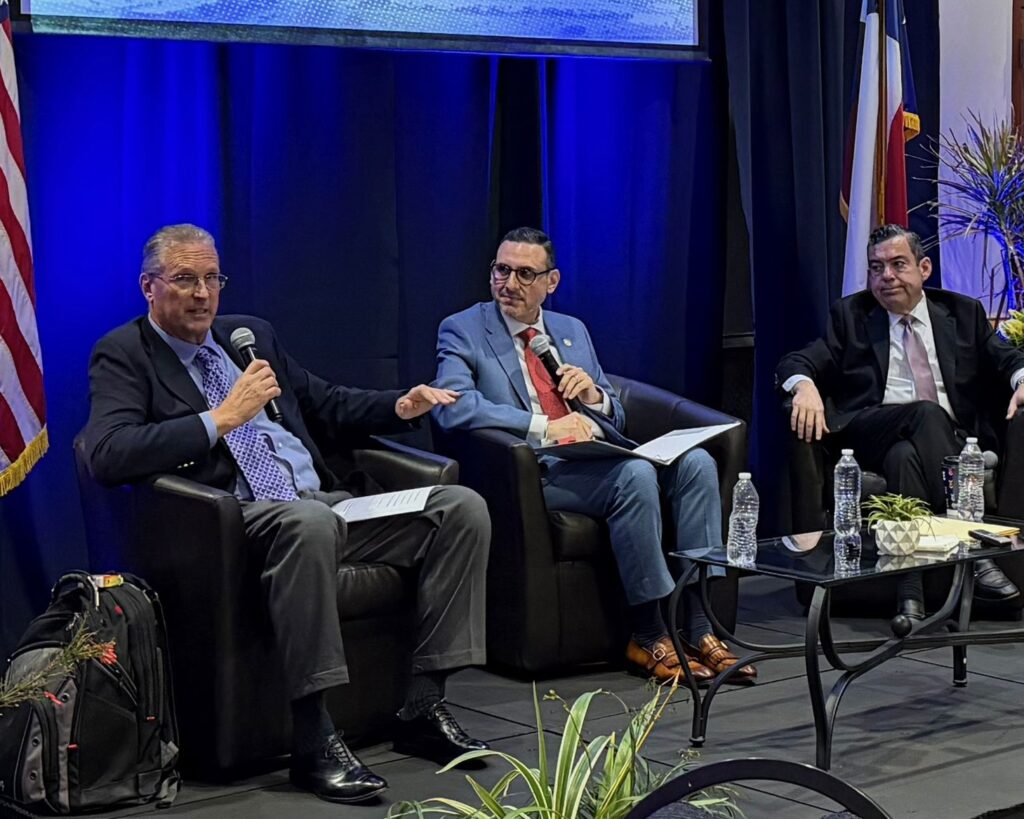
Photo Credit | Kristen Mosbrucker-Garza
“We still have some strategic partnerships with local companies that are like a mile from the plant, so this is a continuous improvement over 10 years,” McGrew said. “We can be very responsive on the border. We can even export on Sundays and respond very quickly.”
That change also reduced the company’s exposure to tariffs, especially on goods imported from China, because those parts fall under the United States-Mexico-Canada Agreement — the next generation of the North American Free Trade Agreement. But some raw materials are simply not manufactured across North America and have been subject to record-high tariffs imposed by the Donald Trump administration.
Velvac, headquartered in New Berlin, Wisconsin, has operated in Reynosa for more than two decades and employs about 300 workers in a manufacturing facility spanning 225,000 square feet. The company also leases a 100,000-square-foot warehouse in Pharr, according to regulatory records.
In 2017, Velvac was acquired by Eastern Company but continues to operate as an independent subsidiary. In 2024, Eastern Company estimated it incurred $2.5 million in tariffs on products produced in China, up from $2.2 million in 2023, according to U.S. Securities and Exchange Commission filings. Tariffs for Velvac alone were not broken out separately, and data about tariffs paid in 2025 have not yet been released.
But Velvac has been paying tariffs imposed by the Trump administration last year, especially on its mirrors imported from Asian countries.
About a week ago, the U.S. Supreme Court struck down President Donald Trump’s emergency tariffs.
While that could save companies like Velvac money, it’s unclear for now, and the situation’s instability forces the business to shift its attention away from its ultimate strategy of market growth and instead map out all of its raw material and component expenses yet again.
“It’s called a spend map, it’s kind of a visual parade by commodity, and it shows our total spend there, who our suppliers are, the country of origin, and you’ve got to drill down to the next level of HTS [Harmonized Tariff Schedule],” McGrew said.
About 90% of the company’s spending is on goods covered by USMCA deals, but the remaining 10% are subject to overseas tariffs.
“So we’ve looked at whether we should make that in the U.S., or this is something we could do on materials or redesign,” he said.
But ultimately, McGrew said that the business has weathered many storms, and the uncertainty is unsettling but not defeating.
“It’s just another crisis of the day. We’re going to get through it, but it is frustrating,” he said.
And that’s still important, because tariffs are not eliminated — despite the U.S. Supreme Court ruling and some companies lining up for refunds, said Jorge Torres, CEO of Interlink Trade Services in McAllen.
“It’s not the end of the road for tariffs,” Torres said, noting that Trump mentioned tariffs, national security, and trade in his recent State of the Union speech.
“Tariffs have become economics. [Trump] is going to use that as a negotiation tool. He’s looking at trade as national security for certain commodities, just look at China,” he said.
For example, there are four more ways Trump can impose tariffs on goods imported into the U.S. moving forward.
During Trump’s first term, he leveraged Section 301, which cited China’s unfair trade practices, and those tariffs are still in effect. There’s Section 232, a temporary tariff meant to protect national security interests. And Section 338, which Trump has not yet used, could impose tariffs of up to 50% if countries are accused of discriminating against the U.S. in trade.
For now, Trump invoked Section 122 tariffs, which expire after 150 days, but the president can impose up to 15% tariffs worldwide. That’s what Trump did after the U.S. Supreme Court ruling last week, imposing 10% tariffs across the globe.
While there are some companies that have filed lawsuits seeking refunds, there was no clear guidance about how that might happen, Torres said.
“It’s very likely that there’s going to be refunds, but we still have not received information about how that’s going to work out,” Torres said.

Kristen Mosbrucker-Garza
Reporter
Kristen Mosbrucker-Garza is a versatile multimedia news reporter who lives and works along the Texas-Mexico border in Hidalgo County. Mosbrucker-Garza is a news reporter for the Rio Grande Valley Business Journal. During her career she's worked for the McAllen Monitor, San Antonio Business Journal, The Advocate Newspaper in Louisiana, Phoenix New Times, and public media outlets in Baltimore and Philadelphia.
Most Read
- Is SpaceX quietly building a data center at Starbase? Job postings offer clues
- 25 Mexican businesses eye McAllen expansion after city pitches U.S. market entry program
- SpaceX’s futuristic city of Starbase finalizes massive 7,100-acre annexation. Here’s what we know.
- McAllen metro keeps selling more homes as Brownsville-Harlingen market sees 17% drop through August
- Rio Grande LNG moves closer to getting even bigger at Port of Brownsville
Get the latest business news delivered to your inbox every morning for free.
Try 30 Days Free!
Get full access to award-winning journalism covering business, real estate, health care, economic trends, and the people shaping the Rio Grande Valley.
30 Days Free!
$9.95/month
Limited time offer
Subscription renews after your 30 day free trial at $9.95/mo.
Included Benefits
- Unlimited access to all articles
- Daily business news and analysis
- Subscriber-only content and features
Stories That Matter
- McAllen’s job market keeps climbing while Brownsville loses ground
- Mission EDC launches search for new CEO with salary up to $190K
- Texas transportation leaders to discuss Rio Grande Valley infrastructure at Mission summit
- Mission’s first Small Business Expo puts $25K on the line for local entrepreneurs
- McCoy’s gives $10K, tools to launch Mid-Valley construction academy
- UT Health RGV performs new digestive procedure for first time in the Valley
- South Texas College plans $4.7M makeover of cosmetology, security facilities in McAllen
- TSTC bets on advanced manufacturing to meet RGV’s industrial boom
- Pharr’s cross-border business push earns international recognition
- Brownsville eases drought restrictions after nearly three years as Rio Grande reservoir levels improve