If the proposed massive data center, next to Harlingen’s airport, opens by 2030, the city’s water provider could be responsible for millions of gallons of water each day until 2050 — potentially until 2080.
The source of that water must be reclaimed water first, but if that’s not available, the city’s drinking water is the next required source, according to the contract obtained by the Rio Grande Valley Business Journal.
Harlingen Water Works officials are confident that they will never have to sell the city’s drinking water to the data center. But it’s unclear whether the city will be in the same position today as it will be in 20 years, or even 50 years, by the time the agreement expires.
Also, the water deal for supply begins when the data center is commissioned, or opens, not just the year the agreement was signed in 2025. It also automatically extends for two 15-year terms for a total of a 50-year lock-in, records show.
Eneus Energy has plans for a massive data center and touts its locally sourced reclaimed wastewater deal as a way to “avoid reliance on the local potable water supply,” according to its website. The contract is between Harlingen Water Works and RGV Property Group LLC, which has about 1,800 acres of land from the Stone Brothers under contract to purchase by mid-2027 — a deal that was pushed back from April 2026.
The first tranche of water — about .5 million gallons of water each day — is expected to be delivered to the data center by the end of 2026, according to the deal signed in September 2025. Each year, that ramps up until it hits 4.6 million gallons of water each day by the end of 2030.
Plenty of water for now
Harlingen Water Works agreed to sell the data center 4.7 million gallons of water each day, which is a comfortable figure if it’s reclaimed wastewater, officials said. Even if potable drinking water is sold, there’s also plenty of excess in the city’s portfolio now, officials said.
Harlingen has access to 21,338 acre-feet of water from the Rio Grande River each year as its sole source of raw drinking water, irrigation, commercial, and industrial use. About 15% of that water is lost due to evaporation or absorption into the ground of canals, pipelines, and reservoir systems. So that’s about 18,137 acre-feet of water each year, or 16 million gallons per day.
On average, residential households, commercial customers, and wholesale municipal customers use between 13 million and 15 million gallons of potable water each day. Harlingen also processes wastewater for its own residents and for the cities of Combes and Primera. Those households and commercial customers require about 5.5 million gallons of wastewater each day.
In total, there are about 28,000 water customers and 22,000 wastewater connections supplying water and sewer service to more than 88,700 residents.
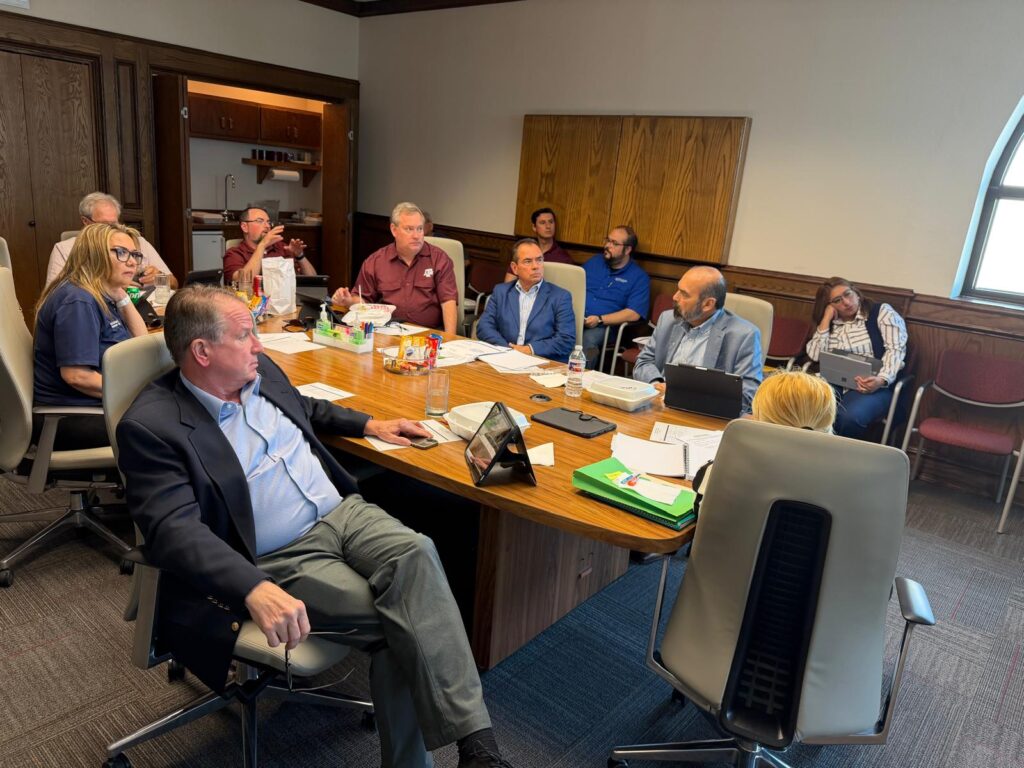
Harlingen Water Works has the capacity to produce 38 million gallons of treated drinking water each day, according to Roy Rodriguez, interim general manager of Harlingen Water Works.
“That’s probably more than most utilities, but it’s not unusual. For wastewater, it’s very consistent because everybody showers at the same time, washes dishes the same amount of time and toilet use,” Rodriguez said in a recent interview. “Wastewater keeps coming.”
As for how likely it may be that the data center would end up using drinking water from Harlingen, Rodriguez said it’s extremely unlikely.
“We looked back two years because that question came up. I asked how many days would we not have [reclaimed water for a] facility like this, and the answer was zero,” he said.
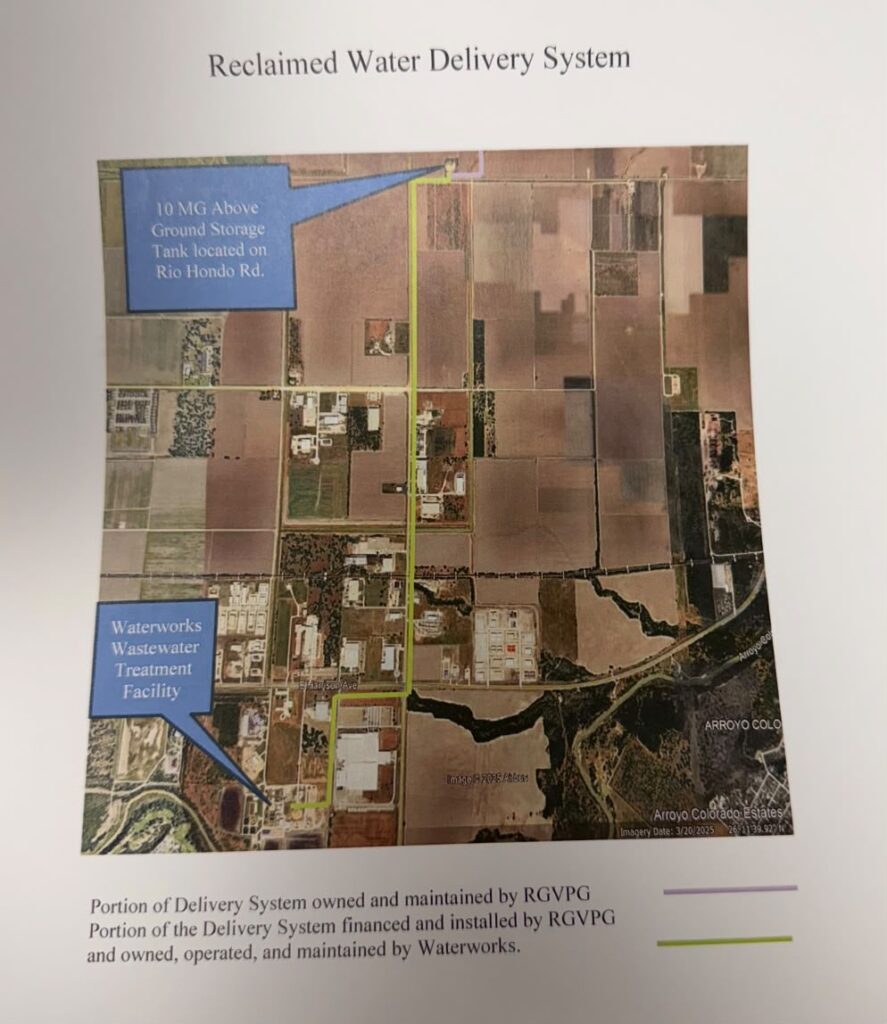
Photo Credit | Kristen Mosbrucker-Garza
Surface water, from the Rio Grande River, that’s treated for drinking water standards, is an increasingly scarce resource due to three factors: drought with low reservoir levels at the Falcon and Amistad dams, lack of adherence to the 1944 water treaty by Mexico, and miles of open canal systems that enable the river water to evaporate before it reaches customers.
Groundwater, which comes from aquifers, is being used in some Valley communities as desalinated brackish water that runs through reverse osmosis, but it’s a small slice of the supply and not currently a resource in Harlingen. Seawater desalination is proposed in Port Isabel and South Padre Island in two different projects, but it’s also a small part of the supply, and only the SPI project could potentially reach Harlingen.
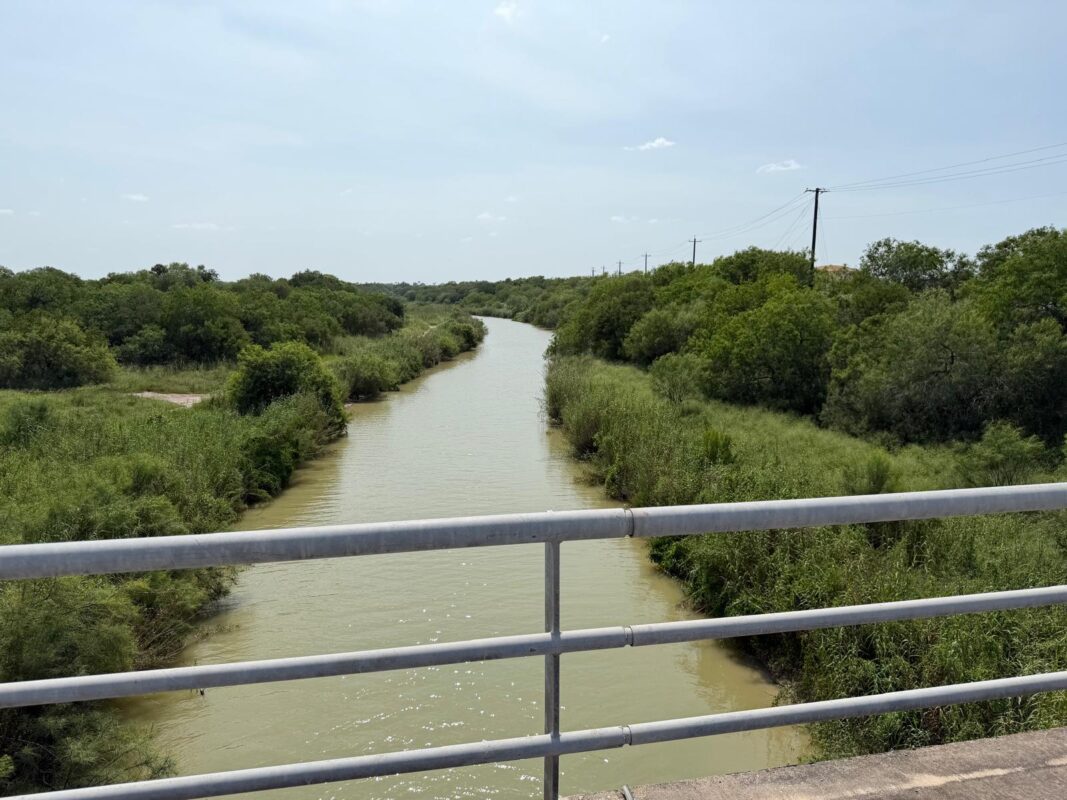
Reclaimed water, otherwise discharged into the Arroyo Colorado River or used for municipal park irrigation in Harlingen, is treated wastewater from the city’s sewer system. Reclaimed water is projected to remain steady, or even increase as the population of a community grows, according to Harlingen Water Works.
One of Harlingen’s water treatment plant has the ability to process 4 million gallons of water per day of “bottle water quality” effluent or reclaimed water “to provide process water for industry with the use of reverse osmosis treatment. It requires about 5.3 million gallons per day of wastewater, which is distilled down, and the 1.3 million gallons per day of brine is left over.
Not enough water later
By 2050, demand for water is expected to outpace supply in the Rio Grande Valley, according to the Texas Water Development Board’s planning region projections.
The biggest hurdle may be whether the Harlingen population and water demands may outpace the supply of the surface water by 2050.
Some drought-stricken communities rely on reclaimed water that’s processed again to drinking water standards. Harlingen already provides an unspecified amount of reclaimed water for the irrigation of its soccer complex, golf course, and nature park.
The data center company can apply to become a commercial customer, pay an unspecified water impact fee, and pay the inside city limit rate for potable drinking water, even though the property sits in Cameron County, and the city of Harlingen has a temporary moratorium on data centers with plans for a long-lasting ban or development limitation.
The data center company agreed to pay a $50,000 annual reservation fee to Harlingen Water Works until the data center begins commercial operations or the agreement is terminated. In addition to that, the value of the contract was about $1.2 million each year. That’s because the reclaimed water rate is 75 cents per 1,000 gallons of water delivered to the data center, a cost that can increase up to 3% each year.
But the company would be unable to ask for any more water than what’s under contract now.
“The availability of reclaimed water and potable water beyond the contract quantity of water may be limited by drought conditions, agreements to provide reclaimed water and to other users, and by the obligation of the waterworks to provide potable water to its customers,” the contract stated.
Rodriguez said he wouldn’t budget on that point either.
“If they called me today and said tomorrow I’m going to need 6 million [gallons of reclaimed water] well I can’t provide it. Period. Conversation’s over. I’m not going to supplement it with drinking water,” he said. “We can estimate what’s going to happen with wastewater. On the water side, if it rains, we don’t sell as much water.”
He said it was a good deal for Harlingen Water Works and that McAllen Public Utility, his former employer, has a similar deal with industrial customers such as the natural gas power generation plants on the city’s north side but the volume is closer to about 3.5 million gallons of water per day.
It’s not immediately clear how the data center may use Harlingen’s water. “They may produce their own power, build a power plant, but that’s a question for the county,” he said.
Water is becoming more expensive
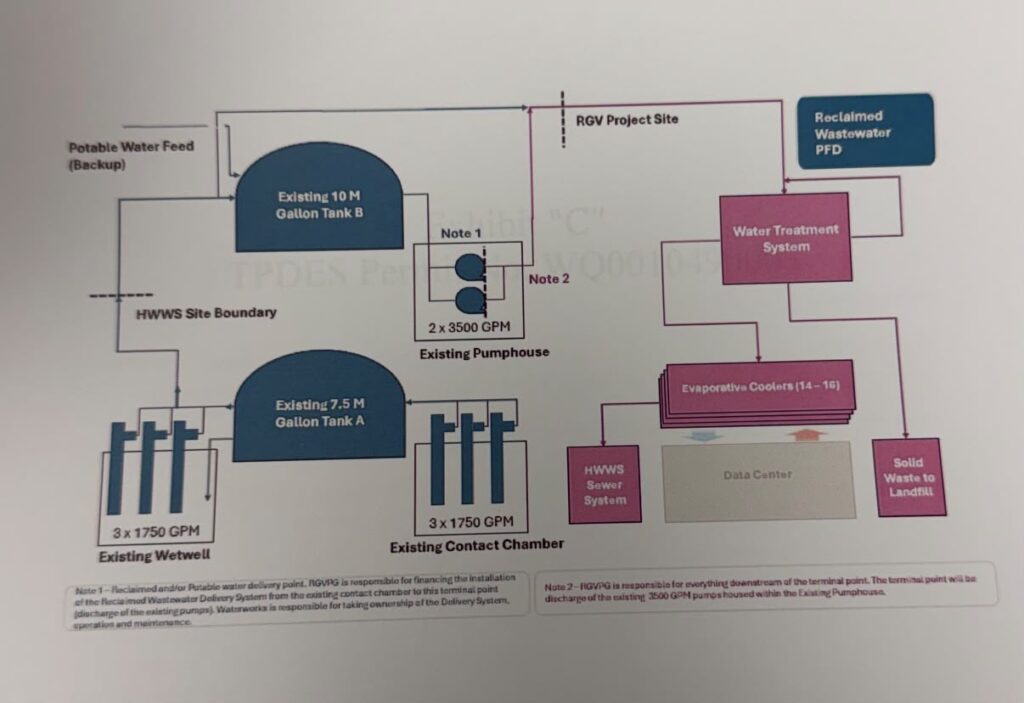
Photo Credit | Kristen Mosbrucker-Garza
Surface water is the cheapest for any customer because it requires less processing to reach drinking level standards. Then it gets more expensive from there: reclaimed water, desalinated brackish groundwater, and then seawater desalination.
But repairing and replacing aging water infrastructure is increasingly expensive, often responsible for the rate hikes.
Harlingen Water Works expects to raise water rates on customers soon to pay for maintenance and improvements — the rate hike was delayed for several years in a row because the projected repair work did not happen in the timeline anticipated. In 2024, Harlingen Water Works approved rate hikes. Now, those won’t go into effect until October 2026.
The revenue from the data center deal would help the municipal water agency stay in the black. For example, its potable water service is running in the red this year. The water side of the business was projected to lose $1.6 million this year, but so far has generated $831,654 in revenue. As far as the wastewater business, it has generated $1.2 million in net income, and the potable water has lost $406,126 so far this year.
Separate authority powers
For the past few months, there has been increasing tension between Harlingen Water Works and the Harlingen City Commission.
Dozens of community members have been protesting the construction of a data center, and the city commission approved a 120-day moratorium with plans to ban the practice outside of city limits and its extraterritorial jurisdiction in recent weeks.
There’s pressure by the most vocal residents for the city to pressure the water board to revoke the data center contract.
While the city commission appoints the water board members for four-year terms as trustees, their decisions during that term are independent.
There was an item on the city agenda by Mayor Norma Sepulveda about the city commission reviewing the water board’s authority to enter into contracts, but it was removed from the agenda.
When asked about that decision, Sepulveda said water board members asked for collaboration without the need for an ordinance.
That’s the same model in Brownsville, Harlingen, and McAllen. The goal is to have a division that offers accountability to the ratepayers instead of voters.
“Harlingen Water Works makes decisions based on what’s best for our network. And politics has very little to do with that decision. That way, we build a water line or sewer line where it belongs, not where there’s political pressure. That’s the reason for the separation, the money isn’t comingled either,” Rodriguez said.
Most of the money from the potential data center deal is not even part of the budget yet, because the data center has not been built, he said.
None of the Harlingen Water Works board members contacted for this news story responded and deferred comment to the interim general manager immediately after its most recent board meeting.

Kristen Mosbrucker-Garza
Reporter
Kristen Mosbrucker-Garza is a versatile multimedia news reporter who lives and works along the Texas-Mexico border in Hidalgo County. Mosbrucker-Garza is a news reporter for the Rio Grande Valley Business Journal. During her career she's worked for the McAllen Monitor, San Antonio Business Journal, The Advocate Newspaper in Louisiana, Phoenix New Times, and public media outlets in Baltimore and Philadelphia.
Most Read
- How much water does SpaceX need to operate near Brownsville? Nearly 20x its current use
- Could apartment-to-condo conversion help make $100K homeownership in the McAllen metro more affordable? One investor says yes.
- SpaceX’s futuristic city of Starbase finalizes massive 7,100-acre annexation. Here’s what we know.
- Cameron County is negotiating a $20M Fluidstack data center donation after Harlingen waffles on the same offer
- Fluidstack breaks ground on $4 billion Cameron County AI data center
Get the latest business news delivered to your inbox every morning for free.
Try 30 Days Free!
Get full access to award-winning journalism covering business, real estate, health care, economic trends, and the people shaping the Rio Grande Valley.
30 Days Free!
$9.95/month
Limited time offer
Subscription renews after your 30 day free trial at $9.95/mo.
Included Benefits
- Unlimited access to all articles
- Daily business news and analysis
- Subscriber-only content and features
Stories That Matter
- These four projects are driving more than $41B in Cameron County investment
- Mission’s first Small Business Expo puts $25K on the line for local entrepreneurs
- Reynosa’s newest technical high school focuses on AI, semiconductors and bionics
- McCoy’s gives $10K, tools to launch Mid-Valley construction academy
- UT Health RGV performs new digestive procedure for first time in the Valley
- TSTC bets on advanced manufacturing to meet RGV’s industrial boom
- Pharr’s cross-border business push earns international recognition
- Brownsville eases drought restrictions after nearly three years as Rio Grande reservoir levels improve
- Texas A&M’s $53.5M McAllen research center will tackle water, food security and Valley health
- STC puts AI to work across 55 courses — from construction sites to car repair