What normally ends up in the trash after breakfast could become a tool to address one of Reynosa’s most complex environmental challenges: wastewater contamination that eventually reaches the Rio Grande.
That is the premise behind Proyecto MADRE — an acronym for Mejoramiento del Agua mediante Regeneración Ecológica (Water Improvement through Ecological Regeneration).

Photo Credit | Anayancy Ulloa
It’s an initiative promoted by Rotary Reynosa Centenario that seeks to transform eggshells into natural biofilters capable of reducing contaminants found in drains and wastewater systems across the city.
Chemist Bertha Arizpe Cepeda, director of the project, explained that the team has already identified four intervention points in Reynosa where they eventually plan to apply the processed material.
“We have four points. At each point, we would apply 130 kilograms (286.6 pounds) of eggshell per week. We’re still far from what we need,” she said during a presentation before industrial representatives.
Despite awareness campaigns and collection centers installed in Reynosa schools, the project has only managed to gather approximately 184 kilograms (405.7 pounds) of eggshells over the past two-and-a-half months.
The initiative was recently presented to members of the Comité de Ayuda Mutua at Parque Industrial Villa Florida, chaired by Amalia González Trigos and made up of 35 maquiladora companies, as part of a strategy to bring the industrial sector into the collection campaign.
‘The water we use returns more contaminated‘
Proyecto MADRE focuses on reducing contamination in wastewater flowing through drains, sewage systems and open channels before ultimately connecting with the Rio Grande.
“The Rio Grande is practically the only source of fresh water we have in this region,” explained Romero López. “The problem is that the water we use returns more contaminated than when it arrived.”
During the presentation, the coordinators explained that a significant portion of Reynosa’s wastewater is not fully treated before reaching bodies of water connected to the river.
“Wastewater treatment plants do not have the capacity to process all the water,” explained Arizpe Cepeda. “Much of it ends up in drains and eventually reaches the Rio Grande.”
The specialist said she has spent the last five years monitoring river conditions and observing a steady increase in contaminants.
“Every day the water becomes more contaminated, even though we have more technology and more treatment plants,” she stated.
The model Reynosa adopted from Toluca
The methodology used by Proyecto MADRE was originally developed in Toluca, State of Mexico, where it began as an alternative to address pollution in the Lerma River.
According to Romero López, the connection was made through Rotary, which allowed the model to be replicated in Reynosa.
“The original idea for the project started in Toluca,” he explained. “They are the only ones who authorized us to replicate it here.”
The coordinator detailed that community-level applications already exist in Toluca, where crushed eggshells are used to reduce organic load in domestic wastewater systems.
How eggshells become biofilters
The project uses the calcium carbonate naturally contained in eggshells to absorb contaminants present in wastewater.
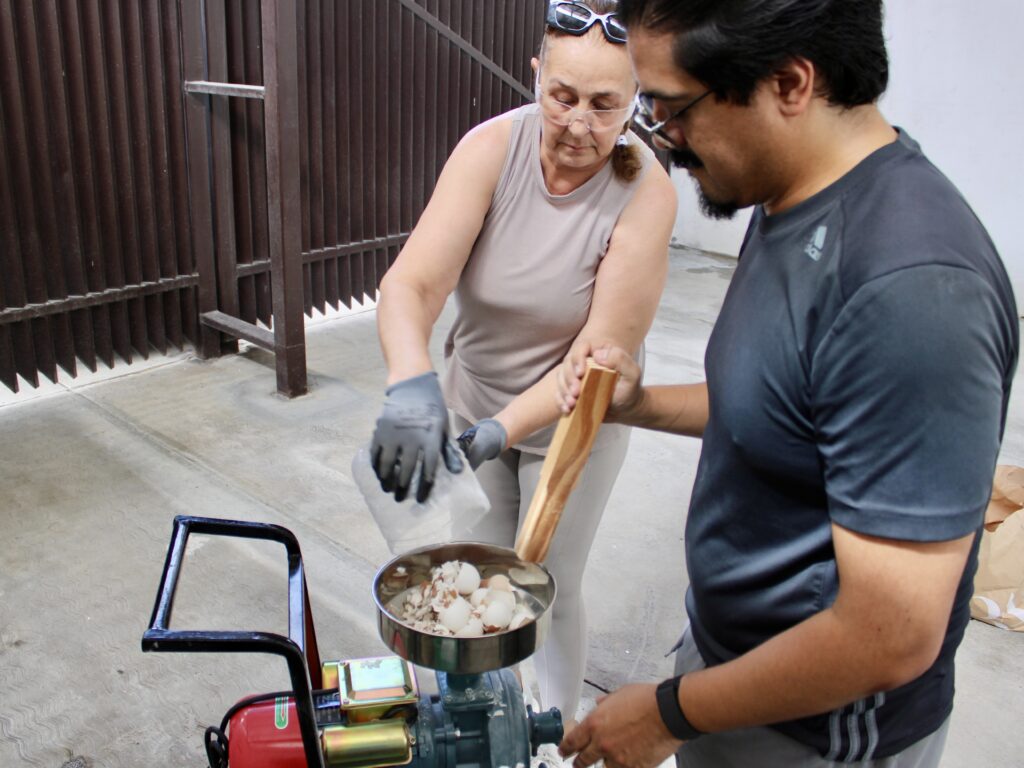
Photo Credit | Anayancy Ulloa
“Calcium carbonate acts like a sponge,” Arizpe, a chemist, explained. “It absorbs grease, oils, phosphates, nitrates, and organic matter.”
The process begins with the collection of completely dry eggshells at collection centers installed in schools and other institutions.
The material is then compacted and crushed into a fine powder using mills adapted by the project itself.
“This is not about creating a physical filter,” Romero López said. “It is a biological form of depuration.”
The tests developed in Reynosa are carried out in coordination with the Comisión Municipal de Agua Potable y Alcantarillado de Reynosa (COMAPA), the Reynosa Municipal Water and Sewer Utility, which has supported the project through monitoring and technical analysis.
“We have been conducting tests for almost two years,” Arizpe Cepeda said. “Certified laboratories have helped us perform physical, chemical and microbiological analyses.”
Students lead collection effort
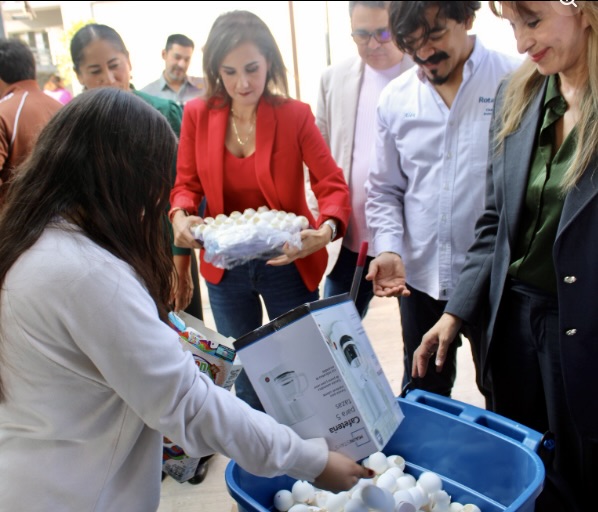
Since February, Proyecto MADRE has carried out environmental awareness campaigns at public and private schools across Reynosa.
Courtesy of | Proyecto MADRE
The initiative now operates at least five active collection centers and is working to add two more. Participating campuses include the Center for Industrial and Service Technology Studies No. 71 (CETis 71), CEBETIS 276, Universidad del Atlántico, and other schools throughout the city.
One of the program’s most active collection sites has been CETis 71, where students have taken a leading role in gathering eggshells and promoting the initiative.
“They are the ones driving the project,” Romero López said.
Organizers say changing everyday habits remains one of the biggest challenges. The long-term goal is to encourage families to think differently about waste and water conservation.
“We are planting a seed to change habits,” Arizpe Cepeda said.
A project sustained through volunteer work
Behind the project there is no large institutional structure or permanent funding.
Romero López — who is a dentist by profession — and Arizpe carry out much of the project on a volunteer basis, dedicating additional time outside of their professional responsibilities.
Currently, both coordinate awareness campaigns, collection centers, eggshell collection, crushing operations and pilot testing in coordination with COMAPA Reynosa.
The next step: involving the maquiladora industry
After consolidating its initial phase with schools, Rotary Reynosa Centenario now seeks to scale the project into Reynosa’s maquiladora industry.
The primary focus is industrial cafeterias, which is why the coordinators attended the invitation extended by Amalia González, president of the Comité de Ayuda Mutua at Parque Industrial Villa Florida, where representatives from the 35 member companies reported consumption levels of up to 3,000 eggs per day in some facilities.
The coordinators explained that the project can adapt to each company’s logistical needs and that the primary goal is to prevent eggshells from ending up in the trash.
“We take care of the grinding process and delivering the material to COMAPA,” Romero López said. “All we are asking is for something you already consume not to end up as waste.”
‘What are we waiting for?’
During the meeting with maquiladora companies, Arizpe delivered one of the event’s strongest reflections.
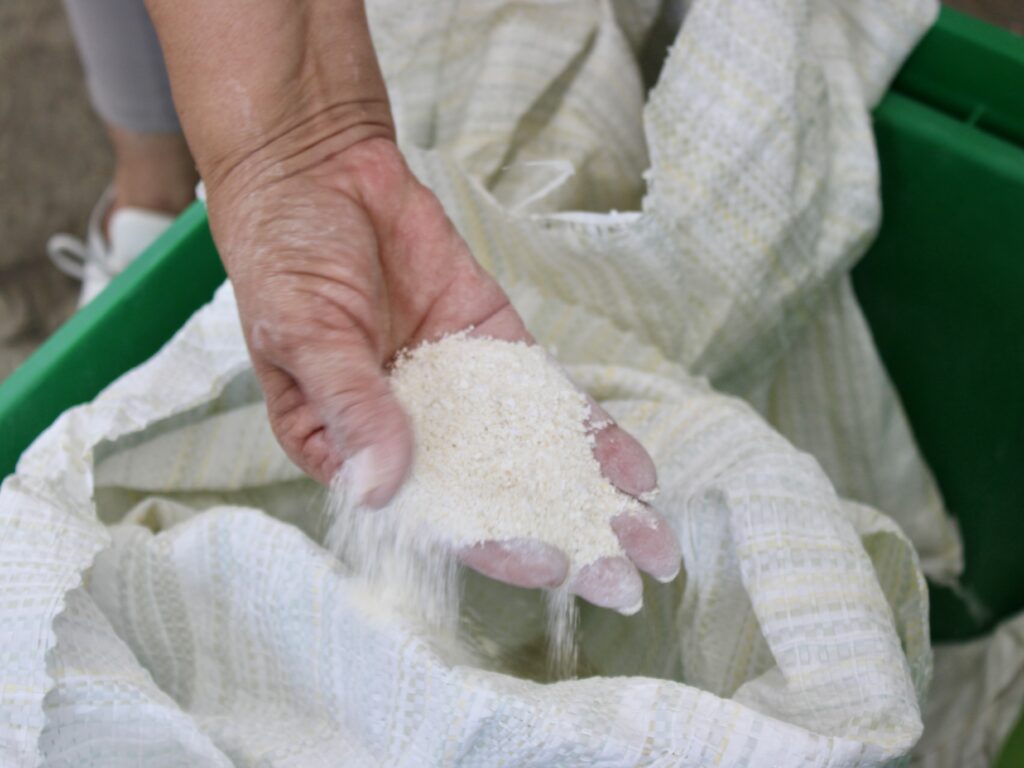
Photo Credit | Anayancy Ulloa
“If we already have a household waste product that we throw away and we can use it to mitigate water contamination, what are we waiting for?” Arizpe asked.
That statement summarizes the purpose of Proyecto MADRE: transforming everyday waste into a collective environmental tool to confront one of Reynosa’s greatest environmental challenges.
The initiative has also been presented to Nohemí Alemán Hernández, Secretary of Urban Development and Environment for the Municipality of Reynosa, as well as Ernesto Gómez from the municipal comptroller ‘s office.
Rotary Reynosa Centenario now seeks to bring together citizens, schools and industry to scale an initiative attempting to transform household waste into an environmental solution for Reynosa.

Anayancy Ulloa
Reporter
Anayancy Ulloa Luna is a contributor to the Rio Grande Valley Business Journal who hails from Reynosa in the Mexican state of Tamaulipas. Ulloa has a long history as a U.S.-Mexico region business expert in marketing, formerly the editorial director of Mexico Industry.
Most Read
- Is SpaceX quietly building a data center at Starbase? Job postings offer clues
- 25 Mexican businesses eye McAllen expansion after city pitches U.S. market entry program
- Rio Grande LNG moves closer to getting even bigger at Port of Brownsville
- Starbase EDC may issue $3 billion in tax-exempt bonds to support SpaceX, records show
- Edinburg ISD rejects nearly $6M offer for prime land near La Sienna despite $15M budget deficit
Get the latest business news delivered to your inbox every morning for free.
Try 30 Days Free!
Get full access to award-winning journalism covering business, real estate, health care, economic trends, and the people shaping the Rio Grande Valley.
30 Days Free!
$9.95/month
Limited time offer
Subscription renews after your 30 day free trial at $9.95/mo.
Included Benefits
- Unlimited access to all articles
- Daily business news and analysis
- Subscriber-only content and features
Stories That Matter
- Love’s plans $600K electric vehicle charging project in Edinburg
- Reynosa truckers protest highway robberies, extortion and rising costs
- 5×5 Brewing plots $2.5M comeback with new Edinburg brewpub near UTRGV
- S-Mart opens seventh Matamoros store with $12.6M investment, plans more
- Mission’s first Small Business Expo puts $25K on the line for local entrepreneurs
- McCoy’s gives $10K, tools to launch Mid-Valley construction academy
- UT Health RGV performs new digestive procedure for first time in the Valley
- TSTC bets on advanced manufacturing to meet RGV’s industrial boom
- Pharr’s cross-border business push earns international recognition
- Brownsville eases drought restrictions after nearly three years as Rio Grande reservoir levels improve