About one in four workers in Tamaulipas still do not earn enough to afford basic needs like food, even as that share declined last year. But a much larger group — nearly half — work in jobs without healthcare benefits or legal protections.
The first measure reflects what economists call “labor poverty,” which tracks whether income from work can cover the cost of a basic food basket.
The second reflects job quality — whether workers have access to things like healthcare, retirement benefits, and formal employment protections.
According to Mexico’s national statistics agency, the Instituto Nacional de Estadística y Geografía (INEGI), employment in Tamaulipas increased by about 41,000 workers compared with a year earlier, bringing the state’s total employment to about 1.7 million workers.
But those gains might not hold.
Recent layoffs across the border’s manufacturing and logistics sectors are already cutting into employment in key cities.
Earlier this month, Reynosa officials reported 2,500 maquila jobs had been lost in the first two months of the year due to a slow down in e-commerce and auto demand in the U.S.
And just this week, one of the city’s largest logistics hubs shut down. It’s unclear how many employees were laid off, but when XB Fulfillment opened in 2022, the company projected hiring 1,500 workers.
Matamoros has also been rocked by massive layoffs tied to the corporate restructuring of First Brands Group, which supported operations at various companies throughout the city. The parent company’s bankruptcy filing has led to more than 4,000 job losses there.
Affording basic needs
More workers in Tamaulipas are now earning enough to cover essential expenses like food — a key measure of labor poverty.
According to INEGI, labor poverty fell to 25.3% in the fourth quarter of 2025, down from 29.5% a year earlier.
That means fewer workers are earning below what’s needed to cover basic food costs.
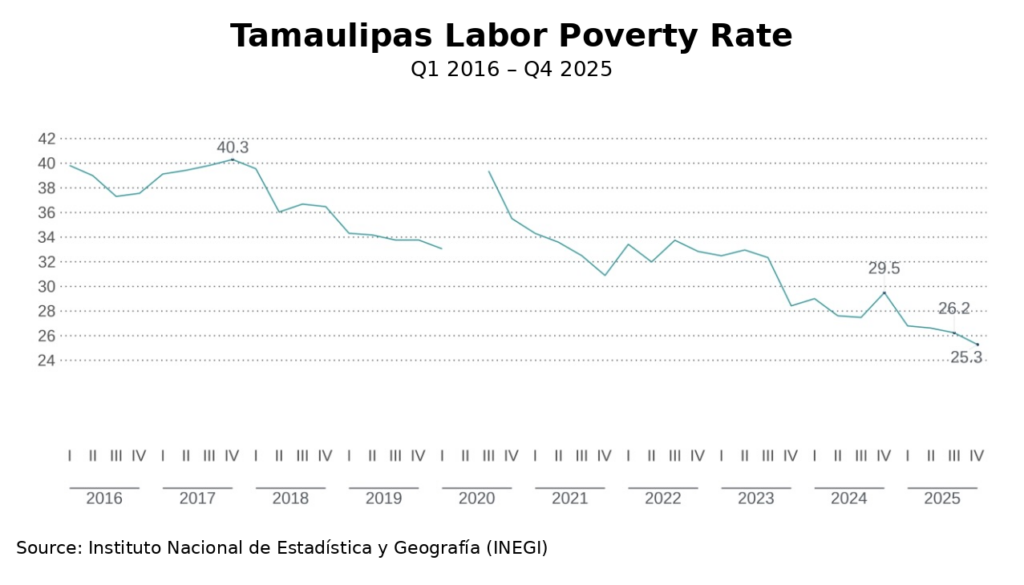
The improvement reflects a simple shift: more people are working, and they’re earning slightly more.
Real labor income per person reached 3,878.94 pesos per month, or about $228. That’s up 7.5% year over year, or roughly 270 pesos more per worker, which amounts to about $16.
At the same time, the state’s total wage income rose 6.6% to 12.68 billion pesos, or about $746 million, helping boost overall purchasing power.
Job growth improves access to work
More people are working, and fewer are struggling to find enough hours.
More people are working across Tamaulipas, with about 41,000 additional workers compared with a year earlier, bringing the total workforce to 1.7 million.
The unemployment rate dropped to 2.6%, while underemployment — people who want more hours than they can get — fell to 7.6%, down from 12.3% the previous year.
These gains point to a stronger job market in terms of availability.
But they do not necessarily mean better jobs.
Benefits and protections
Nearly half of workers in Tamaulipas are in jobs that operate outside the formal system.
In practical terms, that means work without health insurance, retirement benefits, legal contracts, and worker protections.
These jobs often pay in cash, are tied to unregistered businesses, or involve people working for themselves to get by.
According to INEGI data, 766,000 workers — or 45.9% of the employed population — fall into this category.
These jobs can provide income, but they make it harder for workers to build long-term financial security or access services like healthcare.
Business leaders warn of long-term limits
Business groups along the border say this type of employment continues to hold back economic growth.
Heberardo González Garza, president of Coparmex Reynosa, said informality remains a persistent challenge.

“Three out of every 10 jobs created in Reynosa are informal, well below the state and national average,” he said in January.
The concern is that while these jobs help reduce poverty in the short term, they do not create the kind of stable, long-term growth the region needs.
The commerce sector is raising similar concerns.
“The slight reduction in labor poverty is a positive step, but the growth of informality shows that significant barriers still exist for millions of workers and small businesses to integrate into the formal economy,” Gildardo López Hinojosa, president of CANACO Reynosa, said.
According to the organization, about 67% of Mexico’s micro, small, and medium-sized businesses operate informally, generating 96.7% of informal employment.
A labor market improving — but still uneven
The data show clear progress: more people are working, earning more, and able to meet basic needs.
But the fact that nearly half of workers are still in jobs without benefits or protections shows those gains are not yet translating into a more stable economy.
For Tamaulipas, that creates a split reality.
More workers are getting by today.
But many still lack the foundation to build long-term security.

Anayancy Ulloa
Reporter
Most Read
- SpaceX’s futuristic city of Starbase finalizes massive 7,100-acre annexation. Here’s what we know.
- SpaceX reschedules Starship’s first flight around the Earth
- How much water does SpaceX need to operate near Brownsville? Nearly 20x its current use
- Could apartment-to-condo conversion help make $100K homeownership in the McAllen metro more affordable? One investor says yes.
- Crunch Fitness is expanding and struggling in the Valley. Here’s why
Get the latest business news delivered to your inbox every morning for free.
Try 30 Days Free!
Get full access to award-winning journalism covering business, real estate, health care, economic trends, and the people shaping the Rio Grande Valley.
30 Days Free!
$9.95/month
Limited time offer
Subscription renews after your 30 day free trial at $9.95/mo.
Included Benefits
- Unlimited access to all articles
- Daily business news and analysis
- Subscriber-only content and features
Stories That Matter
- Starbase leaders approved a 45-year land deal with SpaceX for 166 acres, but what will be built there remains a mystery
- Two Valley businesses turned mangonadas into a school-friendly popsicle. Now they want to take it nationwide
- Pharr doubles bridge capacity as data centers and produce drive new trade demand
- Mission’s first Small Business Expo puts $25K on the line for local entrepreneurs
- Reynosa’s newest technical high school focuses on AI, semiconductors and bionics
- McCoy’s gives $10K, tools to launch Mid-Valley construction academy
- UT Health RGV performs new digestive procedure for first time in the Valley
- Construction begins on Saronic’s $3.2B Brownsville shipyard. Here’s what’s being built first
- TSTC bets on advanced manufacturing to meet RGV’s industrial boom
- Pharr’s cross-border business push earns international recognition