The Rio Grande Valley Public Utility Agency is a new organization, initially created by a core group of smaller cities seeking ways to improve regional water infrastructure without overloading municipal budgets with debt.
The first cities to join the utility agency include San Benito, Mercedes, Weslaco, and Raymondville. Each city commission passed ordinances to create the agency and join it in recent weeks.
None of the city representatives agreed to be interviewed for this news story; instead, the group provided a joint statement. The initial board of directors includes the mayors of each respective city: Adrian Gonzalez, of Weslaco; Oscar Montoya Sr., of Mercedes; Ricardo Guerra, of San Benito; and Gilbert Gonzales, of Raymondville.
“The goal and purpose of the RGVPUA is to create a separate governmental entity that can help foster and create opportunities for economic growth within all of these cities and the surrounding region,” the statement said.
The RGVPUA would allow cities to work together to develop a regional water and wastewater system, while considering public-private partnerships to help move the project forward.
The agency doesn’t have the authority to impose taxes or use eminent domain to acquire land.
The service area of the utility agency includes each of the city’s boundaries and the extra-territorial jurisdiction area.
“As our city grows, and not only our city, but the region grows, we’re trying to find different ways of how we can all work together and regionalize projects to continue growing our city and the surrounding cities,” Weslaco Mayor Adrian Gonzalez said during a recent city commission meeting. “I guess this is just a way to get creative and get more things done. We have a lot of projects that we need to target, and this is a way to do it.”
Most cities across the Valley rely heavily on the Rio Grande River for drinking water.
The rights to that water from the river lie in the hands of a patchwork of irrigation districts, often more than a century old, which the cities pay for their share of raw water. Then the cities operate water and wastewater treatment plants to produce drinking water and discharge effluent back into the environment, sometimes through irrigation of parkland or municipal golf courses.
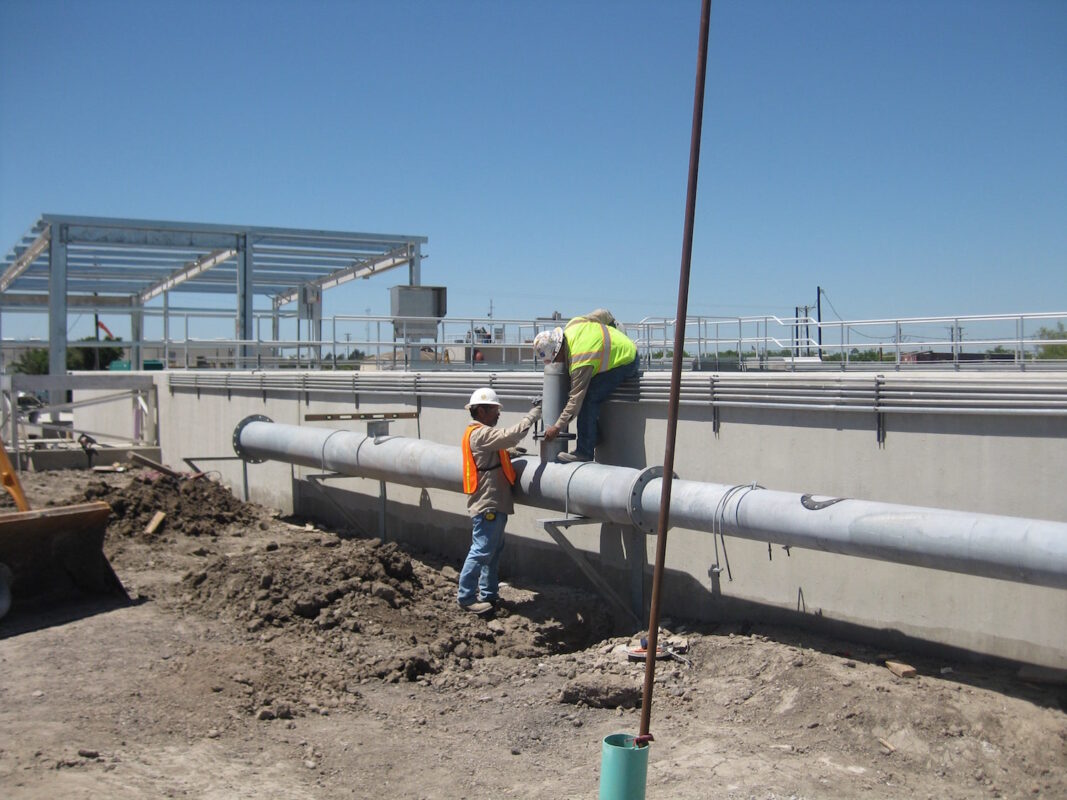
But those water and wastewater treatment plants are decades old; the cities have often outgrown initial capacity limits; and it’s increasingly expensive to repair or expand that water infrastructure, but environmental regulations require regular upgrades for public safety to avoid sewage overflows, for example.
Much of the funding for improvements stems from the Texas Water Development Board or the North American Development Bank.
In November 2025, voters approved the creation of the Texas Water Fund, which earmarks $1 billion in state sales tax revenue for the next 20 years. That influx of new funding for water infrastructure improvements means more money is available, but competition is likely to increase.
“Many of these communities are struggling with dilapidated or abandoned utilities, the lack of adequate resources and capital investment has prevented these systems from applying for funding for necessary maintenance,” State Sen. Adam Hinojosa, who authored a bill to create the PUA system said.
“Nothing is mandatory — you don’t even have to join a PUA. But there’s benefits because of the economies of scale and ability to speak as one voice for the Valley,” Carlos Rubinstein, principal at RSAH20 LLC in Austin, a former Texas Water Development Board chairman, and once the Brownsville city manager, said during a recent Weslaco commission meeting.
The next step is to establish the organization’s bylaws. The group is open to any city across the Valley.

Kristen Mosbrucker-Garza
Reporter
Kristen Mosbrucker-Garza is a versatile multimedia news reporter who lives and works along the Texas-Mexico border in Hidalgo County. Mosbrucker-Garza is a news reporter for the Rio Grande Valley Business Journal. During her career she's worked for the McAllen Monitor, San Antonio Business Journal, The Advocate Newspaper in Louisiana, Phoenix New Times, and public media outlets in Baltimore and Philadelphia.
Most Read
- Australian company plans to build a $607M lithium refinery at the Port of Brownsville. It’s a big bet on America’s battery future
- 25 Mexican businesses eye McAllen expansion after city pitches U.S. market entry program
- SpaceX’s futuristic city of Starbase finalizes massive 7,100-acre annexation. Here’s what we know.
- SpaceX reschedules Starship’s first flight around the Earth
- How much water does SpaceX need to operate near Brownsville? Nearly 20x its current use
Get the latest business news delivered to your inbox every morning for free.
Try 30 Days Free!
Get full access to award-winning journalism covering business, real estate, health care, economic trends, and the people shaping the Rio Grande Valley.
30 Days Free!
$9.95/month
Limited time offer
Subscription renews after your 30 day free trial at $9.95/mo.
Included Benefits
- Unlimited access to all articles
- Daily business news and analysis
- Subscriber-only content and features
Stories That Matter
- A Brownsville startup wants to deliver water in space. First, it needs $7M
- $10M apartment complex planned in Hidalgo
- Edinburg looks to attract new franchise businesses with matchmaking event
- T-Mobile plans fiber-optic internet expansion in Mercedes
- New Harlingen airport CEO eyes Mexico flights, cargo expansion and more development
- Mission’s first Small Business Expo puts $25K on the line for local entrepreneurs
- McCoy’s gives $10K, tools to launch Mid-Valley construction academy
- UT Health RGV performs new digestive procedure for first time in the Valley
- TSTC bets on advanced manufacturing to meet RGV’s industrial boom
- Pharr’s cross-border business push earns international recognition