The company behind a second liquefied natural gas export terminal at the Port of Brownsville — a project estimated to cost $4 billion — told its general contractor on Friday to move forward with its plans.
Texas LNG Brownsville LLC, a subsidiary of Houston-based Glenfarne Group LLC, announced that Kiewit Energy Group Inc., the contractor responsible for engineering, procurement and construction at the terminal has a ‘limited notice to proceed’ in July 2026.
That means Kiewit expects to issue purchase orders for engineering activities, geotechnical work, and long- lead equipment, which is machinery, components, or systems that take a long time to manufacture, ship, or deliver after they’re ordered.
The notice comes before the company makes a final investment decision — expected by the end of 2026.
The decision, subsequent work, and purchase orders, “demonstrate the strength of the project’s world-class partner network and Glenfarne’s continued disciplined advancement of Texas LNG,” Brendan Duval, CEO of Glenfarne said in a news release. “By progressing key equipment, engineering and site readiness work, we are maintaining project momentum.”
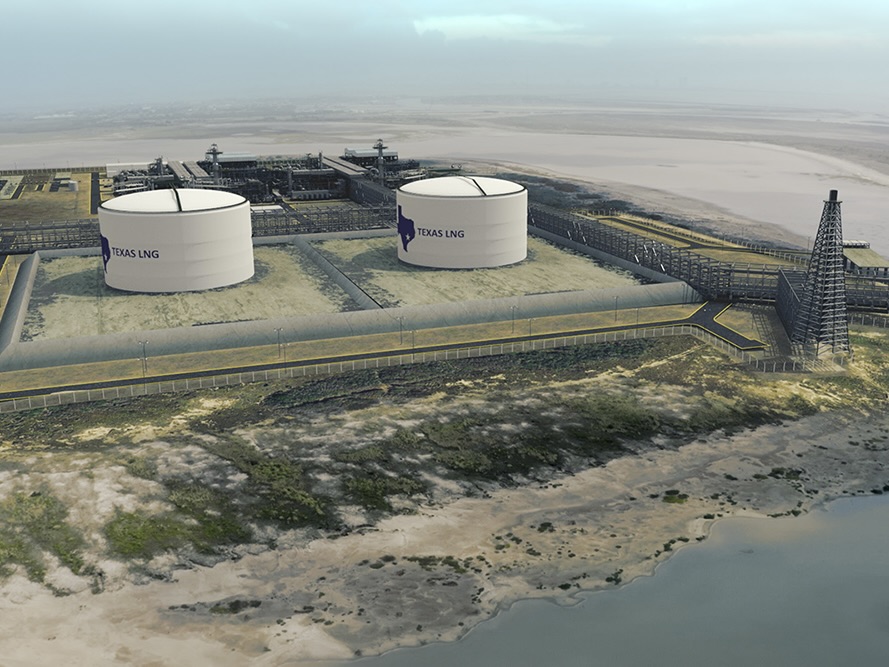
Texas LNG has a 50-year lease with the Port of Brownsville, a deal for 625 acres inked back in December 2020 for a 4 million tonnes per annum export terminal on the port channel.
LNG terminal operators typically tap general contractors for the ground-up work. Betchel has been building the Rio Grande LNG terminal at the Port of Brownsville for Houston-based NextDecad, the port’s other LNG project already under construction.
More than 6,000 workers have been working around the clock for Bechtel in Brownsville after the federal government recently allowed the project to employ night shifts to speed up construction.
Similarly, Kiewit, the Omaha, Nebraska-based general contractor, would be in charge of hiring workers for the Texas LNG project.
In mid-June, Kiewit posted job openings for an environmental project manager, a survey manager, and a grading superintendent in Brownsville, according to its website.
Texas LNG projected it would support 975 jobs and produce $823 million in gross domestic product during the construction phase — which includes $40 million in sales taxes, $1.5 million in franchise tax fees, $12.3 million in other revenues to the state, and $3.1 million in sales taxes to nearby cities, according to its economic incentive application to the Point Isabel School District.
Texas LNG promised the school district $15 million under the Texas Jobs, Energy, Technology, and Innovation, or JETI program, in addition to 110 high-paying permanent jobs.
But the school board voted against approving the proposed incentives, worth $160 million.
Still, Cameron County leaders approved a 95% tax abatement for the company in 2024.
Texas LNG has held its Federal Energy Regulatory Commission permit since November 2019.
The company told federal regulators that Kiewit had already completed its front-end engineering and design work for the project, and that Texas LNG had begun its geoarchaeological survey and excavation work in May, according to Oscar Lopez, the Houston-based regulatory & permitting director for the company.
LNG, or liquefied natural gas, is a compressed, supercooled product often exported overseas as an alternative energy source to nations without domestic energy extraction industries, such as many European and Asian countries.
For example, Texas LNG has a long-term 20-year contract with German multinational energy company RWE Supply and Trading for 1 million tonnes of LNG annually — that’s about 25% of the export terminal’s capacity in Brownsville.
Texas LNG also has a 20-year contract with the Australian multinational Macquarie Energy for 500,000 tonnes of LNG per annum.
The company pitches itself as a greener export terminal because it plans to plug into the electric grid to power the facility instead of burning natural gas brought in by pipeline.
The company said its facility will produce significantly lower carbon emissions than most LNG plants, which typically burn natural gas or steam to power refrigeration compressors — sometimes using up to 10% of incoming gas as fuel.
Because the South Texas grid includes wind and solar power, Texas LNG said it will not need carbon capture or offsets to meet its emissions goals.
Over the past few months, demand for LNG has pushed prices to record highs as a result of the military operations against Iran by the U.S. and Israel. The fight over access and control of the Strait of Hormuz in the Middle East has intermittently stalled vessel traffic in the ocean for months.
The fighting halted LNG projection at the world’s largest facility in nearby Qatar after military weaponry damage.
Peace talks among the U.S., Iran and Israel were on pause as of July 9, as the funeral for the slain Iranian leader Ali Khamenei, who was killed in war strikes by the U.S. and Israel in February, began Saturday.
The price of LNG has cooled since a record high in March, when the war fighting began in earnest. In July, the natural gas market in Europe was still 60% higher than before the war began, but it was trading around 121% higher in mid-March 2026.
Correction: The feature image originally published with this story did not depict the proposed Texas LNG facility.

Kristen Mosbrucker-Garza
Reporter
Kristen Mosbrucker-Garza is a versatile multimedia news reporter who lives and works along the Texas-Mexico border in Hidalgo County. Mosbrucker-Garza is a news reporter for the Rio Grande Valley Business Journal. During her career she's worked for the McAllen Monitor, San Antonio Business Journal, The Advocate Newspaper in Louisiana, Phoenix New Times, and public media outlets in Baltimore and Philadelphia.
Most Read
- How much water does SpaceX need to operate near Brownsville? Nearly 20x its current use
- Could apartment-to-condo conversion help make $100K homeownership in the McAllen metro more affordable? One investor says yes.
- SpaceX’s futuristic city of Starbase finalizes massive 7,100-acre annexation. Here’s what we know.
- Cameron County is negotiating a $20M Fluidstack data center donation after Harlingen waffles on the same offer
- Fluidstack breaks ground on $4 billion Cameron County AI data center
Get the latest business news delivered to your inbox every morning for free.
Try 30 Days Free!
Get full access to award-winning journalism covering business, real estate, health care, economic trends, and the people shaping the Rio Grande Valley.
30 Days Free!
$9.95/month
Limited time offer
Subscription renews after your 30 day free trial at $9.95/mo.
Included Benefits
- Unlimited access to all articles
- Daily business news and analysis
- Subscriber-only content and features
Stories That Matter
- These four projects are driving more than $41B in Cameron County investment
- Mission’s first Small Business Expo puts $25K on the line for local entrepreneurs
- Reynosa’s newest technical high school focuses on AI, semiconductors and bionics
- McCoy’s gives $10K, tools to launch Mid-Valley construction academy
- UT Health RGV performs new digestive procedure for first time in the Valley
- TSTC bets on advanced manufacturing to meet RGV’s industrial boom
- Pharr’s cross-border business push earns international recognition
- Brownsville eases drought restrictions after nearly three years as Rio Grande reservoir levels improve
- Texas A&M’s $53.5M McAllen research center will tackle water, food security and Valley health
- STC puts AI to work across 55 courses — from construction sites to car repair