The last time dozens of stakeholders working along the Texas-Mexico border gathered data about transportation needs was before a global pandemic, a renegotiated foreign trade deal, and a wave of businesses investing in nearshoring.
Back in 2019, a group of binational representatives from the private and public sectors envisioned transportation investments and economic forecasts for 2050. The Texas-Mexico Border Transportation Master Plan was released three years later in 2021. The plan divided the border into three sections: the Rio Grande Valley-Tamaulipas region, the Laredo-Coahuila-Nuevo León region, and the El Paso-Santa Teresa-Chihuahua region.

Courtesy of | TxDOT
Now, the group is back together to update the plan. Stakeholders expect to complete it by January 2027, with the bulk of the critical meetings happening over the next nine months.
“The primary reason for this master plan was to provide some alignment between Texas and Mexico. Both governments realized the importance of transportation flow at the border,” said Teclo Garcia, CEO of Mission EDC and a member of the state’s Border Trade Advisory Committee. “They had always met before for many years, but it was to put plans down on paper and have both sides agree with private and public sector and elected and non-elected leaders coming together to figure out the best way to coordinate our transportation and mobility efforts along the border.”
The plan’s regional sections have been changed to accommodate more specific recommendations. They are now listed as follows: El Paso County-Ciudad Juarez, Presidio County-Ojinaga, Val Verde and Maverick Counties-Piedras Negras and Acuña, Webb County-Colombia to Nuevo Laredo, Starr and Hidalgo Counties to Nuevo Progreso and Miguel Alemán, and Cameron County to Matamoros.
The plan is open for public feedback until Jan. 30 as the group looks to identify transportation investment priorities — and what’s at stake if nothing changes.
Initial plan and where it stands
The scale of the original plan illustrates what was at stake when the master plan was first developed.
It identified more than 600 transportation infrastructure projects along the border in both Texas and Mexico. As of 2021, completing all of them was estimated to cost nearly $33 billion.
More than 100 of those projects were proposed for Mexico, with an estimated cost of $4.7 billion in 2021.
On the U.S. side, the plan identified nearly 500 projects, 300 of which were approved by the Texas Department of Transportation. Of those, 57 have either begun construction or been completed.
In the Rio Grande Valley and its counterpart region in northern Tamaulipas, more than 200 projects were under consideration, with a combined estimated cost of $13 billion.
About $11.7 billion of that total was allocated to projects in the Valley, including improvements to Interstate 69 and the Progreso International Bridge. On the Mexican side, proposed projects included the García–Monterrey Airport Railway and the Matehuala–Saltillo Highway.
Trade, tourism and traffic
The stakes are high to ensure trade and tourism along the border continue.
Of the $840 billion in trade between the U.S. and Mexico in 2024, $553 billion of that passed through Texas. That’s a 33% increase in overall trade between the two countries when compared to 2019. The number of passenger vehicles also grew by 6% to 35 million between 2019 and 2024.
Cross-border traffic growth has intensified congestion at ports of entry, even as presidential permits authorizing new border crossings have been approved over the last six years.
In 2019, commercial trucks entering the U.S. from Mexico lost a combined 1.6 million hours to border delays — an average of 21 minutes per vehicle. Each minute of delay costs $22 in U.S. gross domestic product and $12 in Mexican GDP, according to the report.
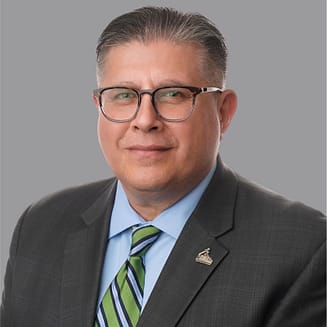
“Wait times have always been an issue,” Garcia said. “At peak times, wait times can get really long, and that affects delivery and other things in the logistics world of taking goods to market or from warehouse to warehouse across the border.”
Reducing border crossing delays for travelers could have unlocked “up to $2.7 billion in potential” gross domestic product in 2019, and as much as $119 billion by 2050, previous estimates suggest.
One way to reduce border wait times for commercial traffic is to create unified cargo processing systems in which customs agents from both the U.S. and Mexico jointly inspect commercial vehicles instead of using two separate inspection stations. That’s already done in Nogales, Arizona, and a similar facility is under construction at the Donna-Rio Bravo International Bridge.
Much of the plan involves gathering accurate data so leaders can make informed decisions about future investments to address potential issues, Garcia said. But most important is developing the roadways, including an interstate loop around the Valley.
“I think for us and a lot of other cities in the region, it has to be surface transportation, improving roadways and connectors, continuing to fund the loop that is being built in Hidalgo County, and improving mobility in Cameron County,” Garcia said. “Having interstate-level highways is a huge difference maker for logistics companies, freight forwarders, trucks, etcetera.”

Kristen Mosbrucker-Garza
Reporter
Kristen Mosbrucker-Garza is a versatile multimedia news reporter who lives and works along the Texas-Mexico border in Hidalgo County. Mosbrucker-Garza is a news reporter for the Rio Grande Valley Business Journal. During her career she's worked for the McAllen Monitor, San Antonio Business Journal, The Advocate Newspaper in Louisiana, Phoenix New Times, and public media outlets in Baltimore and Philadelphia.
Most Read
- SpaceX is giving Brownsville $220M for water projects. In exchange, the city gave up zoning control of 444 acres near Starbase
- SpaceX seeks to take zoning control over nearly 450 acres from city of Brownsville as a ‘regional’ water deal takes shape
- How much water does SpaceX need to operate near Brownsville? Nearly 20x its current use
- Port of Brownsville could soon host Nodule City, a first-of-its-kind commercial deep-sea mining hub
- Cameron County is negotiating a $20M Fluidstack data center donation after Harlingen waffles on the same offer
Get the latest business news delivered to your inbox every morning for free.
Try 30 Days Free!
Get full access to award-winning journalism covering business, real estate, health care, economic trends, and the people shaping the Rio Grande Valley.
30 Days Free!
$9.95/month
Limited time offer
Subscription renews after your 30 day free trial at $9.95/mo.
Included Benefits
- Unlimited access to all articles
- Daily business news and analysis
- Subscriber-only content and features
Stories That Matter
- Job growth in McAllen to hit 1% increase through August, Brownsville’s official data shows nearly 1% decline
- Abbott freezes all state permits for data centers, halting projects even off the grid
- Reynosa Raises the Bar for Electronics Manufacturing
- Rio Grande Valley receives more than $2M in state grants for veteran services
- Rio Bank is building a new $5.3M bank and office building in McAllen
- Mission’s first Small Business Expo puts $25K on the line for local entrepreneurs
- Reynosa’s newest technical high school focuses on AI, semiconductors and bionics
- McCoy’s gives $10K, tools to launch Mid-Valley construction academy
- UT Health RGV performs new digestive procedure for first time in the Valley
- TSTC bets on advanced manufacturing to meet RGV’s industrial boom