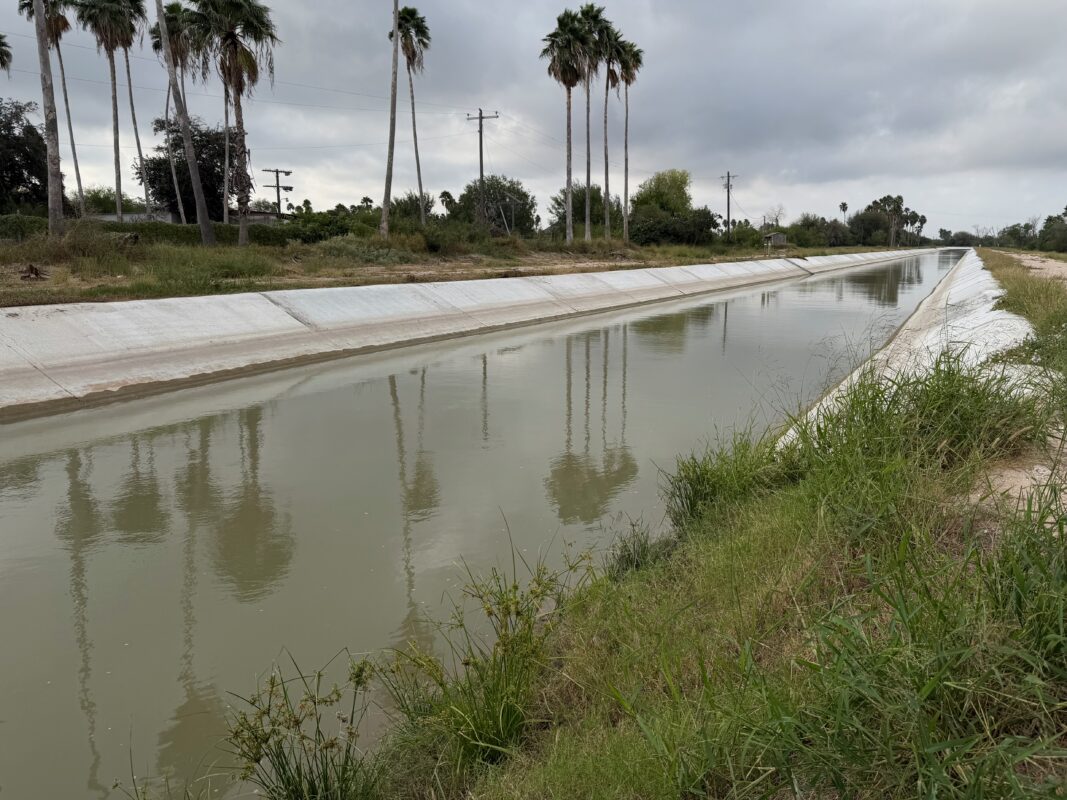
For more than a century, the canal system of the Hidalgo County Irrigation District No. 1 has directed water from the Rio Grande River to farmers and the nearby cities of Edinburg and McAllen.
The 27-mile-long stretch is pumped from the river near Peñitas, then gravity takes over, allowing the water to flow both north and east.
“It’s designed to flow freely. We don’t force the water down here. The elevation every mile; it’s supposed to drop a foot,” Carlos Guzman, general manager of Hidalgo County Irrigation District No. 1, told the Rio Grande Valley Business Journal in a recent interview.
Instead, the system has a series of gates that enable the district to manage the water flow. Some of those gates are still manual, while others have been retrofitted with solar-powered, remotely monitored systems to track and conserve water.
The canals were carved out of dirt, and many are still earthen canals, essentially a creek system – but that means water may seep out before it reaches either agricultural or municipal customers. To conserve water from the Rio Grande River, the open canals are converted to lined cement or buried underground in reinforced concrete pipelines.
That’s because water loss for open canals is a challenge for water districts.
“Evaporation is probably our biggest devil as far as water [conservation] because we take our water over 27 miles of canals, mostly in open canals,” Guzman said. “So we have minor leaks along the way [with the earthen canals], along with the evaporation. The reason that we need all of these improvements with our lines is because the water loss for most irrigation districts is 30% or more on the evaporation side.”
To help improve the water system across the Rio Grande Valley, which includes more than 3,000 miles of canals of all sizes, irrigation districts – nonprofit organizations that sell water and manage infrastructure for farmers and municipalities alike – need funding.
Historically, much of the funding came from the federal Bureau of Reclamation or sometimes loans from the state Water Development Board. This year, there are more funding opportunities, such as the North American Development Bank’s Water Resiliency Fund or the Texas Water Development Board’s new dedicated funding stream approved by voters in November. It earmarks $1 billion each year for the next 20 years, using a portion of state sales tax revenue into the Texas Water Fund.
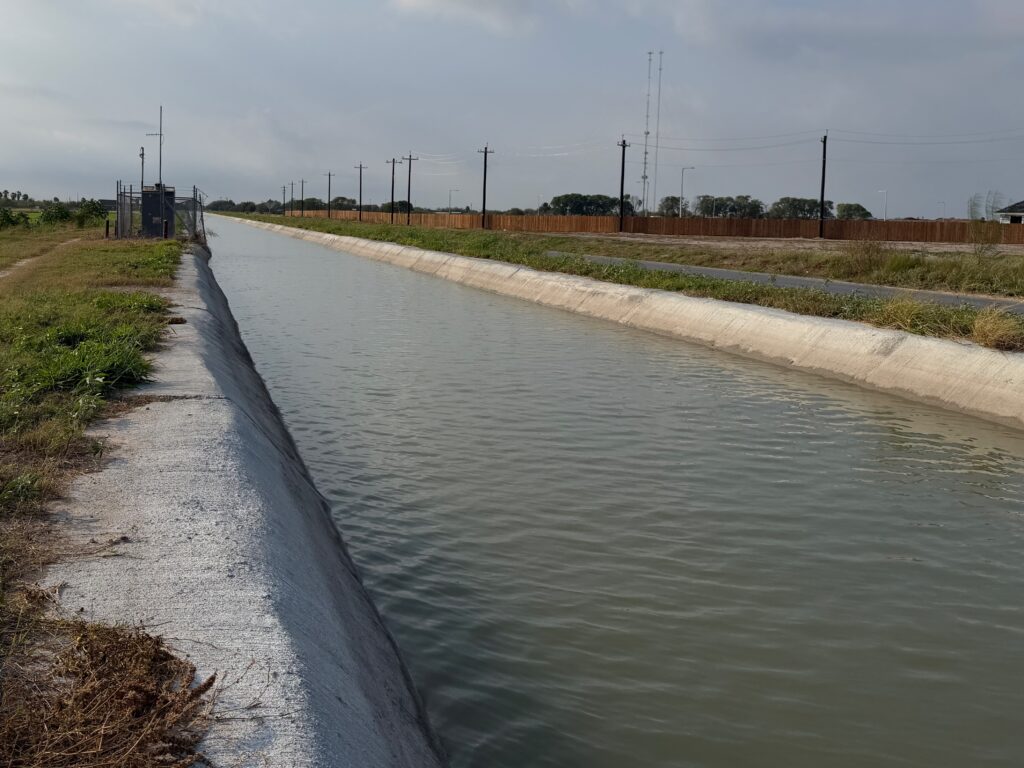
Photo Credit | Kristen Mosbrucker-Garza
“In the past, cities have just relied on the water district and expected water to be delivered. I think more partnerships between districts and cities need to be created,” said Jim Darling, former mayor of McAllen and chairman of the Rio Grande Regional Water Planning Group Region M, which includes the Valley, about taking care of thousands of miles of canals. “That’s a big obligation for a [water] district to take on. Farmers can’t afford to pay for that.”
The new Water Resiliency Fund is a grant and low-interest loan program open to irrigation districts across Hidalgo, Cameron, Starr, and Willacy counties.
The NADBank’s board of directors approved $400 million in financing for U.S.-Mexico border water conservation projects. In that figure, NADBank is using $100 million for “concessional financing,” which refers to favorable loan terms, often in the form of forgivable grants, over the next five years. The remaining $300 million will be used for low-interest loans through the bank’s existing revolving loan fund.
One example of a water conservation project occurred in 2003, when the Hidalgo County Irrigation District No. 1 replaced 26,000 feet of its North Branch-East Main and 5,000 feet of its Curry Main open canal system with a reinforced concrete pipe buried underground.
The project cost $5.78 million and was partially financed by the North American Development Bank with a $2.89 million grant, as well as a $350,000 Texas State Energy Conservation Office grant, with the remainder paid for by irrigation district debt and cash on hand.
At the time, the Texas A&M University Texas Water Institute estimated that the projects could save 4,625 acre-feet of water and 885,675 kilowatt-hours each year, as less water would need to be pumped from the river.

Kristen Mosbrucker-Garza
Reporter
Kristen Mosbrucker-Garza is a versatile multimedia news reporter who lives and works along the Texas-Mexico border in Hidalgo County. Mosbrucker-Garza is a news reporter for the Rio Grande Valley Business Journal. During her career she's worked for the McAllen Monitor, San Antonio Business Journal, The Advocate Newspaper in Louisiana, Phoenix New Times, and public media outlets in Baltimore and Philadelphia.
Most Read
- SpaceX is giving Brownsville $220M for water projects. In exchange, the city gave up zoning control of 444 acres near Starbase
- SpaceX seeks to take zoning control over nearly 450 acres from city of Brownsville as a ‘regional’ water deal takes shape
- Port of Brownsville could soon host Nodule City, a first-of-its-kind commercial deep-sea mining hub
- Cameron County is negotiating a $20M Fluidstack data center donation after Harlingen waffles on the same offer
- How much water does SpaceX need to operate near Brownsville? Nearly 20x its current use
Get the latest business news delivered to your inbox every morning for free.
Try 30 Days Free!
Get full access to award-winning journalism covering business, real estate, health care, economic trends, and the people shaping the Rio Grande Valley.
30 Days Free!
$9.95/month
Limited time offer
Subscription renews after your 30 day free trial at $9.95/mo.
Included Benefits
- Unlimited access to all articles
- Daily business news and analysis
- Subscriber-only content and features
Stories That Matter
- McAllen’s $204M water investment expects to seek construction bids in 2027
- Saronic lands Navy landing craft contract, first build at Brownsville’s Port Alpha
- The Rio Grande Valley’s tech industry is small but growing — meet some of the next-gen workforce
- Entrepreneurs enter Mission EDC’s ‘Shark Tank’ competition for $25K top prize
- Mission’s first Small Business Expo puts $25K on the line for local entrepreneurs
- Reynosa’s newest technical high school focuses on AI, semiconductors and bionics
- McCoy’s gives $10K, tools to launch Mid-Valley construction academy
- UT Health RGV performs new digestive procedure for first time in the Valley
- TSTC bets on advanced manufacturing to meet RGV’s industrial boom
- SpaceX reschedules Starship’s first flight around the Earth