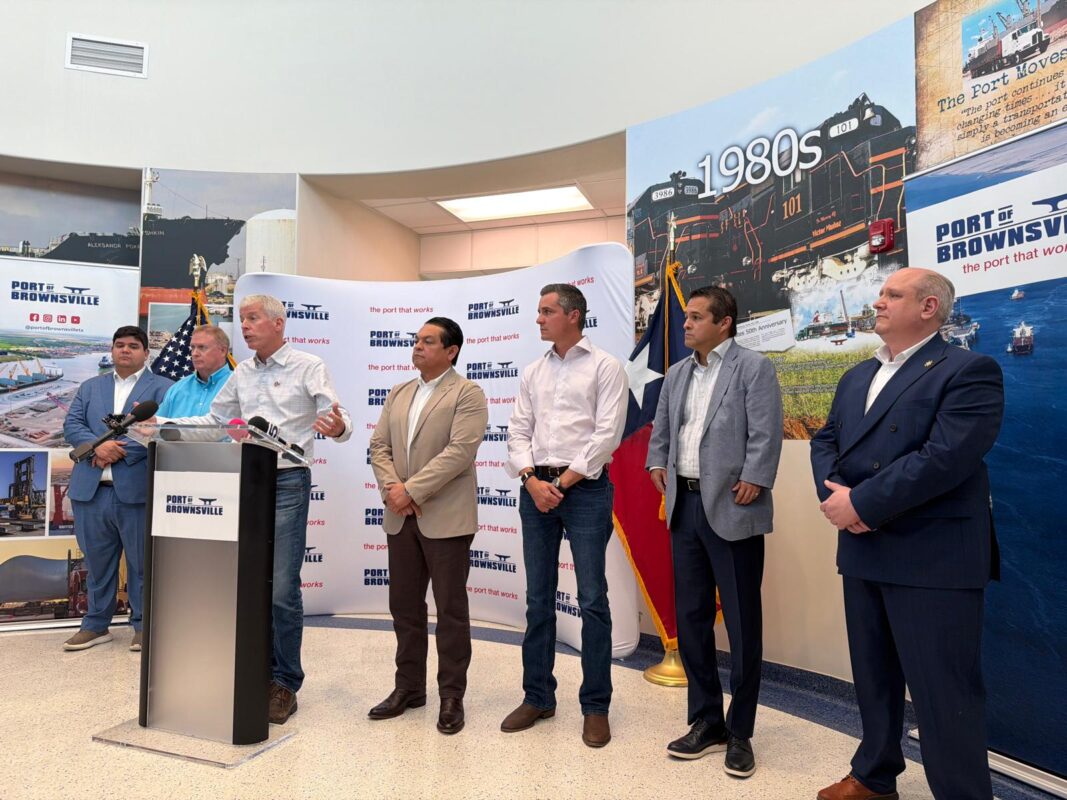
The Port of Brownsville hosted a tour with a top Donald Trump administration official on Tuesday, who said he was interested in connecting with business leaders investing in “building big in America.”
U.S. Energy Secretary Chris Wright, a former oil and gas industry executive who hails from Colorado, lauded Brownsville as a model of the Make America Great Again slogan touted by President Trump.
“This is a community that’s leaning into building big things in America, you know, from SpaceX to LNG exports, to the first major refinery built in over 50 years and many others. So we came down to meet with the business leaders here and thank them for their efforts and investment in this community,” U.S. Secretary Wright said.
But the energy market, in particular, has always been a global business, which means oil, gas, and renewable companies often require visas for skilled foreign-born workers to lend expertise, train, or even build and operate refineries.
And that’s likely going to be the case for the America First Refining project, the first U.S. oil refinery planned in nearly five decades, at the Port of Brownsville.
Still, U.S. Energy Secretary Wright said he was confident that the Donald Trump Administration can balance the immigration visa needs of global companies with the priority of deporting immigrants from America at a record pace.
“The Trump administration is thrilled about the idea of the first major refinery built in the United States in 50 years; it brings a lot of jobs and opportunities to the region here in the Valley,” he said. “Brownsville is a community on the move; more jobs are being created, more manufacturing jobs here, more exports of energy, so I think you’ll see increasing federal partnership here within the community.”
The Trump administration has prioritized extreme scrutiny of U.S. visa policies, fully funded Immigration and Customs Enforcement deportation proceedings, which include hiring agents who conduct public capture and arrest before detention of individuals accused of not having valid immigration paperwork — including dozens of raids in the Brownsville area over the past few months.
It’s unclear whether the Trump administration’s policies may clash with its aspirations to enable a foreign direct investment by Reliance Industries of India at the Port of Brownsville.
Company officials from India recently posed at the Port of Brownsville in social media posts.
Reliance Industries, a publicly traded multinational in India, has not confirmed a 20-year contract with the refinery, but President Trump touted the deal, naming Reliance as the customer.
The deal is for 1.2 billion barrels of light shale oil worth $125 billion. The refinery is expected to produce 50 billion gallons of refined oil products over a 20-year period, worth $175 billion.
The overall value of the project is $300 billion, which would increase American exports and reduce the trade imbalance, something the Trump administration has pursued over the past year through a tariff war.
America First Refining, the North Texas company behind the $3 billion to $4 billion oil refinery at the port, expects to contribute excess electricity to the grid, powered by otherwise unused hydrogen produced during the refining process of West Texas light shale oil.
America First Refining, the developer behind the 164,300-barrel-per-day oil refinery, was incorporated in December 2025. But its key executives have operated its predecessors since 2015, which enabled the former company to transfer ownership of key environmental permits to America First Refining.
Dallas-based America First Refining CEO John Calce is also an executive with Centurion Terminals, ARX Energy, Jupiter Brownsville, and Element Fuels Holdings — all of which previously pitched a Port of Brownsville project dating back to 2015.
Investor and former Trump White House official Nick Ayers is the vice chairman of America First Refining. Donald Trump Jr. is also a minority stake investor in America First Refining.
America First Refining has held a 240-acre lease at the Port of Brownsville on the south side of the ship channel for years, and the company has already done some site preparation and pre-construction on the land. Its predecessor, Element Fuels, had a deal with general contractor McDermott for front-end engineering design services and utilities.
Its 650-mile-long crude oil pipeline from the Permian Basin has yet to be built and would require landowner deals across Texas.
The refinery is expected to export U.S. shale oil products to its customers and manufacture 85,200 barrels per day of ultra-low sulfur gasoline, 61,320 barrels per day of ultra-low sulfur diesel, and 12,840 barrels per day of gasoil, jet fuel, and specialized gasoline that meet standards for sale in Mexico City, which requires low-emission fuels and an unspecified amount of propane.
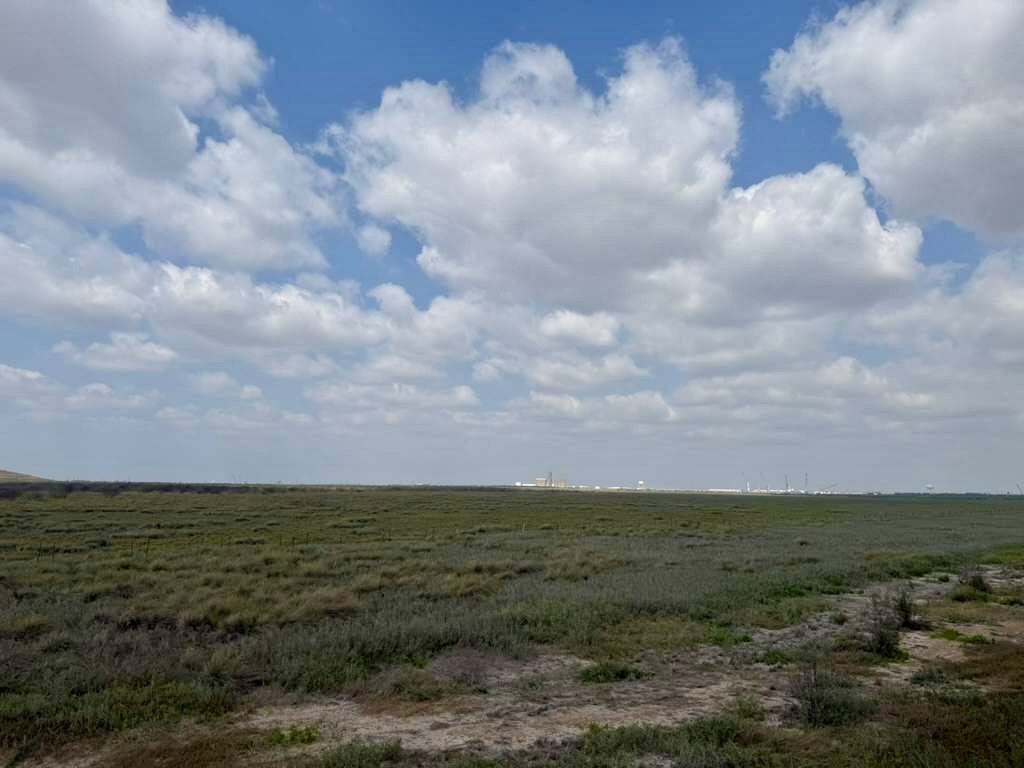
Photo Credit | Kristen Mosbrucker-Garza
The project is expected to bring 500 jobs with an average salary of $80,000 a year and support thousands of construction jobs in the coming years, according to the port. The goal is to ensure there are local training programs to increase workers across the Rio Grande Valley’s chances of securing those jobs.
America First Refining claims that its low-carbon hydrogen will offset its carbon dioxide emissions, and any excess hydrogen — an estimated 100 megawatts of electricity — could be sold back to the power grid.
“There is a large amount of workers who are from Mexico and are from south of the border that came to the United States legally; they are a key part of the workforce in the energy industry. And of course, all throughout the valley, but we believe that we can balance that. The Trump administration is for legal immigration,” Wright said. “Our country is a nation of immigrants, and our administration is an administration of immigrants, so we are a pro-immigrant administration — we just want legal immigration. We want to end illegal immigration and the criminality that comes with illegal immigration. But we believe they can be balanced.”
But the Trump administration has a track record of allowing its immigration policies to clash with the workforce of foreign direct investment companies.
In September 2025, hundreds of workers in Georgia were detained by ICE agents near Savannah while they were working on a $7.6 billion manufacturing plant that is a joint venture by Hyundai Motor and LG Energy Solution.
ICE agents detained more than 475 workers — some of whom were Mexican, Japanese, or Chinese nationals, while most were South Korean citizens who were reportedly there to train U.S. workers and lend specific expertise for a new manufacturing industry in America.
The South Korean government ultimately sent a private plane for its citizens, and the company was in an awkward situation of investing billions in America, as its temporary workforce was harassed by ICE agents, thrown to the ground, and publicly humiliated.
In response, Trump publicly accused the workers of being illegal aliens.
That same month, The Guardian reported that a leaked ICE document showed that at least one of the workers detained had a valid B1/B2 working visa and did not violate the terms of the agreement, but the U.S. Department of Homeland Security claimed the individual admitted to unauthorized work and chose voluntary deportation. These type of visas typically apply to those from certain nations such as China and India.
The individual was a contractor for the HL-GA Battery Company LLC from the South Korean business SFA.
“From statements made and queries in law enforcement databases, [redacted] has not violated his visa; however, the Atlanta Field Office Director has mandated [redacted] be presented as a Voluntary Departure. [Redacted] has accepted voluntary departure despite not violating his B1/B2 visa requirements,” according to the internal document.
In response, South Korean President Lee Jae Myung said that “the rights and interests of South Korean nationals and the business operations of South Korean companies investing in the United States must not be infringed upon.”

Kristen Mosbrucker-Garza
Reporter
Kristen Mosbrucker-Garza is a versatile multimedia news reporter who lives and works along the Texas-Mexico border in Hidalgo County. Mosbrucker-Garza is a news reporter for the Rio Grande Valley Business Journal. During her career she's worked for the McAllen Monitor, San Antonio Business Journal, The Advocate Newspaper in Louisiana, Phoenix New Times, and public media outlets in Baltimore and Philadelphia.
Most Read
- SpaceX is giving Brownsville $220M for water projects. In exchange, the city gave up zoning control of 444 acres near Starbase
- SpaceX seeks to take zoning control over nearly 450 acres from city of Brownsville as a ‘regional’ water deal takes shape
- Port of Brownsville could soon host Nodule City, a first-of-its-kind commercial deep-sea mining hub
- Cameron County is negotiating a $20M Fluidstack data center donation after Harlingen waffles on the same offer
- How much water does SpaceX need to operate near Brownsville? Nearly 20x its current use
Get the latest business news delivered to your inbox every morning for free.
Try 30 Days Free!
Get full access to award-winning journalism covering business, real estate, health care, economic trends, and the people shaping the Rio Grande Valley.
30 Days Free!
$9.95/month
Limited time offer
Subscription renews after your 30 day free trial at $9.95/mo.
Included Benefits
- Unlimited access to all articles
- Daily business news and analysis
- Subscriber-only content and features
Stories That Matter
- McAllen’s $204M water investment expects to seek construction bids in 2027
- Saronic lands Navy landing craft contract, first build at Brownsville’s Port Alpha
- The Rio Grande Valley’s tech industry is small but growing — meet some of the next-gen workforce
- Entrepreneurs enter Mission EDC’s ‘Shark Tank’ competition for $25K top prize
- Mission’s first Small Business Expo puts $25K on the line for local entrepreneurs
- Reynosa’s newest technical high school focuses on AI, semiconductors and bionics
- McCoy’s gives $10K, tools to launch Mid-Valley construction academy
- UT Health RGV performs new digestive procedure for first time in the Valley
- TSTC bets on advanced manufacturing to meet RGV’s industrial boom
- SpaceX reschedules Starship’s first flight around the Earth