Over the past two decades, Mexican shoppers have accounted for a smaller share of retail spending in Texas border cities, even as overall retail sales have grown, according to an analysis by the Federal Reserve Bank of Dallas.
Researchers found it’s due to a variety of factors, including American brands investing in new store locations in Mexico, border security measures leading to longer wait times at international ports of entry, and fewer overall border crossings.
On an average day, more than 230,000 people cross the Texas-Mexico border in passenger vehicles and on foot.
While visiting shoppers make most purchases in cash — making it difficult to track spending — researchers estimated that, when the local population is taken into account, excess retail sales reflect cross-border shopping trends.
Local metro spending
When it comes to the Rio Grande Valley, Mexican shopping trends in the upper and lower Valley have diverged.
Spending by Mexican shoppers has grown in the McAllen-Edinburg-Mission metro area but declined sharply in the Brownsville-Harlingen metro area.
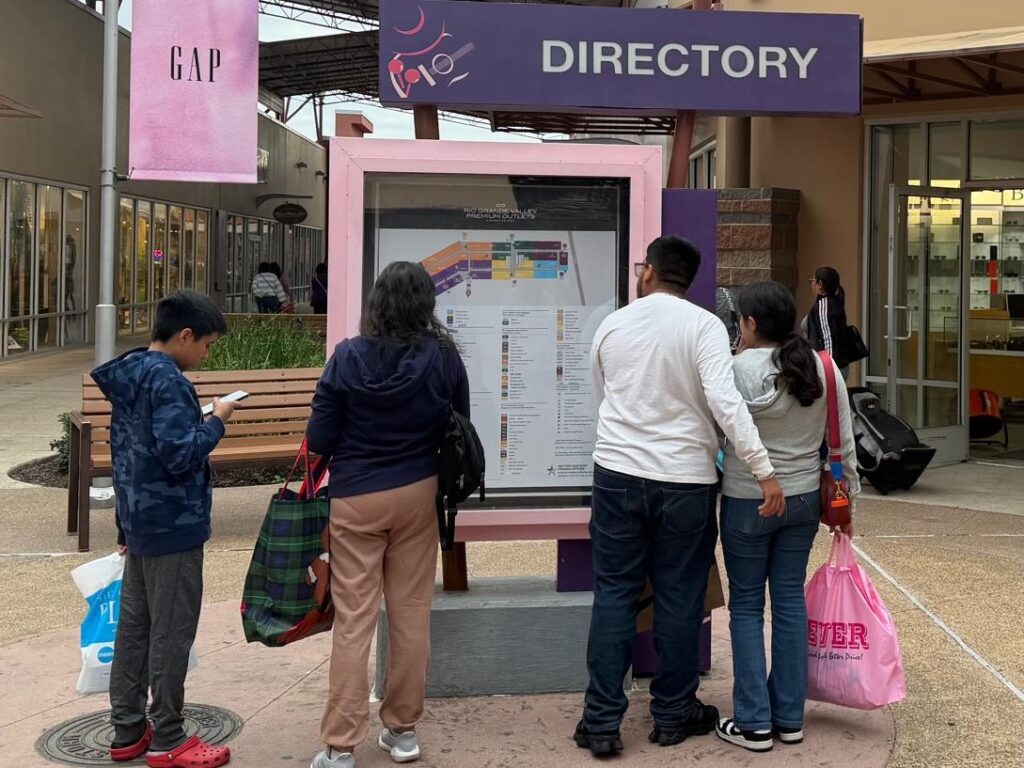
Photo Credit | Kristen Mosbrucker-Garza
The latest analysis, covering a 22-year period from 2001 to 2023, shows that Mexican shoppers increased their overall spending in the McAllen-Edinburg-Mission and Brownsville-Harlingen metro areas, even as their share of total retail sales dropped in both regions.
In 2001, Mexican nationals shopping in the McAllen metro accounted for about 35% of retail sales there. In other words, they contributed $3.5 billion of the region’s $10 billion in total retail sales.
By 2023, Mexican shoppers in the McAllen metro only accounted for about 27% of total spending there, down about 8 percentage points from 2001.
Still, their spending rose about 34%, from roughly $3.5 billion at the start of the new millennium to an estimated $4.7 billion in 2023.
In the Lower Valley, the data tells a very different story.
In 2001, Mexican nationals shopping in the Brownsville-Harlingen metro area accounted for about 25% of retail sales there. That translated to roughly $1.25 billion of the region’s $5 billion in total retail sales.
By 2023, Mexican shoppers accounted for just 3.3% of retail sales in the Brownsville metro, marking a decline of more than 22 percentage points over the 22-year period.
Unlike the McAllen metro area, total spending by Mexican nationals in the Brownsville metro also fell, dropping to an estimated $254 million of the region’s $7.7 billion in retail sales in 2023.
Other Texas border metros saw similar declines in the share of retail sales tied to Mexican shoppers.
Cross-border retail sales shrank in Laredo from 51% to 13% and in El Paso from 11.3% to 7.4% during the same time frame.
Extenuating circumstances and retail expansion
The two biggest declines in cross-border retail sales occurred in 2008 during the Global Financial Crisis and in 2020 during the COVID-19 pandemic.
Meanwhile, big-box brands such as Walmart and Costco have expanded into Mexico.
In 1998, Walmart had about 200 stores across Mexico — that’s increased to more than 3,100 locations.
There are several Walmarts in Mexico directly across the Rio Grande Valley: one in Matamoros across from Brownsville, and a new Walmart under construction in Reynosa.
Costco has expanded similarly from 16 stores in 1998 to 41 locations in 2024.
There’s a Costco in Ciudad Juárez across the border from El Paso, but the closest to the cities of Reynosa and Matamoros is in Monterrey.
Amazon fulfillment centers also operate in larger cities across Mexico, such as Monterrey, but the company does not appear to have much of a presence along the border.

Kristen Mosbrucker-Garza
Reporter
Kristen Mosbrucker-Garza is a versatile multimedia news reporter who lives and works along the Texas-Mexico border in Hidalgo County. Mosbrucker-Garza is a news reporter for the Rio Grande Valley Business Journal. During her career she's worked for the McAllen Monitor, San Antonio Business Journal, The Advocate Newspaper in Louisiana, Phoenix New Times, and public media outlets in Baltimore and Philadelphia.
Most Read
- SpaceX’s futuristic city of Starbase finalizes massive 7,100-acre annexation. Here’s what we know.
- SpaceX reschedules Starship’s first flight around the Earth
- How much water does SpaceX need to operate near Brownsville? Nearly 20x its current use
- Could apartment-to-condo conversion help make $100K homeownership in the McAllen metro more affordable? One investor says yes.
- Crunch Fitness is expanding and struggling in the Valley. Here’s why
Get the latest business news delivered to your inbox every morning for free.
Try 30 Days Free!
Get full access to award-winning journalism covering business, real estate, health care, economic trends, and the people shaping the Rio Grande Valley.
30 Days Free!
$9.95/month
Limited time offer
Subscription renews after your 30 day free trial at $9.95/mo.
Included Benefits
- Unlimited access to all articles
- Daily business news and analysis
- Subscriber-only content and features
Stories That Matter
- Nearly $472M AI data center moves toward construction in Willacy County
- Construction begins on Saronic’s $3.2B Brownsville shipyard. Here’s what’s being built first
- Tamaulipas is rethinking how it sells its cattle. A $44.5M project would keep more of the business at home
- Brownsville is changing its drainage fee. Businesses could pay more as the city looks to raise $6.2M a year
- Mission’s first Small Business Expo puts $25K on the line for local entrepreneurs
- Reynosa’s newest technical high school focuses on AI, semiconductors and bionics
- McCoy’s gives $10K, tools to launch Mid-Valley construction academy
- UT Health RGV performs new digestive procedure for first time in the Valley
- TSTC bets on advanced manufacturing to meet RGV’s industrial boom
- Pharr’s cross-border business push earns international recognition